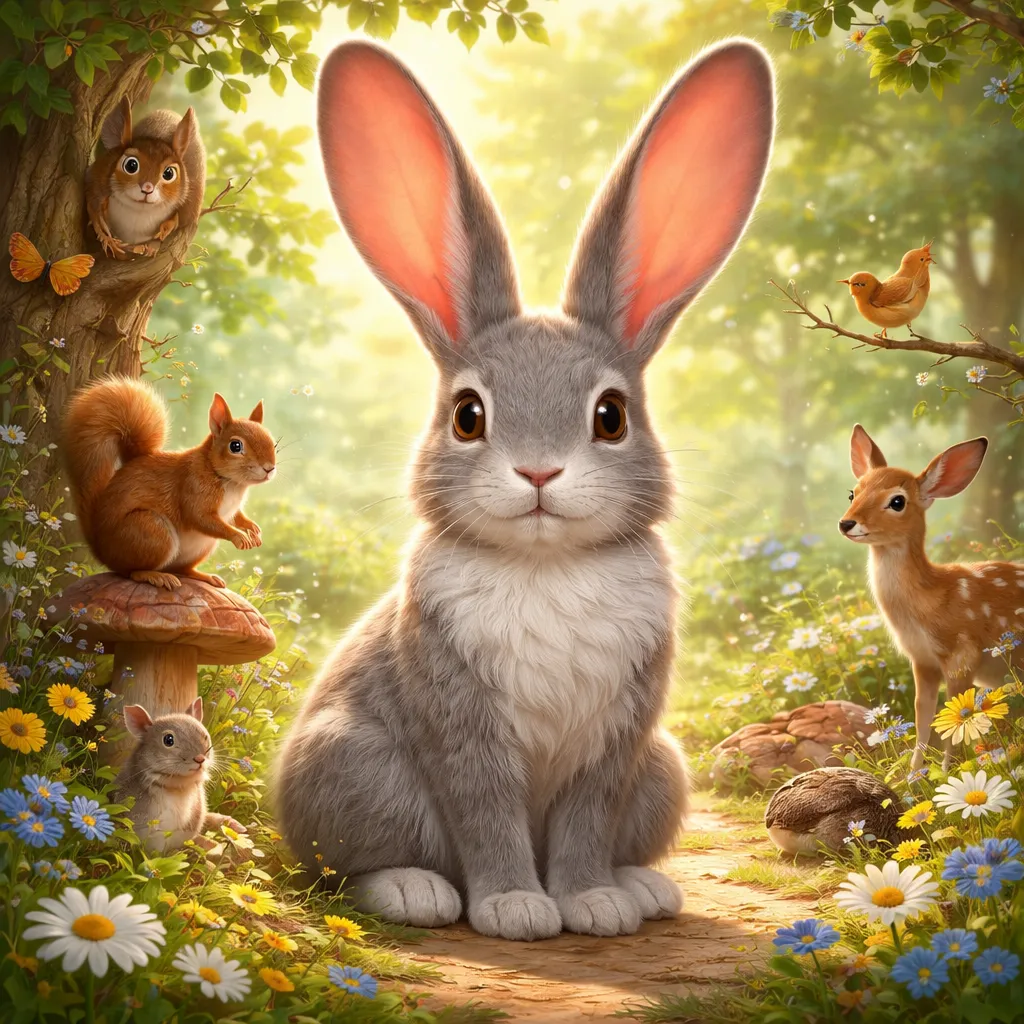

Have you ever watched a rabbit hop through a garden, its long ears twitching? It almost looks like it’s listening to a secret. A long time ago, someone made a playful, bouncy song that imagines a conversation with a very polite rabbit. It’s a song of funny questions and clever answers. Let’s learn about the folk song “Mister Rabbit.”
About the Song
Let’s read the playful, back-and-forth words of this classic song.
Mister Rabbit, Mister Rabbit, your ears are mighty long.
Yes, my friend, they’re put on wrong.
Every little soul must shine, shine.
Every little soul must shine, shine.
Mister Rabbit, Mister Rabbit, your coat is mighty gray.
Yes, my friend, it’s made that way.
Every little soul must shine, shine.
Every little soul must shine, shine.
Mister Rabbit, Mister Rabbit, your tail is mighty white.
Yes, my friend, and I’m getting out of sight.
Every little soul must shine, shine.
Every little soul must shine, shine.
This song is a traditional American folk song, often sung as a call-and-response between a leader and a group. It is a playful, rhythmic tune that imagines a conversation with a rabbit. The singer addresses Mister Rabbit directly, commenting on his long ears, gray coat, and white tail. Mister Rabbit gives funny, wise, or evasive answers. The repeated line, “Every little soul must shine, shine,” adds a spiritual or joyful feeling to the silly questions. The song likely has roots in the African American folk tradition of the American South and became a favorite children’s song.
What the Song is About
The song paints a picture of a funny meeting in a field or garden. A person sees Mister Rabbit and starts talking to him. They point out the rabbit’s most noticeable features: his very long ears, his gray fur (his “coat”), and his little white tail.
Mister Rabbit answers each observation. About his long ears, he says, “They’re put on wrong,” which is a silly way of saying that’s just how they are. About his gray coat, he says, “It’s made that way,” meaning it’s natural. But when the person mentions his white tail, Mister Rabbit says he’s “getting out of sight,” meaning he’s hopping away to hide. After each exchange, everyone sings the joyful line, “Every little soul must shine,” which feels like a celebration of the rabbit, the singer, and all living things. The song is about playful observation, imagination, and the joy of talking to animals.
Who Made It & Its Story
“Mister Rabbit” is a traditional folk song, so its original author is unknown. It comes from the rich oral tradition of the American South, with influences from both African American and Anglo-American folk music. The song was collected by folklorists in the early 20th century. The call-and-response structure and the spiritual-sounding “shine” refrain are hallmarks of African American musical tradition. The song became a standard in music education and children’s groups because of its simple melody and interactive format. It encourages creativity, as singers can invent new verses about other animals or features.
This playful song has remained a favorite for three fun reasons. First, its call-and-response format is incredibly engaging for children, making them active participants. Second, it personifies an animal in a humorous and relatable way, sparking the imagination. Third, the repeating, joyful refrain (“Every little soul must shine”) is uplifting and easy to remember, turning a simple animal song into a celebration of life.
When to Sing It
This song is perfect for playful, outdoor moments. You can sing it while on a nature walk, pretending to talk to animals you see. You can sing it as a call-and-response game with your family in the backyard, taking turns being the questioner and the rabbit. You can also chant it while playing a hopping game, bouncing like a rabbit on the “shine, shine” part.
What Children Can Learn
This simple, interactive song is a fun teacher. Let’s hop into its lessons.
Vocabulary
The song teaches us descriptive and comparative words. “Mister” is a polite title for a man or, in this case, a male animal. A “rabbit” is a small, furry animal with long ears. “Mighty” is an old-fashioned way of saying “very” or “extremely.” “Long” means having a great distance from end to end. A “coat” here means an animal’s fur. “Gray” is a color between black and white. A “tail” is the part that sticks out from the back of an animal. “Shine” means to give off or reflect light. A “soul” is the spiritual or inner part of a living being.
Let’s use these words! You can say, “The mighty oak tree was very tall.” Or, “The dog’s coat was soft and brown.” New word: Personification. This is when you give human traits to something that isn’t human, like talking to a rabbit as “Mister.”
Language Skills
This song is a great lesson in using possessive adjectives and the present simple tense for descriptions. The song uses the possessive adjective “your” to talk about the rabbit’s features: “your ears… your coat… your tail.” This shows belonging.
The descriptions use the present simple tense: “Your ears are mighty long.” This tense states a fact that is true right now. The rabbit’s responses also use the present simple: “They ’re put on wrong. It ’s made that way.” The song also practices direct address (talking right to Mister Rabbit) and contractions (“they’re” for “they are,” “it’s” for “it is”).
Sounds & Rhythm Fun
Listen to the bouncy, hopping rhythm of the melody. The song is in a lively 4/4 time. The call-and-response pattern makes it a conversation. The lyrics have a clear, catchy rhyme: “long” and “wrong,” “gray” and “way,” “white” and “sight.” The repetition of “shine, shine” is fun and emphatic.
The rhythm is peppy and light. Try a gentle hop: MIS-ter RAB-bit, MIS-ter RAB-bit, your EARS are MIGHT-y LONG. The melody uses a small range of notes and is very simple. This repetitive, responsive, and joyful musical pattern is what makes the song so easy and fun to sing. You can write your own animal conversation song! Use the same bouncy rhythm. Try: “Miss Squirrel, Miss Squirrel, your tail is mighty bushy. Yes, my friend, it’s kind of rushy. Every little soul must climb, climb. Every little soul must climb, climb.”
Culture & Big Ideas
“Mister Rabbit” is a classic example of American children’s folk music. It comes from a tradition where songs were used to teach observation, humor, and interaction with the natural world. The rabbit is a trickster figure in many cultures, including African and Native American folklore, and this song captures that playful, elusive spirit. The line “Every little soul must shine” connects the song to spirituals and the idea that all creatures have value and a spirit. The song reflects a time when entertainment was homemade and based on the simple wonders of the everyday environment.
The song conveys three important ideas. First, it’s about curiosity and observation. The song encourages us to look closely at animals and wonder about their features. Second, it expresses humor and acceptance. The rabbit’s answers are funny and accepting of his own nature, teaching us to be comfortable with who we are. Third, it highlights the connection between all living things. The refrain suggests that every creature, from a rabbit to a person, has an inner light or “soul” that is worthy of notice and celebration.
Values & Imagination
Imagine you are in a sunny field talking to Mister Rabbit. What does he look like? How do his long ears move? What shade of gray is his coat? Now, imagine you are Mister Rabbit. How do you feel when someone points out your ears? Do you feel shy when they mention your white tail? Draw a picture of the scene. Draw Mister Rabbit with very long ears, a gray coat, and a white tail. Draw a person pointing and singing. From the rabbit, draw a little thought bubble with the words, “Yes, my friend, they’re put on wrong!” This captures the song’s playful conversation.
The song encourages kindness towards animals, careful observation, and finding joy in simple, imaginary play. A lovely idea is to have a “Backyard Conversation” game. With your family, go outside or look out a window. Choose an animal you see (a bird, a squirrel, a bug). Make up one line to say to it, like “Mister Bird, your song is mighty loud.” Then, imagine what it might say back. This extends the song’s imaginative play to your own world.
So, as the last “shine, shine” fades, think about the playful joy of this old tune. It is a vocabulary lesson in animal descriptions. It is a grammar lesson in possessives and present facts. It is a music lesson in a bouncy, call-and-response rhythm. From the first question about long ears to the final hop out of sight, it wraps lessons in curiosity, self-acceptance, and universal joy in a tune that makes you want to hop, talk, and shine. “Mister Rabbit” teaches us that animals are fun to talk to, that it’s okay to be different, and that every little soul—even a rabbit’s—has its own special light.
Your Core Takeaways
You are now an expert on the song “Mister Rabbit.” You know it is a traditional American call-and-response song about a playful conversation with a rabbit. You’ve learned words like “mighty,” “coat,” and “soul,” and you’ve practiced possessive adjectives and the present simple tense. You’ve felt its bouncy, hopping rhythm and created your own animal verse. You’ve also discovered the song’s folk roots and its messages about curiosity, self-acceptance, and the inner light in all living things.
Your Practice Missions
First, stage a “Rabbit Interview.” With a family member, act out the song. One person is the curious singer, and the other is Mister Rabbit (maybe hopping or wearing bunny ears). Perform the call-and-response. Then, make up one new question for Mister Rabbit about another feature (like his whiskers or his hop) and a funny answer. This brings the song to life.
Second, create a “Soul That Shines” badge. The song says, “Every little soul must shine.” Design a badge or a sticker that represents something that makes your own “soul shine”—maybe reading, dancing, helping, or drawing. Decorate it with bright colors. Wear it or display it. This activity personalizes the song’s uplifting message.