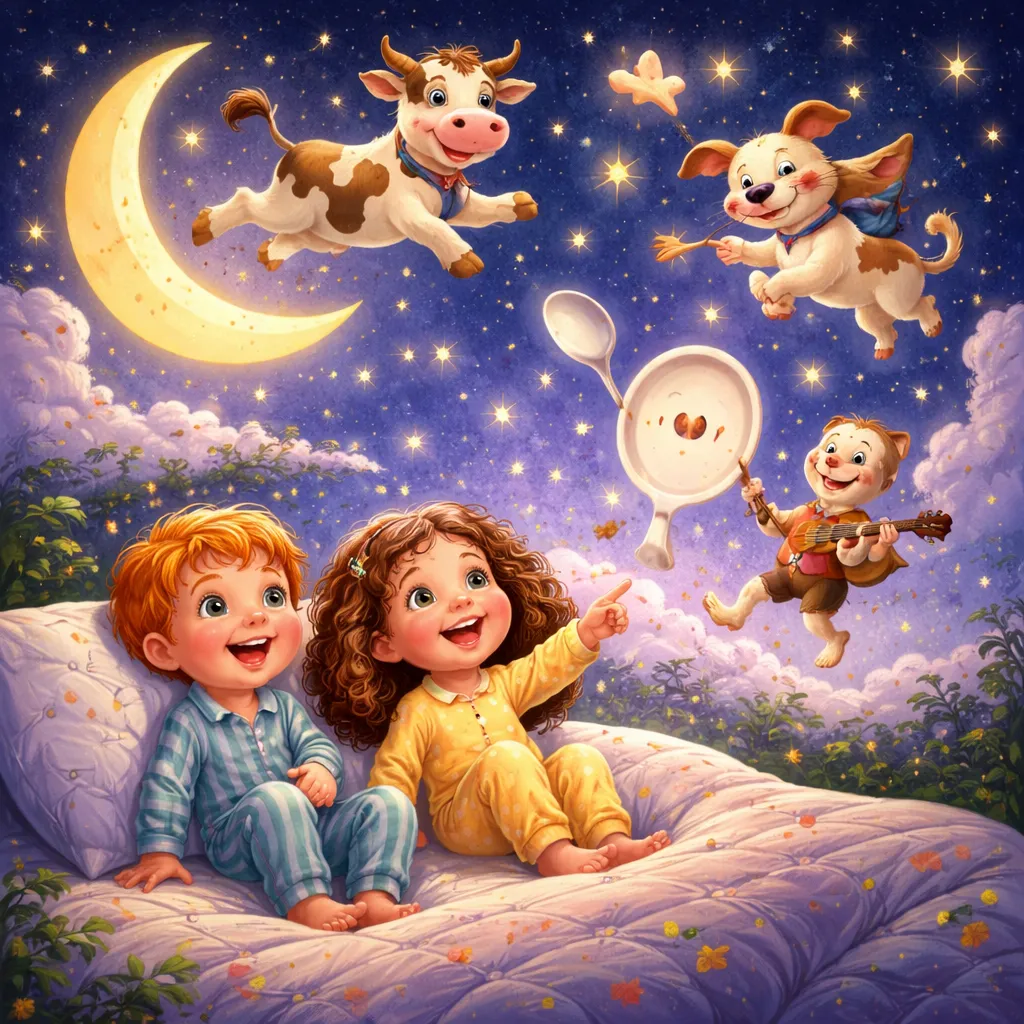

What is the Rhyme "Hey Diddle Diddle"?
"Hey Diddle Diddle" is one of the most playful and imaginative English nursery rhymes ever written. It tells a silly story full of impossible things. A cat plays the fiddle. A cow jumps over the moon. A little dog laughs at the fun. A dish runs away with a spoon. The English song: Hey Diddle Diddle has delighted children for centuries with its nonsense images. Nothing in this rhyme could really happen, and that is exactly why children love it. The impossible events spark imagination and creativity. Children learn that stories can be silly and fun. They do not have to make sense. The rhyme opens a door to a world where anything can happen and play is the only rule.
The Complete Lyrics of the Nursery Rhyme
Let us look at the words together. The rhyme is short but packed with memorable images.
Hey diddle diddle,
The cat and the fiddle,
The cow jumped over the moon.
The little dog laughed
To see such fun,
And the dish ran away with the spoon.
Vocabulary Learning from the Song
This English song: Hey Diddle Diddle introduces children to wonderful words about animals, objects, and actions. Each word builds their understanding of language and imagination.
First, the song introduces animal characters. "Cat" is a common pet. "Cow" is a farm animal. "Little dog" is another pet. Children know these animals from real life or books. Putting them in impossible situations makes the familiar animals feel new and exciting.
"The fiddle" is another word for violin. A cat playing the fiddle is a silly picture. You can show your child a picture of a fiddle or violin. Talk about how music is made with string instruments.
The song teaches action words in impossible ways. "Jumped over the moon" is a huge action that could never happen. "Laughed" shows the dog's happy reaction. "Ran away" shows the dish and spoon escaping. These verbs come alive in the silly context.
"Dish" and "spoon" are everyday objects from the kitchen. Making them run away like characters turns ordinary things into story heroes. Children will look at dishes and spoons differently after hearing this rhyme.
Phonics Points to Practice
Let us listen for special sounds in the song. Phonics helps children connect letters to the sounds they hear. This English song: Hey Diddle Diddle gives us many sounds to explore.
Listen to the "d" sound in "diddle" and "dog" and "dish." It is a soft sound made with the tongue behind the teeth. Say "hey diddle diddle" slowly. Feel how your tongue moves for each "d." Practice other "d" words like "daddy," "door," and "duck."
The "c" sound appears in "cat" and "cow." It is made at the back of the throat. Practice other "c" words like "cake," "car," and "come."
Listen to the "f" sound in "fiddle" and "fun." It is made by putting your top teeth on your bottom lip and blowing air. Practice other "f" words like "fish," "flower," and "family."
The "l" sound in "laughed" and "little" is a light sound made with the tongue touching the roof of the mouth. Practice other "l" words like "lion," "leaf," and "lullaby."
The "r" sound in "ran" and "away" has an "r" in the middle but "ran" gives us the beginning "r." Practice "r" words like "rabbit," "red," and "run."
Grammar Patterns We Can Learn
This silly rhyme teaches important grammar in a very natural way. The English song: Hey Diddle Diddle introduces past tense verbs, prepositions, and the concept of personification.
The song uses past tense throughout. The cow "jumped." The dog "laughed." The dish "ran away." These are all past tense verbs. You can talk about your own day using past tense. "We played at the park." "The dog barked." "The spoon fell on the floor." This helps children understand how we talk about things that already happened.
The preposition "over" shows where the cow jumped. "Over the moon" means from one side to the other, above it. You can practice using "over" in daily life. "The ball went over the fence." "The bird flew over our house."
The song uses personification, giving human qualities to objects. The dish and spoon run away like people. The dog laughs with joy. This teaches children that stories can make anything come alive. You can practice personification in play. "What would your teddy bear say?" "Where is your doll going today?"
Learning Activities to Do at Home
Bringing this English song: Hey Diddle Diddle into your daily life is simple and joyful. Here are some activities you can try with materials you already have.
A wonderful activity is the "Silly Scene" drawing. After singing the song, give your child paper and crayons. Ask them to draw the cow jumping over the moon. Draw the cat playing the fiddle. Draw the dish and spoon running away. This builds comprehension and creativity. Display their artwork proudly.
Another activity is the "Kitchen Characters" game. Take a dish and a spoon from your kitchen. Give them voices. What would they say? Where would they run? Act out the story with the real objects. This brings the rhyme into the real world.
You can also have a "Moon Jumping" movement activity. Pretend to be the cow. Crouch down and then jump as high as you can. Can you jump over the moon? Use a pillow or cushion as the moon to jump over. This builds gross motor skills and connects movement to the story.
Printable Materials for Learning
Creating simple printables can make this English song: Hey Diddle Diddle more visual and engaging. You can make these materials together with your child.
Character puppets are perfect for this rhyme. Draw or print pictures of the cat, cow, dog, dish, and spoon. Attach them to craft sticks or straws. Your child can hold up each puppet as you sing about that character. This builds comprehension and makes the story interactive.
A story sequencing page helps with order. Draw simple pictures of each event on a page. The cat with the fiddle. The cow jumping over the moon. The dog laughing. The dish running with the spoon. Your child can point to each picture as you sing. This builds sequencing skills.
You can also create simple word cards. Write words from the rhyme on cards. "Cat," "fiddle," "cow," "moon," "dog," "laughed," "dish," "spoon." Show each card as you sing that word. This builds early reading skills in a gentle, supportive way.
A mobile craft is wonderful for this rhyme. Cut out shapes of the moon, cow, cat, fiddle, dog, dish, and spoon. Hang them from a hanger or stick with strings. Your child can watch their mobile turn and remember all the characters.
Educational Games for Deeper Learning
Games make learning active and exciting. They encourage children to use the language from the English song: Hey Diddle Diddle in new and creative ways.
The "What If?" game builds imagination. Ask your child, "What if the pig jumped over the moon?" Create a new verse. "Hey diddle diddle, the pig and the fiddle, the pig jumped over the moon." Try different animals and different actions. What if the horse danced on the stars? What if the sheep sang a song? This shows children how to play with the story pattern.
The "Character Voices" game brings the story to life. Give each character a different voice. The cat playing fiddle might have a musical voice. The cow jumping over the moon might have a surprised voice. The laughing dog has a happy, giggly voice. The dish and spoon might have squeaky逃跑 voices. This builds vocal play and creativity.
The "Find the Rhymes" game builds phonemic awareness. Ask your child, "What rhymes with moon?" Spoon, soon, tune, balloon. "What rhymes with cat?" Hat, bat, sat, mat. List the rhymes together. This builds important pre-reading skills.
The "Moon Jumping Contest" game adds movement. Place a pillow or cushion on the floor. Take turns being the cow and jumping over it. How high can you jump? Can you jump without touching it? This builds gross motor skills while connecting to the story.
The "Dish and Spoon Adventure" game extends the story. After the dish runs away with the spoon, where do they go? Do they come back? Do they meet other kitchen friends? Create a new adventure together. This builds narrative skills and imagination.
The "Animal Orchestra" game connects to the cat playing fiddle. What if other animals played instruments? A dog playing drums. A cow playing piano. A sheep playing trumpet. Create an animal orchestra and make the sounds. This builds creativity and musical awareness.
The "Nonsense Words" game explores the playful language. "Hey diddle diddle" are nonsense words that sound fun. Can your child make up their own nonsense words? "Ziggy zaggy zee." "Wibble wobble woo." This shows children that language can be playful and creative.
The "Night Sky" observation connects to the moon. On a clear night, look at the real moon with your child. Is it full like in the song? Can you imagine a cow jumping over it? This connects the imaginative song to the real world and builds wonder about the night sky.