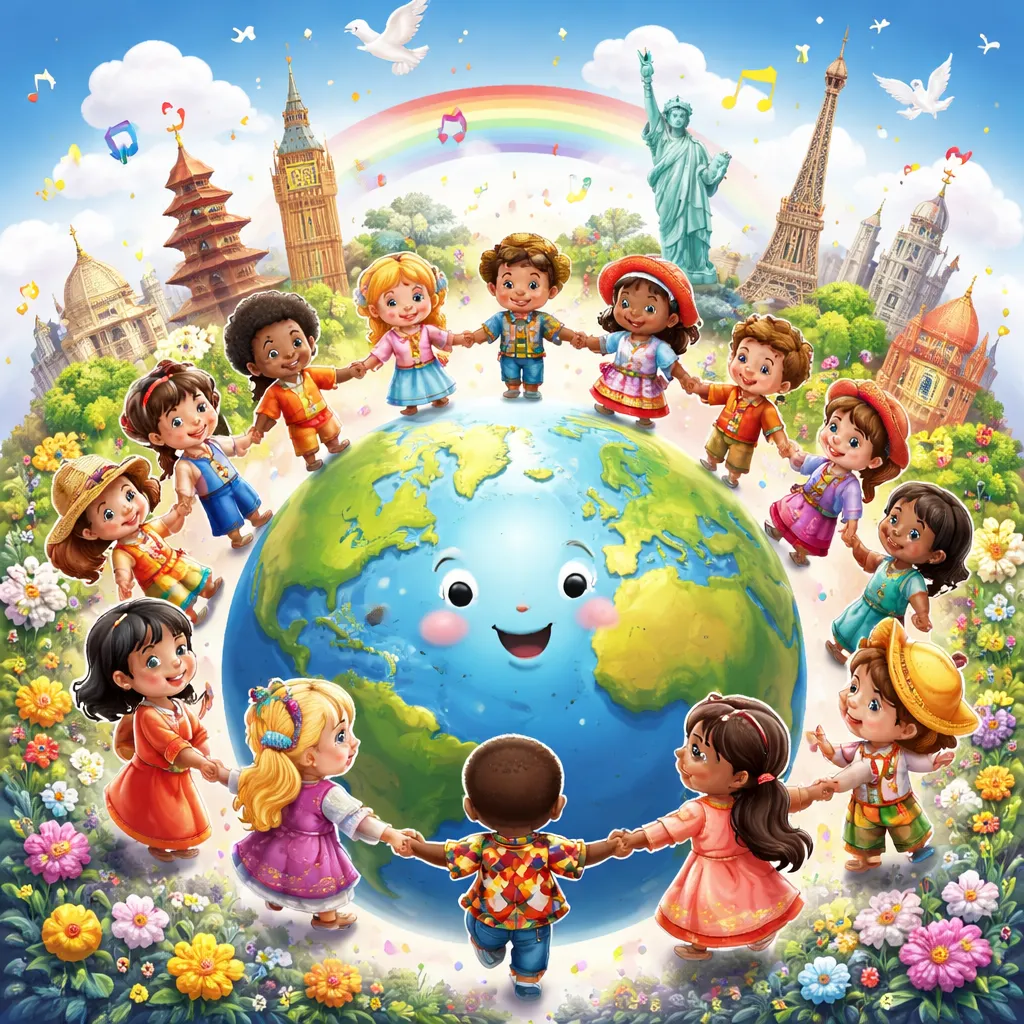

Some songs carry a message that reaches across all borders. The English song: It's a Small World does exactly that. This simple tune has been sung by millions of people in countless languages. It reminds us that despite our differences, we all share one world. For families learning English together, this song offers a beautiful way to explore themes of unity, friendship, and global connection. Let us discover what makes this classic song so powerful for young learners.
What Is the Story Behind This Famous Song?
The English song: It's a Small World was created for the 1964 New York World's Fair. Walt Disney wanted a ride that would celebrate children and unity around the world. He asked the Sherman Brothers, Richard and Robert, to write a song for this attraction.
The brothers faced a challenge. They needed a song that could be translated into many languages and sung by children everywhere. They wrote "It's a Small World" as a simple, repetitive tune. The message was clear. People everywhere laugh, cry, and hope. We are more alike than different.
The ride became one of the most popular attractions at the fair. It later moved to Disneyland and then to Disney parks around the world. The song plays continuously as boats carry visitors past dolls dressed in traditional costumes from every continent. The melody repeats endlessly, becoming what some call an "earworm" that stays in your mind.
The Sherman Brothers won a Grammy Award for this song. It has been translated into dozens of languages and sung by children worldwide. Understanding this背景 helps families appreciate why the song continues to unite people across cultures.
The Complete Lyrics of the Song
Reading the words helps us understand the song's beautiful message. Here are the lyrics to the English song: It's a Small World. Let us look at them in sections.
It's a world of laughter, a world of tears
It's a world of hopes and a world of fears
There's so much that we share that it's time we're aware
It's a small world after all
There is just one moon and one golden sun
And a smile means friendship to everyone
Though the mountains divide and the oceans are wide
It's a small world after all
It's a small world after all
It's a small world after all
It's a small world after all
It's a small, small world
Learning New Words from the Song
The English song: It's a Small World introduces many meaningful words. Let us explore them together.
First, the song mentions "laughter" and "tears". Laughter is the sound we make when happy. Tears are drops from our eyes when we cry. These two words represent joy and sadness. Everyone experiences both, no matter where they live.
The song also talks about "hopes" and "fears". Hopes are things we wish will happen. Fears are things that scare us. These emotions connect all humans across cultures.
The word "share" means to have or use something together. The song says we share so much. We share feelings, dreams, and this planet. Learning this word helps children understand cooperation.
The song mentions "moon" and "sun". These are celestial bodies everyone sees. The same moon shines on children everywhere. The same sun warms all people. This physical reality supports the song's message of unity.
"A smile means friendship to everyone" teaches that some things need no translation. Smiles communicate kindness in every culture. This word helps children understand non-verbal communication.
"Mountains divide" and "oceans are wide" describe physical barriers. Mountains and oceans separate lands. But the song says even these cannot truly separate us. We remain connected.
Exploring Pronunciation and Rhythm
The English song: It's a Small World offers gentle practice with English rhythm. The waltz-like tempo makes it easy to feel the natural stress patterns.
Listen to the opening lines "It's a world of laughter, a world of tears". The rhythm goes It's a WORLD of LAUGH-ter, a WORLD of TEARS. The strongest beats fall on "world", "laugh", and "tears". Clapping along helps children feel this pattern.
The chorus repeats "It's a small world after all" four times. The rhythm stays consistent. It's a SMALL WORLD AF-ter ALL. This repetition helps children internalize the phrase naturally.
The line "there's so much that we share that it's time we're aware" has a longer flow. Breaking it into chunks helps. "There's so much that we share" then "that it's time we're aware". Practicing these phrases builds fluency.
Finding Grammar Patterns in the Lyrics
The English song: It's a Small World offers useful grammar examples for young learners. One pattern appears in the opening structure. "It's a world of laughter" uses the contraction "it's" for "it is". This introduces the concept of contractions. We use them constantly in spoken English.
The song uses "a world of" plus nouns repeatedly. "A world of laughter, a world of tears, a world of hopes, a world of fears." This pattern shows how we describe something by what it contains. For example, "a day of fun" or "a story of adventure".
Another pattern appears with "there's" as a contraction of "there is". "There's so much that we share" introduces a big idea. We use "there is" for singular things and "there are" for plural. This song uses "there's" even with "so much" because it's informal.
The line "that it's time we're aware" uses "it's time" plus a clause. This structure suggests something should happen now. For example, "It's time we go home" or "It's time we eat dinner".
The song also uses "though" to show contrast. "Though the mountains divide and the oceans are wide" introduces something true despite obstacles. We use "though" to connect contrasting ideas. For example, "Though it's raining, we will play inside" or "Though I'm tired, I'll finish my homework".
Fun Learning Activities for the Whole Family
Listening to the English song: It's a Small World can inspire many family activities. Here are some ideas to try together.
First, create a family world map. Get a large map or print one from online. Mark places where your family has lived, visited, or has friends. Talk about each place in English. "Grandma lives here" or "We visited this beach last summer". This builds geography vocabulary and personal connection.
Second, have a smile experiment. Spend a day noticing smiles. Count how many smiles you see and share. Talk about it at dinner. "I smiled at the bus driver" or "The store clerk smiled at me". This connects the song's message about smiles to daily life.
Third, learn about children in other countries. Choose a country each week. Look at pictures of children there. What do they wear? What do they eat? How do they play? Use English to describe similarities and differences. "Children in Japan eat rice too" or "Children in Kenya play games like us". This builds cultural awareness and vocabulary.
Creating Printable Materials at Home
Families can make simple learning tools based on the English song: It's a Small World. These activities help reinforce new ideas.
Create a feelings chart with the words from the song. Draw four sections labeled "Laughter", "Tears", "Hopes", and "Fears". Each day, family members can put a mark in the section that matches how they feel. Talk about it in English. "I felt laughter today when we played" or "I had hopes about my test". This builds emotional vocabulary.
Make a "small world" book with drawings from around the world. Fold papers together to make a small book. On each page, draw something the song mentions. A smiling face, the moon, the sun, mountains, oceans. Write simple sentences. "The moon shines on everyone" or "Smiles mean friendship". Read this book together.
Create a fill-in-the-blank page using song lyrics. Remove key words like "laughter", "tears", "hopes", "fears", "share", "moon", "sun", and "smile". Leave blanks where those words belong. Listen to the song together and fill in the missing words. This builds listening and spelling skills.
Connecting the Song to Daily Life
The English song: It's a Small World teaches a powerful lesson about human connection. Despite our differences, we share the same feelings and hopes. This message matters now more than ever.
Talk with your children about times they felt connected to someone different. Maybe a new student from another country joined their class. Maybe they saw children in another country on television. Use English to share these moments. "The new girl smiled at me" or "Those children looked happy like us".
The song also teaches about global awareness. We share this planet with billions of other people. What happens in one place affects others. Use the song to introduce simple global concepts. "When it's night here, children in China are waking up" or "The same sun warms children everywhere".
Parents can model the song's inclusive attitude. When meeting people from different backgrounds, show curiosity and respect. Say things like "I wonder what games children play in your country" or "Your smile is just like ours". Children learn openness from watching us.
Educational Games to Play Together
Games make learning with the English song: It's a Small World exciting. Here are some simple games to try.
Play the emotion guessing game. One person acts out an emotion from the song like laughter, tears, hope, or fear. Others guess which emotion it is. Say the word in a sentence. "You are showing laughter" or "You look like you have hopes". This builds emotional vocabulary.
Try the world tour game. Name a country, and everyone shares one thing they know about it. Use English sentences. "In Mexico, they speak Spanish" or "In Japan, children eat with chopsticks". This builds world knowledge and speaking skills.
Play the smile chain game. One person smiles at another. That person smiles at someone else. Keep the smile moving around the room. When the smile reaches you, say "A smile means friendship". This builds positive feelings and language together.
Why This Song Helps English Learning
The English song: It's a Small World helps learners in special ways. The simple vocabulary matches what beginners need. Words like world, laughter, tears, hopes, fears, moon, sun, and smile appear in early lessons. Learning them through song makes them easy to recall.
The repetition in the chorus reinforces key phrases. "It's a small world after all" repeats many times. Repetition builds memory without effort. By the end of the song, children can sing the main message themselves.
The global theme creates meaningful context. Children learn that English connects them to people everywhere. This motivation makes practice feel purposeful.
The gentle melody creates positive associations. When children feel hopeful and connected, their brains learn better. The song's uplifting mood supports language acquisition naturally.
Making Music Part of Your Routine
Families can make songs a regular part of English time. Choose one song each week to explore together. Listen during quiet moments or while looking at a globe.
The English song: It's a Small World works perfectly for moments when you want to feel connected. Play it when discussing other cultures or when saying goodnight to family far away. Let the music remind everyone that we share one world.
Remember that language learning thrives on meaning and connection. When children associate English with unity, friendship, and global awareness, they want more. They learn that English is not just schoolwork. It is a key to the whole world.
Keep singing, keep smiling, and keep celebrating our small world together. In the great family of humanity, every new English word builds another bridge between hearts.