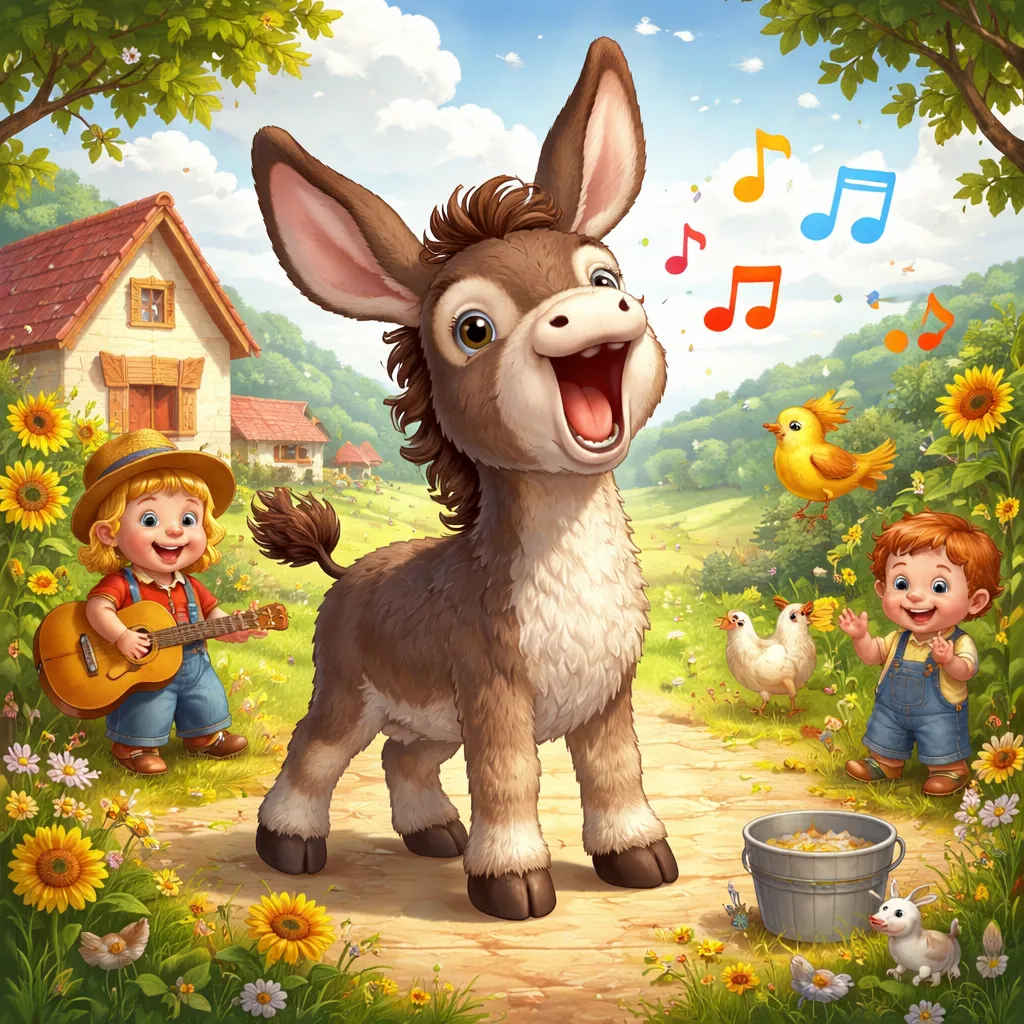

Have you ever been to a farm or a zoo and heard a funny, loud sound? "Ee-aw! Ee-aw!" That is the sound a donkey makes. In Germany, there is a playful and silly song all about a little donkey who has a very special answer for everything. It is a song full of questions and one famous sound. Let’s listen closely and learn the funny song “The Little Donkey (Der kleine Esel).”
About the Song
Here are the curious and repetitive lyrics of a beloved traditional German children’s song:
Der kleine Esel, der kleine Esel,
der sagt zu allem nur: I-Ah!
Fragt ihn der Hund: Wau, wau, wau?
Sagt er nur: I-Ah!
Fragt ihn die Katz: Miau, miau, miau?
Sagt er nur: I-Ah!
Fragt ihn das Schaf: Mäh, mäh, mäh?
Sagt er nur: I-Ah!
Der kleine Esel, der kleine Esel,
der sagt zu allem nur: I-Ah!
English Translation:
The little donkey, the little donkey,
he says to everything only: I-Ah!
The dog asks him: Woof, woof, woof?
He says only: I-Ah!
The cat asks him: Meow, meow, meow?
He says only: I-Ah!
The sheep asks him: Baa, baa, baa?
He says only: I-Ah!
The little donkey, the little donkey,
he says to everything only: I-Ah!
This is a classic and humorous German-language call-and-response song for children. The song is about a very stubborn or perhaps very simple little donkey. “The little donkey, the little donkey, he says to everything only: I-Ah!” it introduces. No matter what question he is asked, his answer is always the same. His friends, the dog, the cat, and the sheep, all ask him questions in their own animal language. “The dog asks him: Woof, woof, woof?” But the donkey just replies, “I-Ah!” The same happens with the cat and the sheep. The song is playful, showing a donkey who has only one answer for every friend, making it a fun and predictable game.
What the Song is About
The song is a funny conversation between animal friends. Imagine a sunny farmyard. A little grey donkey with big ears is standing there. “The little donkey, the little donkey, he says to everything only: I-Ah!” he announces proudly. His friends are confused and want to talk.
First, a happy dog runs up. “The dog asks him: Woof, woof, woof?” The dog is asking a doggy question, maybe “Do you want to play?” But the donkey looks at the dog and simply says, “I-Ah!” Next, a curious cat comes closer. “The cat asks him: Meow, meow, meow?” The cat is asking a cat question, like “Do you see that bird?” The donkey just answers, “I-Ah!” Then, a gentle sheep walks over. “The sheep asks him: Baa, baa, baa?” The sheep might be asking about the green grass. The donkey’s answer? Still, “I-Ah!” The little donkey has only one thing to say, and he says it to everyone. The song is about playful miscommunication and a donkey who knows his own mind.
Who Made It & Its Story
“Der kleine Esel” is a well-known German folk song that belongs to the playful world of animal sound and question-answer songs for young children. Its specific writer is unknown, as it has been sung in German playgrounds and homes for generations. The song connects to the universal childhood joy of animal sounds and the humor of a character who breaks the expected rules of conversation. The donkey (“Esel”) in German culture can symbolize stubbornness (“Eigensinn”), and the song plays with this idea in a gentle, funny way for children.
This call-and-response song is loved for three clear reasons. First, it is a brilliant and funny way to learn and practice the German names for common farm animals and their sounds in a memorable, repetitive dialogue. Second, it introduces simple question-and-answer sentence structures in a highly predictable and engaging format, building confidence in conversational patterns. Third, it is incredibly interactive and perfect for group singing, with one group singing the questions and another group joyfully shouting the donkey’s constant reply.
When to Sing It
This song is perfect for playful, group singing times. You can sing it as a funny call-and-response game with friends or family, with one person singing all the animal questions and everyone else shouting “I-Ah!” as the donkey. You can chant it on car trips, taking turns making different animal sounds for the donkey to answer. You can also sing it as a silly sound-making song, enjoying all the different animal noises before the donkey gives his famous reply.
What Children Can Learn
This interactive, humorous song is a wonderful teacher about animal sounds, asking questions, and giving funny answers in German.
Vocabulary
The song teaches us clear words for animals, speaking, and questions in German. “The” (Der). “Little” (kleine). “Donkey” (Esel). “He” / “it” (der / er). “Says” (sagt). “To” (zu). “Everything” (allem). “Only” (nur). “I-Ah!” (The donkey’s sound). “Asks him” (Fragt ihn). “The dog” (der Hund). “Woof” (Wau). “The cat” (die Katz). “Meow” (Miau). “The sheep” (das Schaf). “Baa” (Mäh).
Let’s use these words! You can talk about what animals say: “Die Kuh sagt Muh.” (The cow says Moo.) You can make simple questions: “Fragst du mich?” (Are you asking me?) New word: Stur. This German word means “stubborn,” a funny word people sometimes use to describe a donkey who only says “I-Ah!”
Language Skills
This song is excellent for learning about asking questions and hearing answers. The key structure is “Fragt ihn…? Sagt er…” (Asks him…? He says…). It also introduces the useful word “nur” (only).
Concept Definition: A question is a sentence that asks for information. An answer is a sentence that gives information back. In the song, the dog, cat, and sheep ask questions. The donkey gives an answer. The funny part is that his answer is always the same!
Features and Types: Questions in German often start with a question word like “was” (what) or “warum” (why), or they can be a sentence with the verb first. The song shows questions just with animal sounds: “Wau, wau, wau?” which is like saying “Woof?” as a question. The answer is a simple statement: “Sagt er nur: I-Ah!” (He says only: I-Ah!).
How to Spot Them: Here is a simple “curiosity check” trick. Listen for a sentence that sounds like it wants a reply. Often, the voice goes up at the end, like in “Miau, miau, miau?” You can also look for the word “fragt” (asks), which tells you a question is coming. The answer often follows words like “sagt” (says) or “antwortet” (answers).
How to Use Them: A great way to make a simple Q&A is the “Animal Chat Formula”. The pattern is: “[Animal 1] fragt [Animal 2]: [Sound]? [Animal 2] sagt: [Sound].”
Example from the song: “Der Hund fragt den Esel: Wau? Der Esel sagt: I-Ah!”
Example you can make: “Das Kind fragt die Katze: Miau? Die Katze sagt: Miau!” (The child asks the cat: Meow? The cat says: Meow!)
Sounds & Rhythm Fun
Listen to the catchy, bouncy rhythm of the melody. The song has a very clear, repetitive structure that makes it easy to learn. The most fun part is making all the different animal sounds: the dog’s “Wau, wau, wau!”, the cat’s “Miau, miau, miau!”, and the sheep’s “Mäh, mäh, mäh!” Then, everyone gets to shout the donkey’s famous reply: “I-Ah!” This call-and-response pattern is like a musical conversation.
The rhythm is steady and perfect for clapping along or doing actions for each animal. The repeated line “Sagt er nur: I-Ah!” is the song’s funny punchline every time. This musical pattern is perfect for creating your own silly conversation song. You can write your own “Die kleine Maus” (The Little Mouse) version! Try: “Die kleine Maus, die kleine Maus, die sagt zu allem nur: Piep! Fragt sie die Eule: Hu-hu-hu? Sagt sie nur: Piep!…” (The little mouse… says to everything only: Squeak! The owl asks her: Hoot-hoot-hoot? She says only: Squeak!)
Culture & Big Ideas
“Der kleine Esel” connects to the German appreciation for animal stories (“Tiergeschichten”), humor, and the tradition of carnival (“Karneval/Fasching”) where playful nonsense is celebrated. Donkeys appear in German folklore, sometimes as wise, sometimes as stubborn. The song plays on the stubborn, single-minded donkey in a lighthearted way. Its simple, repetitive Q&A format is classic in German kindergarten music, building language and social skills through play.
The song conveys three playful, important ideas. First, it encourages active listening and turn-taking in conversation, even if the “conversation” is just silly sounds. Second, it celebrates individuality and being yourself, as the donkey happily sticks to his own sound despite what others say. Third, it introduces the fun of predictable patterns and humorous surprises in stories and songs, a key part of early childhood humor and learning.
Values & Imagination
Imagine you are the “kleine Esel” in the farmyard. All your friends are talking, but you have decided on your favorite word. “The little donkey, the little donkey, he says to everything only: I-Ah!” you think. Your friend the dog runs up, barking excitedly. “The dog asks him: Woof, woof, woof?” He wants to know if you saw the mailman. You just smile and say, “I-Ah!” The cat asks you a secret question. “The cat asks him: Meow, meow, miau?” You give the same happy answer. Even the gentle sheep has a question about the tastiest grass. You still say, “I-Ah!” It is your answer for everything. How does it feel to have one sound you love so much? Are your friends confused or do they think it is funny? Draw the little donkey’s conversation. Draw the donkey in the middle. Draw speech bubbles from the dog, cat, and sheep with “Wau?” “Miau?” and “Mäh?”. Draw one big speech bubble from the donkey that says “I-AH!” connecting to all of them. This shows the song’s funny idea.
The song encourages us to enjoy playful conversations, to listen to our friends’ different “voices,” and to sometimes be happily, sillily ourselves. A wonderful activity is the “Esel-Spiel” (Donkey Game) with a friend. One person is the “donkey” who can only say “I-Ah!” The other person is different animals, asking questions in animal sounds. The donkey must answer every time with “I-Ah!” Then switch roles. This connects you to the song’s spirit of playful talk.
So, from the dog’s “Wau” to the donkey’s famous “I-Ah,” this song is a playful chat. It is a vocabulary lesson in farm animals and their sounds. It is a language lesson in simple question-and-answer patterns with “fragt” (asks) and “sagt” (says). It is a music lesson in a catchy, call-and-response melody full of animal noises. “The Little Donkey (Der kleine Esel)” teaches us to enjoy talking and listening, to laugh at silly surprises, and to be cheerfully ourselves.
Your Core Takeaways
You are now an expert on the song “The Little Donkey (Der kleine Esel).” You know it is a funny German song about a donkey who answers every animal’s question with “I-Ah!” You’ve learned German words like “Esel,” “I-Ah,” “sagt,” “fragt,” “Hund,” “Katz,” and “Schaf,” and you’ve practiced simple question-and-answer sentences. You’ve felt its catchy, responsive rhythm and created your own animal conversation verse. You’ve also discovered the song’s message about playful communication, listening, and happy individuality.
Your Practice Missions
First, play the “Tiergeräusche” (Animal Sounds) call-and-response. With a friend, take turns being the asking animal and the donkey. One person makes an animal sound like “Miau?” The other person must immediately answer “I-Ah!” Try with many different animal sounds. This mission makes you a part of the song’s funny conversation.
Second, have a “Frage-Tag” (Question Day). For a few minutes, try to ask simple questions about things you see, like “Was ist das?” (What is that?) pointing to a book. A friend or toy can give a simple, maybe even silly, one-word answer. This mission lets you practice the song’s pattern of asking and answering in a fun, real-world way.