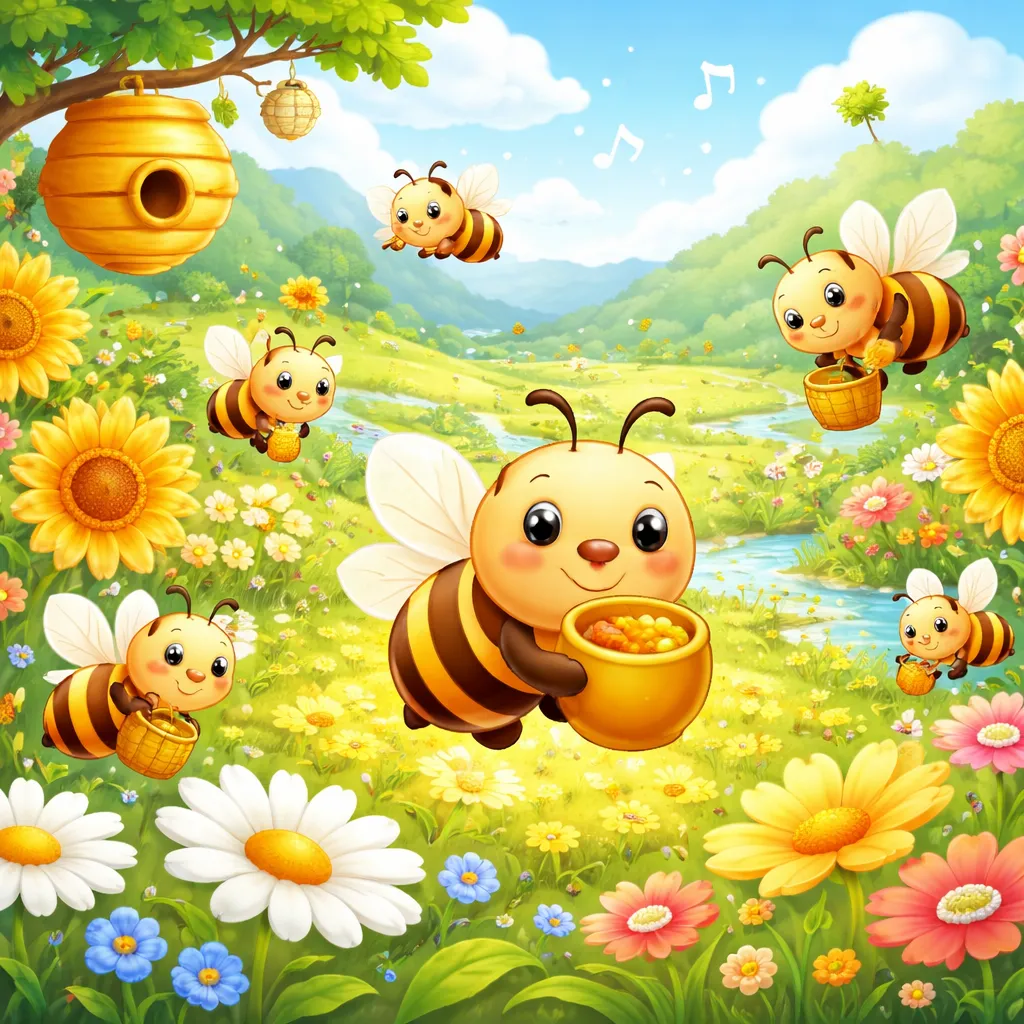

Have you ever seen a small, fuzzy insect zooming from flower to flower on a sunny day? It moves so fast, and it makes a gentle buzzing sound. This tiny creature is one of the most important workers in the whole world! In China, a very famous, short song uses just a few words to tell the story of this little hero’s day. Let’s buzz along with the energetic tune “Little Honeybee” (小蜜蜂, Xiǎo mìfēng).
About the Song
Let’s read the quick, buzzing words of this classic song.
小蜜蜂,嗡嗡嗡,
飞到西,飞到东。
采花蜜,忙做工,
做好蜜,好过冬。
English Translation:
Little honeybee, buzz buzz buzz,
Flies to the west, flies to the east.
Gathers flower nectar, works busily,
Makes good honey, to pass the winter.
This song is a classic Chinese children’s song. It is incredibly short, simple, and repetitive. The song captures the essence of a bee’s life in just four lines. It starts with the bee’s sound (“buzz buzz buzz”), describes its frantic flight in all directions, shows its work of gathering nectar, and finally explains the purpose: to make honey for surviving the winter. The melody is cheerful and bouncy, perfect for imitating the quick, busy movements of a bee. It is a staple in Chinese kindergartens, used to teach children about insects, hard work, and the changing seasons.
What the Song is About
The song paints a fast-moving picture of a bee’s very important job. We first meet the little honeybee and hear its signature sound: “buzz buzz buzz.” Then, we see it flying. It doesn’t fly in one straight line. It zooms to the west, then to the east, all over the place! It is searching for flowers.
When it finds a flower, it gets to work. It “gathers flower nectar.” The song says it is “busy working.” This bee does not stop or play. It has a mission. The song then tells us why it works so hard. It is making honey. And it needs that honey for a very important reason: “to pass the winter.” When it is cold and no flowers are blooming, the bee and its hive will need the honey they made in the warm months to eat. The song is a tiny, perfect lesson about preparation, hard work, and how even the smallest creature has a big job in nature’s plan.
Who Made It & Its Story
“Little Honeybee” is a traditional Chinese children’s song, so its original author is unknown. It has been passed down through generations as part of the oral tradition of teaching young children about the natural world. The song’s simplicity made it easy to remember and teach. It became a formal part of early childhood education in China in the 20th century. The song reflects the cultural values of diligence (勤劳, qínláo) and planning ahead (未雨绸缪, wèi yǔ chóu móu), which are important in Chinese culture. By using the bee as an example, the song makes these big ideas easy for even the youngest child to understand. It is a perfect example of how a simple song can be a powerful teaching tool.
This tiny song has remained a huge favorite for three excellent reasons. First, its melody is incredibly short, catchy, and easy to memorize, which is perfect for very young children. Second, it is packed with educational value, teaching about animal behavior, directions, seasons, and the value of work in just 20 words. Third, it is highly interactive and fun to act out. Children love to buzz around the room, flapping their “wings” and pretending to gather nectar, turning the song into a lively game.
When to Sing It
This song is perfect for active, playful learning. You can sing it while running around the yard or park, pretending to be a bee and flying “to the west and east.” You can chant it during a craft activity about insects, buzzing while you color or draw. You can also sing it as a reminder to finish a task or chore, connecting your work to the bee’s important job.
What Children Can Learn
This compact, energetic song is a hive of knowledge about language, science, and values.
Vocabulary
The song teaches us key nature and action words. A “honeybee” (蜜蜂, mìfēng) is a flying insect that makes honey. “Buzz” (嗡嗡, wēng wēng) is the onomatopoeic sound a bee makes. “West” (西, xī) and “East” (东, dōng) are cardinal directions. “Nectar” (花蜜, huāmì) is the sweet liquid inside flowers that bees collect. “Work” (做工, zuògōng) means to do a job or task. “Honey” (蜜, mì) is the sweet, golden food bees make from nectar. “Winter” (冬, dōng) is the cold season of the year.
Let’s use these words! You can say, “The bee collects nectar from the clover.” Or, “Squirrels gather nuts to prepare for winter.” New word: Pollination. This is the process of moving pollen between flowers, which bees do while collecting nectar. This helps plants grow fruits and seeds.
Language Skills
This song is a brilliant lesson in using simple present tense for habits and directional phrases. The song describes what the bee always does: it “flies,” “gathers,” “works,” and “makes.” The simple present tense is used for routines and general truths.
The song uses the directional phrases “飞到西,飞到东” (flies to the west, flies to the east). The structure “到 + [Direction]” means “to [a place].” This is a simple way to describe movement. The song also uses the purpose structure “好…” (in order to…): “好过冬” (in order to pass the winter). This shows the reason for an action.
Sounds & Rhythm Fun
Listen to the buzzing, energetic, and quick rhythm of the melody. The song is in a bouncy 2/4 time, which feels like the fast beating of bee wings. The best part is the onomatopoeia “嗡嗡嗡” right at the beginning, which instantly sets the scene. The melody is based on just a few notes that go up and down, mimicking flight. The Chinese lyrics have a very clear, driving rhyme: “嗡” (wēng) and “东” (dōng), “工” (gōng) and “冬” (dōng).
The rhythm is steady and insistent, like a worker on a mission. Try a quick, light step: 小 蜜 蜂,嗡 嗡 嗡 (xiǎo mìfēng, wēng wēng wēng). The short phrases and repetition make the song incredibly easy to learn and hard to forget. This simple, repetitive, and buzzing musical pattern is what makes the song so effective. You can write your own “busy animal” song! Use the same quick rhythm. Try: “Little squirrel, chatter chatter, up the tree, down it scatter. Gather nuts, hide them away, for a cold and snowy day.”
Culture & Big Ideas
“Little Honeybee” is a wonderful example of how Chinese children’s songs teach moral lessons through nature. The bee is a symbol of hard work, teamwork, and contributing to the community (the hive). This connects to the cultural value of being diligent and prepared. The song can be linked to the Mid-Autumn Festival, where honey is sometimes used in foods, celebrating the harvest. More broadly, it connects to the Spring Festival (Chinese New Year), a time of preparation and storing food for the new year. The song teaches children to observe and appreciate small creatures and understand their crucial role in the environment, fostering a sense of responsibility and wonder for the natural world.
The song conveys three important ideas. First, it’s about the importance of hard work and diligence. The bee is never lazy; it is always “busy working,” showing that consistent effort is needed to achieve a goal. Second, it expresses the value of preparation and planning for the future. The bee works in the warm months to have food for the winter, teaching us to think ahead. Third, it highlights that every creature, no matter how small, has a significant role to play. The bee’s work makes honey for itself, but it also pollinates flowers, helping plants grow. Our own small, consistent actions can have big, sweet results.
Values & Imagination
Imagine you are the little honeybee. Your wings beat so fast. What does the world look like from up high? Can you see all the bright colors of the flowers? Now, imagine landing on a flower. How does the pollen feel on your legs? How does the nectar taste? Sweet? Now, imagine returning to your hive with your treasure. How does it feel to contribute to the honey for your whole bee family? Draw a map of the bee’s journey. Draw a hive in the middle. Draw winding paths to different flowers on the left (west) and right (east). Draw a little bee on the path. At the hive, draw a pot of honey. This shows the song’s story of gathering and returning.
The song encourages a strong work ethic, planning ahead, and appreciation for teamwork and nature’s tiny helpers. A lovely family activity is to have a “Bee’s Breakfast.” Taste a little bit of honey (if you’re not allergic) on toast or in tea. Talk about how many bees worked to make that spoonful of honey. Then, go outside and quietly watch flowers for a few minutes to see if a real bee visits. This connects the song’s lesson to a real, sensory experience.
So, as the last note about preparing for winter fades, think about the big lesson in this tiny song. It is a vocabulary lesson in nature and directions. It is a grammar lesson in the simple present and expressing purpose. It is a music lesson in a buzzing, energetic rhythm. From the first “buzz” to the final plan for winter, it wraps lessons in diligence, preparation, and purpose in a melody that makes you want to zoom into action. “Little Honeybee” teaches us that work can be joyful, that it’s smart to prepare, and that even the smallest buzz contributes to the world’s sweetest results.
Your Core Takeaways
You are now an expert on the song “Little Honeybee” (小蜜蜂). You know it is a traditional Chinese song about a bee busily gathering nectar to make honey for winter. You’ve learned words like “nectar,” “buzz,” and directional words, and you’ve practiced the simple present tense and the “in order to” structure. You’ve felt its quick, buzzing rhythm and created your own animal verse. You’ve also discovered the song’s cultural values and its messages about hard work, planning for the future, and the important role of small creatures.
Your Practice Missions
First, host a “Busy Bee” dance. With your family, clear a space. Play the song and pretend to be bees. Buzz around the room, flying “west” and “east.” When the song says “采花蜜,” pretend to land on flowers (cushions or chairs) and gather nectar. When it says “好过冬,” pretend to pour the nectar into a honey pot. This active play brings the song to life.
Second, create a “Bee’s Purpose” drawing. Fold a paper into four squares. In the first square, draw the bee buzzing. In the second, draw it flying to a flower. In the third, draw it making honey in the hive. In the fourth, draw the hive covered in snow, with honey inside. Under each picture, write one line from the song that matches. This activity reinforces the song’s sequence and the cause-and-effect of the bee’s work.