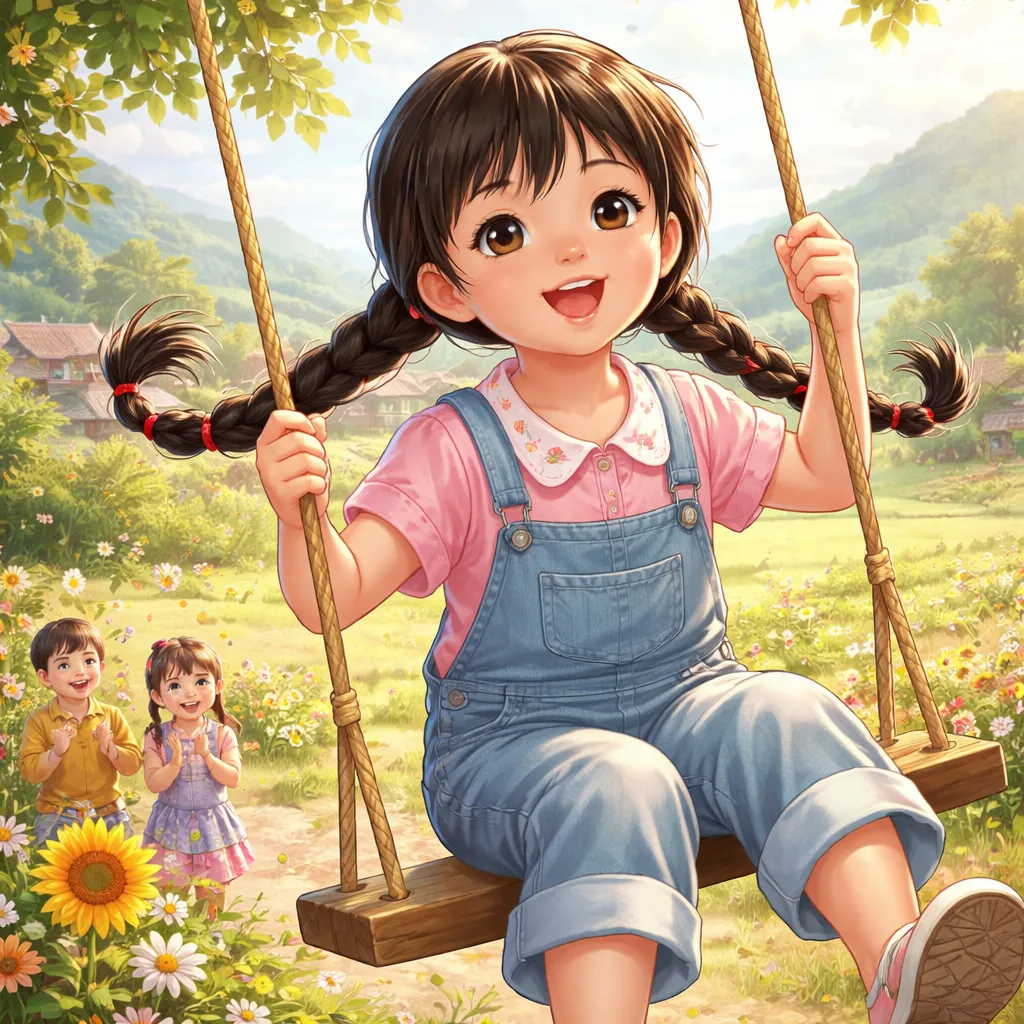

Do you ever look in the mirror in the morning? Maybe you brush your hair, or someone helps you put it in a ponytail or braids. Have you ever thought that your hairstyle can tell a happy little story? In China, there is a sweet, gentle song all about a girl’s special hairstyle and the family who helps her with it. Let’s look in the mirror with the warm tune “Little Pigtails” (小辫子, Xiǎo biànzi).
About the Song
Let’s read the loving, descriptive words of this family song.
小辫子,小辫子,
多美丽的小辫子。
妈妈给我梳辫子,
一梳梳得真整齐。
小辫子,小辫子,
多漂亮的小辫子。
爸爸给我扎辫子,
一扎扎个蝴蝶结。
小辫子,小辫子,
多神气的小辫子。
姐姐给我戴花儿,
戴朵花儿笑嘻嘻。
English Translation:
Little pigtails, little pigtails,
What beautiful little pigtails.
Mommy combs my pigtails for me,
Combing them so very neatly.
Little pigtails, little pigtails,
What pretty little pigtails.
Daddy ties my pigtails for me,
Tying them into a butterfly bow.
Little pigtails, little pigtails,
What spirited little pigtails.
Big sister puts a flower in for me,
Puts in a flower, smiling happily.
This song is a lovely modern Chinese children’s song that celebrates a simple, loving family moment. The singer, likely a little girl, proudly sings about her “little pigtails,” a common and cute hairstyle for young girls in China. Each verse describes a different family member helping to create the look: her mother combs the hair neatly, her father ties it with a bow, and her older sister adds a beautiful flower. The song is all about the care, love, and teamwork within a family, shown through the act of styling hair. The melody is sweet, flowing, and full of affection, making everyone who sings it feel warm and cherished.
What the Song is About
The song paints a tender picture of a morning or special day at home. A little girl is getting ready, and her family is helping her look her best. She looks at her two “little pigtails” in the mirror and thinks they are beautiful. Her mother starts the job. Her mother’s hands are gentle. She carefully combs the girl’s hair, making sure every strand is smooth and the pigtails are perfectly even and tidy.
Then, her father takes a turn. He might not do this every day, so it feels extra special. He takes the neat pigtails and ties a ribbon or elastic into a perfect “butterfly bow.” The bow sits nicely at the end of each pigtail. Finally, her big sister adds the finishing touch. Maybe she picks a flower from the garden or a pretty hair clip. She gently places the flower in the girl’s hair. The little girl looks in the mirror, sees her wonderful pigtails and the loving faces of her family around her, and she can’t help but smile a big, happy smile. The song is about more than hair; it’s about the love woven into everyday routines.
Who Made It & Its Story
“Little Pigtails” is a beloved modern Chinese children’s song that gained popularity in the late 20th and early 21st centuries. While the specific composer is not widely attributed, it is a staple in many Chinese children’s music collections. The song reflects the deep value of family harmony and intergenerational bonding in Chinese culture. The involvement of multiple family members—mother, father, and older sister—shows how the whole family unit participates in caring for and cherishing a child. The hairstyle, “little pigtails” or bianzi, is a traditional and common hairstyle for young girls, symbolizing youth, neatness, and familial care. The song beautifully turns this everyday grooming ritual into a celebration of familial love and attention to detail, making an ordinary moment feel extraordinary and full of significance.
This song is cherished for three heartwarming reasons. First, its melody is gentle, catchy, and full of warmth, making it easy and soothing to sing. Second, it celebrates a universal, relatable family experience that many children, especially young girls, connect with immediately, fostering a sense of being loved and cared for. Third, it showcases teamwork and different forms of love from each family member, teaching children to appreciate the different ways their family shows they care, from a mother’s gentle combing to a father’s bow-tying to a sister’s decorative flair.
When to Sing It
This song is perfect for cozy, loving moments. You can sing it softly in the morning while brushing or styling hair, turning the routine into a special bonding time. You can hum it during a quiet playtime with dolls or stuffed animals, pretending to do their hair just like in the song. You can also sing it as a “thank you” to family members after they help you with something, showing your appreciation for their care.
What Children Can Learn
This affectionate song is a wonderful teacher about family, descriptive language, and daily routines.
Vocabulary
The song teaches us words about appearance, family, and actions. “Pigtails” (辫子, biànzi) are two sections of hair tied separately on either side of the head. To “comb” (梳, shū) means to use a comb to make hair neat. “Neat/整齐” (zhěngqí) means tidy and in good order. To “tie” (扎, zā) means to fasten something with a string or ribbon. A “butterfly bow” (蝴蝶结, húdiéjié) is a decorative knot with loops like butterfly wings. “Spirited/神气” (shénqì) means looking lively, proud, and full of energy. To “put in” or “wear” (戴, dài) means to place something on your body, like a flower in your hair.
Let’s use these words! You can say, “My father can tie a perfect butterfly bow on my gift.” Or, “She looked very spirited in her new outfit for the party.” New word: Grooming. This is the act of making yourself neat and clean, like brushing your hair or washing your face.
Language Skills
This song is an excellent lesson in using descriptive adjectives and the causative structure “给…V” (to do something for someone). The song uses lovely adjectives to describe the pigtails: “美丽” (beautiful), “漂亮” (pretty), and “神气” (spirited). These words tell us not just how the hair looks, but how it makes the girl feel.
The key grammar is the “给我” (for me) structure. “妈妈给我梳辫子” means “Mommy combs the pigtails for me.” The pattern is [Family Member] + 给 + me + [Action] + [Object]. This clearly shows someone doing a helpful action for the singer. We also see the complement “得” (de) in “梳得真整齐” (combs so neatly), which is used to describe how an action is done.
Sounds & Rhythm Fun
Listen to the gentle, swaying, and repetitive rhythm of the melody. The song has a smooth, flowing 3/4 or 6/8 time signature, which gives it a lullaby-like, rocking feel, like the motion of brushing hair. The repetition of the phrase “小辫子,小辫子” at the start of each verse is catchy and comforting. The melody rises and falls gently, matching the affectionate tone. The Chinese lyrics have a very clear and sweet rhyme scheme: “子” (zi) is repeated, and the ends of the lines rhyme: “丽” (lì) and “齐” (qí), “亮” (liàng) and “结” (jié), “气” (qì) and “嘻” (xī).
The rhythm is steady and gentle. Try a slow, gentle sway: 小 辫 子, 小 辫 子 (xiǎo biànzi, xiǎo biànzi). The simple, repetitive structure makes it very easy to learn and remember. This soothing, repetitive, and loving musical pattern makes the song feel like a hug. You can write your own “getting ready” song! Use the same gentle, repetitive rhythm. Try: “Little shoes, little shoes, what shiny little shoes. Grandpa polishes my shoes for me, polishes them so they glow. Little coat, little coat, what cozy little coat. Grandma buttons my coat for me, buttons it right to the top.”
Culture & Big Ideas
“Little Pigtails” offers a window into the warm, intimate daily life of a Chinese family and the importance of presenting oneself neatly. Well-groomed hair, especially in traditional styles like pigtails for girls, is often seen as a sign of being well-cared-for and respectful. The song highlights the shared responsibility in childcare, where different family members all contribute in their own loving way. This reflects the collectivist and family-oriented nature of many Chinese households. While not linked to a specific festival, the scene embodies the everyday love and preparation that might happen before a family outing or a family photo, or even just the start of a school day. It teaches that beauty and confidence often come from the loving hands of those who care for us.
The song conveys three beautiful ideas. First, it’s about appreciating the small, loving acts of care from family. A comb, a bow, a flower—these are simple things, but they are filled with love. Second, it expresses pride and joy in one’s appearance when it’s tied to family love. Feeling “spirited” comes from knowing you are cherished. Third, it highlights family teamwork and how each person can contribute in a different, special way. The mother prepares, the father secures, the sister decorates—together, they create something wonderful.
Values & Imagination
Imagine you are the little girl in the song. How does the comb feel on your scalp? Gentle? Soothing? Now, imagine your father’s big hands carefully tying a bow. Can you feel the tug as he makes it just right? Now, imagine your sister choosing the perfect flower. What color is it? How does it smell? Draw a picture of this family moment. Draw a large mirror. In it, draw the girl’s happy face and her finished pigtails with the bow and flower. Around the mirror, draw the reflections of her mother, father, and sister behind her, all smiling as they help. This shows the teamwork and the final, happy result.
The song encourages gratitude for family care, attention to personal grooming as a form of self-respect, and recognizing how small actions build big love. A wonderful family activity is a “Hair Style Story Time.” While brushing or styling hair, a family member can tell a short, made-up story about where the “spirited” person with the pigtails might go on an adventure that day. This connects the act of care with imagination and positive expectations for the day.
So, as the last note about the smiling face fades, think about the loving lesson in this gentle tune. It is a vocabulary lesson in family and grooming. It is a grammar lesson in descriptive words and the “for me” action structure. It is a music lesson in a swaying, soothing rhythm. From the first mention of the little pigtails to the final happy smile, it wraps lessons in family love, teamwork, and self-care in a melody that makes you feel cherished and proud. “Little Pigtails” teaches us that beauty is in the details, that love is in the helping hands, and that a simple hairstyle can hold a whole story of family happiness.
Your Core Takeaways
You are now an expert on the song “Little Pigtails” (小辫子). You know it is a modern Chinese song about a girl whose family helps style her hair, showing their love. You’ve learned words like “pigtails,” “butterfly bow,” and “spirited,” and you’ve practiced using descriptive adjectives and the “for me” sentence pattern. You’ve felt its gentle, swaying rhythm and created your own caring verse. You’ve also discovered the song’s cultural meaning and its messages about appreciating family care, taking pride in oneself, and how teamwork creates beauty.
Your Practice Missions
First, have a “Family Hair Care” moment. Ask a family member to help you brush or style your hair (or you can style a doll’s hair). As you do, sing the song softly. Talk about how it feels to be cared for or to care for someone. Say “thank you.” This mission brings the song’s core message of love and gratitude to life.
Second, create a “Love in Action” drawing. Think of one small, helpful thing each family member does for you (like making breakfast, reading a story, fixing a toy). Draw three small pictures showing these actions. Write a simple sentence under each using the “[Person] 给我 [Action]” pattern from the song, like “Daddy makes pancakes for me.” This activity helps you notice and appreciate the different ways your family shows love.