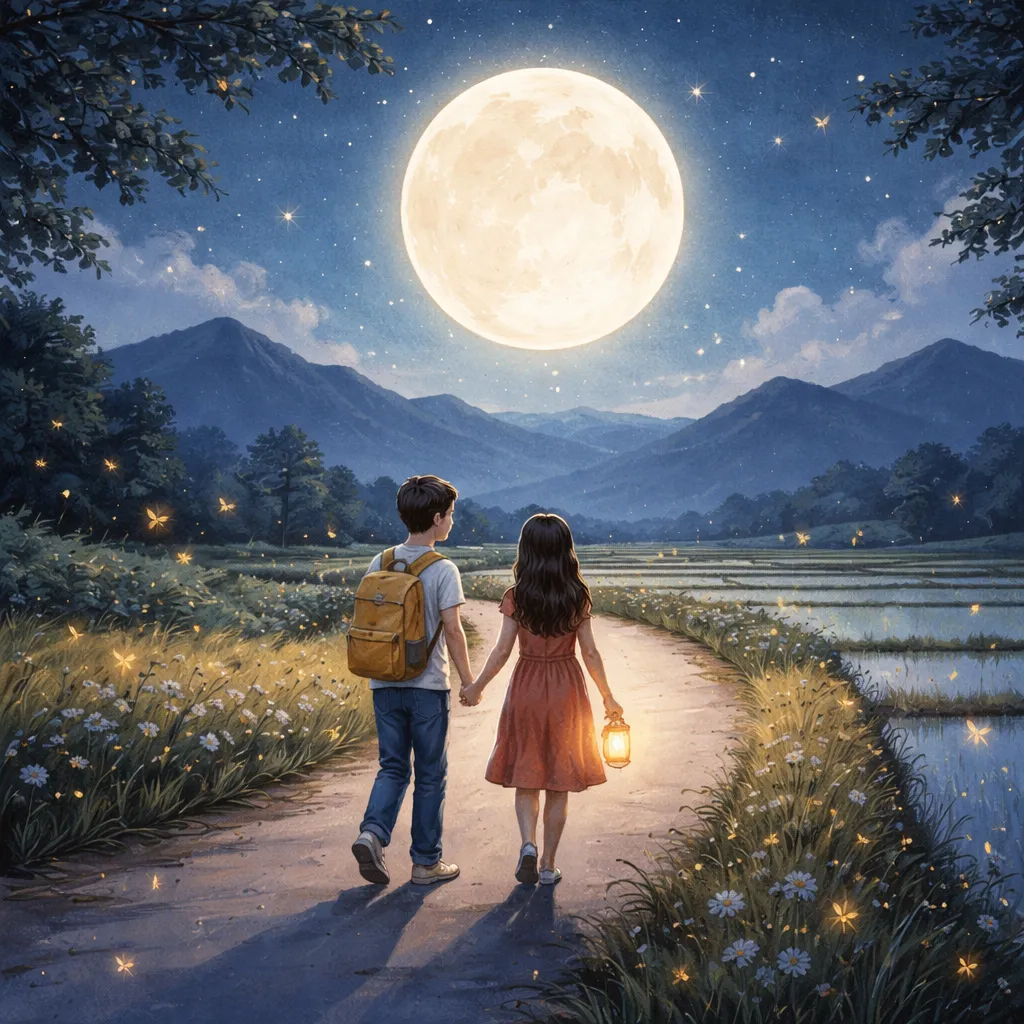

Have you ever walked outside on a clear night, looked up at the moon, and felt like it was walking right along with you? It seems to follow you from behind a tree, over a roof, and down the street. This magical feeling is the heart of a very famous, gentle Chinese folk song. Let’s explore the poetic and mysterious tune “The Moon Is Passing By” (月亮走我也走, Yuèliang zǒu wǒ yě zǒu).
About the Song
Let’s read the simple, repeating lines of this beautiful song.
月亮走我也走, 我送阿哥到村口。 阿哥是个边防军, 十里相送难分手。
啊,天上云追月, 地下风吹柳。 月亮月亮歇歇脚, 我俩话儿没说够。
English Translation: The moon walks, I also walk, I see my elder brother off to the village gate. Elder brother is a frontier guard, Seeing him off for ten miles, it’s hard to part.
Ah, in the sky, clouds chase the moon, On the ground, the wind blows the willows. Moon, oh moon, rest your feet a while, We two haven’t finished our talk.
This song is a traditional Chinese folk song that became widely popular in the mid-20th century. The lyrics are attributed to Hu Xiaoming (胡小明) and the music was composed by Hu Ji (胡积). It is a slow, lyrical, and slightly sad song. The singer, likely a younger sister, describes walking under the moon to see her elder brother (“阿哥”) off as he leaves to serve as a soldier on the frontier. The famous first line captures the optical illusion of the moon moving with the walker, but here it becomes a metaphor for her unwillingness to part—as long as she walks, the moon (and her feeling of connection) walks with her. The song blends a natural observation with deep feelings of family love, duty, and the pain of separation.
What the Song is About
The song paints a picture of a heartfelt, moonlit goodbye. The singer is walking. She looks up and sees the moon moving across the sky. She feels as if the moon is walking with her. She is using this walk to accompany her elder brother to the edge of their village. Her brother is leaving for a very important and distant job: he is a frontier guard, protecting the country’s border.
They walk for a long time (“ten miles”), finding it very hard to say goodbye. The singer then looks around. Above, clouds are chasing the moon. Below, the wind is rustling the willow trees, which often symbolize farewell in Chinese culture. The singer, not wanting the moment to end, speaks directly to the moon. She asks the moon to “rest your feet,” because she and her brother haven’t said all they want to say. The song is about stretching out a final moment with a loved one, using the ever-present moon as a companion and a silent witness to their love and sadness.
Who Made It & Its Story
“The Moon Is Passing By” was adapted and popularized in the 1980s. The lyricist Hu Xiaoming and composer Hu Ji created this version, which became a major hit when sung by the famous Chinese singer Peng Liyuan (彭丽媛). The song’s theme of a family member leaving for military service resonated deeply in China, reflecting the values of sacrifice, patriotism, and family bonds. While the specific story is about a frontier guard, the core feeling of a nighttime farewell under a shared moon is universal. The song beautifully connects a common childhood observation (the moon following you) with a powerful adult emotion, making it a timeless piece that both children and adults can appreciate on different levels. It remains a standard in Chinese folk music repertoire.
This song has remained a classic for three beautiful reasons. First, its melody is hauntingly beautiful, flowing, and deeply emotional, perfectly capturing the feeling of a bittersweet, moonlit night. Second, it brilliantly uses a simple natural phenomenon (the moon seeming to move) to express a complex human emotion (unwillingness to part), making the abstract feeling concrete and relatable. Third, it creates a strong sense of scene and atmosphere—the quiet village, the long road, the chasing clouds, the blowing willows—that pulls the listener right into the story.
When to Sing It
This song is perfect for quiet, thoughtful, and emotional moments. You can hum it softly on a quiet night when the moon is bright and full, thinking about someone you miss. You can sing it slowly on a long car ride at night, watching the moon follow your car. You can also sing it gently as a way to express missing a family member or friend who is far away, imagining the moon connects you.
What Children Can Learn
This poetic, emotional song is a deep well of lessons about science, language, and feelings.
Vocabulary
The song teaches us descriptive and emotional words. The “moon” (月亮, yuèliang) is the bright celestial body that orbits Earth. To “walk” (走, zǒu) means to move on foot. “Elder brother” (阿哥, ā gē) is a respectful and affectionate term for an older brother. A “village gate” (村口, cūnkǒu) is the entrance to a small rural community. A “frontier guard” (边防军, biānfángjūn) is a soldier who guards the national border. “To see someone off” (相送, xiāngsòng) means to accompany someone who is leaving. “Willow trees” (柳, liǔ) are trees with long, thin branches.
Let’s use these words! You can say, “We stood at the village gate to welcome our guests.” Or, “The willow branches swayed in the breeze.” New word: Optical Illusion. This is when your eyes see something that is not really what it seems. The moon “following” you is an optical illusion.
Language Skills
This song is a masterful lesson in using the structure “A 也 B” to show simultaneous action and the imperative mood for direct address. The famous first line “月亮走我也走” uses the pattern: [Noun A] + [Verb] + 也 (also) + [Noun B] + [Verb]. It means “A does [action], and B also does [the same action].” This shows two things happening together.
The singer then directly speaks to the moon using the imperative: “月亮月亮歇歇脚” (Moon, oh moon, rest your feet). This is a plea or a command given directly to an object, which is a poetic device called apostrophe. The song also uses parallelism in the lines “天上云追月,地下风吹柳” (In the sky, clouds chase the moon; on the ground, the wind blows the willows), creating a beautiful, balanced image.
Sounds & Rhythm Fun
Listen to the slow, flowing, almost sighing rhythm of the melody. The song is in a free, lyrical rhythm that feels like walking under a wide, open sky. The repetition of the word “走” (walk) and “月亮” (moon) ties the song together. The melody has a sad, beautiful rise and fall, especially on the emotional “啊” (Ah) and the plea to the moon. The Chinese lyrics have a soft, poetic rhyme: “走” (zǒu) and “口” (kǒu), “军” (jūn) and “分” (fēn), “柳” (liǔ) and “够” (gòu).
The rhythm is not a strict march; it is more like a slow, thoughtful stroll. Try singing with a gentle, even breath: 月 亮 走 我 也 走 (yuèliang zǒu wǒ yě zǒu). The melody is more complex than a simple nursery rhyme, which makes it a wonderful introduction to more expressive singing. This flowing, lyrical, and emotional musical pattern is what makes the song so memorable and moving. You can write your own “walking with” song! Use the same lyrical style. Try: “The shadow walks, I also walk, my silent friend on the sidewalk. The streetlight bright, the evening deep, a promise that I’ll always keep.”
Culture & Big Ideas
“The Moon Is Passing By” is a rich tapestry of Chinese cultural motifs. The moon is a universal symbol of思念 (missing someone) in Chinese poetry, especially during the Mid-Autumn Festival, a time for family reunion. The image of “seeing someone off for ten miles” reflects the traditional value of deep courtesy and reluctant parting. The brother’s role as a frontier guard connects to the cultural esteem for military service and sacrifice for the country. The willow tree is a classic symbol of farewell, as the word for willow (柳, liǔ) sounds like the word for “stay” (留, liú). The song teaches that personal goodbyes are part of larger cycles of nature and duty, and that love can make even the moon seem like a companion in our sadness.
The song conveys three profound ideas. First, it’s about the universal human experience of optical illusion and projection. We see the moon “following” us, and in our loneliness or longing, we project our feelings onto it, making it a companion. Second, it expresses the pain and beauty of sacrifice and duty. The brother leaves for an important job, and the song honors that choice while honestly expressing the sadness it causes. Third, it highlights the deep connection between human emotion and the natural world. The landscape (moon, clouds, wind, willows) is not just a backdrop; it is an active participant in and a mirror for the characters’ feelings.
Values & Imagination
Imagine you are the singer walking that long road. The moon is so bright it casts shadows. What does the dirt road feel like under your feet? Can you hear your footsteps? Now, imagine you are the moon looking down. What do you see? Two small figures walking slowly, then stopping, talking softly. How would it feel to be asked to “rest your feet”? Draw a picture from the moon’s point of view. Draw a winding path from a small village. On the path, draw two tiny figures saying goodbye. In the sky, draw a large, gentle moon looking down. From the moon, draw a beam of light that connects to both figures, as if tying them together. This captures the song’s sense of connection.
The song encourages observation of nature, empathy for those who miss loved ones, and appreciation for the sacrifices people make for their community and country. A lovely family activity is to have a “Moon Watch.” On a clear night, go outside and walk a short distance. Stop and look at the moon. Then walk again and see how it seems to move with you. Talk about how that feels. Then, think of someone you love who is not with you. Imagine they are looking at the same moon. Share one thing you would like to tell them. This connects the song’s theme to a personal moment.
So, as the last plea to the moon fades, think about the deep connection in this lyrical song. It is a vocabulary lesson in nature and emotion. It is a grammar lesson in showing simultaneous action and direct address. It is a music lesson in a flowing, emotional melody. From the first optical illusion to the final unspoken words, it wraps lessons in observation, sacrifice, and the bond between people and the cosmos in a tune that feels like a quiet tear and a comforting hug under the night sky. “The Moon Is Passing By” teaches us that nature shares our journeys, that goodbyes are hard but full of love, and that even the distant moon can feel like a friend when we need one.
Your Core Takeaways
You are now an expert on the song “The Moon Is Passing By” (月亮走我也走). You know it is a Chinese folk song about a sister seeing her soldier brother off under the moon. You’ve learned about the optical illusion of the moon, and words like “frontier guard” and “willow,” and you’ve practiced the “A also B” sentence structure and talking directly to objects. You’ve felt its slow, lyrical rhythm and created your own walking verse. You’ve also discovered the song’s cultural symbols and its messages about the moon as a companion, the pain of parting, and the deep link between human feelings and the natural world.
Your Practice Missions
First, be a “Moon Illusion” scientist. The next clear night, perform an experiment. Stand still and find the moon next to a fixed object (like a tree or a roof corner). Walk 20 steps. Stop and look again. Did the moon seem to move relative to the object? With a grown-up, look up why this happens (it’s because the moon is so far away!). This mission connects the song’s opening line to real science.
Second, create a “Moon Message” art piece. The song is about unspoken words under the moon. Take a piece of dark blue or black paper. Draw a large moon. On the moon, write or draw a short message you would send to someone you miss or care about, just like the singer wanted to tell her brother more. You can use white crayon or chalk to make it glow. Share your moon message. This activity lets you express a personal connection inspired by the song.