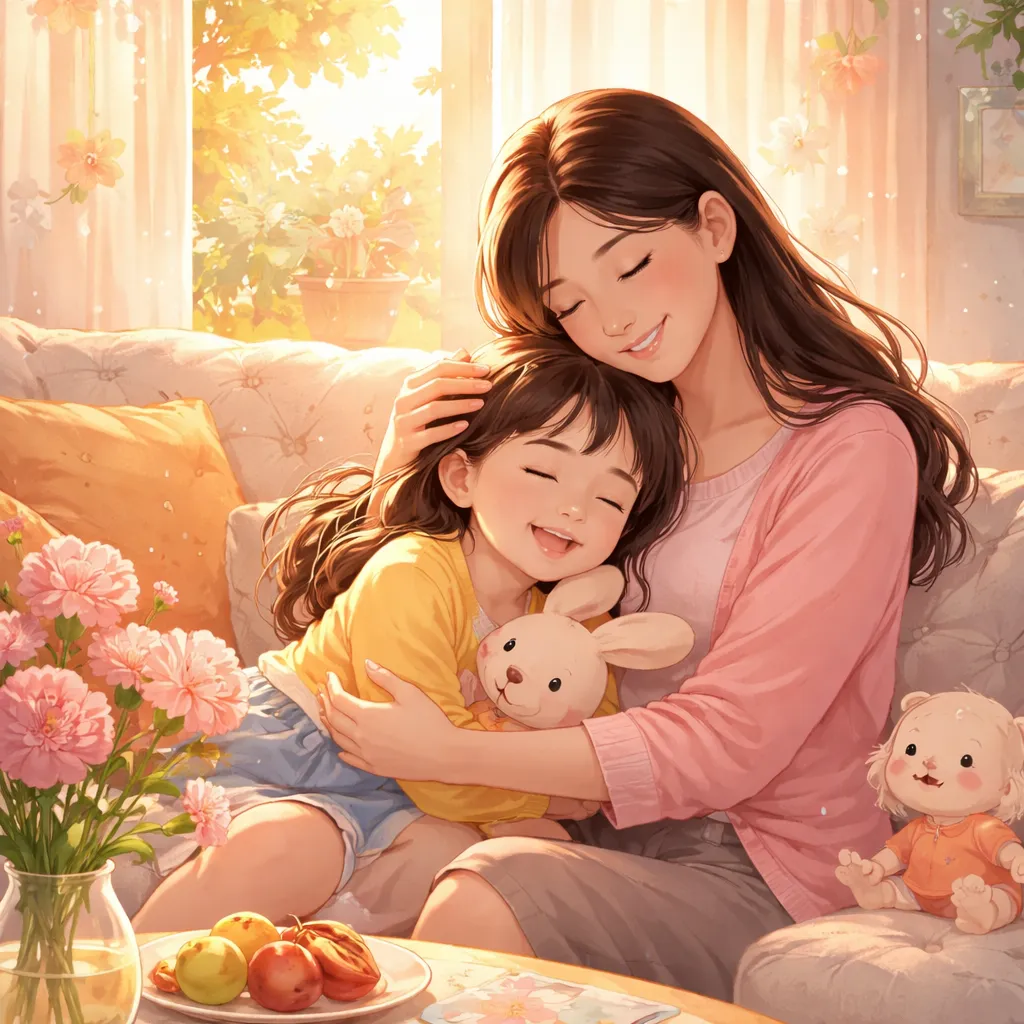

Have you ever felt a warm, safe hug that makes everything better? Maybe when you were sad, hurt, or just needed comfort. For many people, that feeling is most strongly connected to a mother’s love. In China, there is a very famous, heartfelt song that puts this deep feeling into simple, powerful words. It’s a song that has made generations of people cry and smile with love. Let’s learn about the emotional anthem “Mom Is the Best in the World” (世上只有妈妈好, Shìshàng zhǐyǒu māmā hǎo).
About the Song
Let’s read the sincere, loving words of this famous song.
世上只有妈妈好,
有妈的孩子像块宝。
投进妈妈的怀抱,
幸福享不了。
世上只有妈妈好,
没妈的孩子像根草。
离开妈妈的怀抱,
幸福哪里找?
English Translation:
Only mom is the best in the world,
A child with a mom is like a treasure.
Throwing yourself into mom’s embrace,
Happiness is endless.
Only mom is the best in the world,
A child without a mom is like a blade of grass.
Leaving mom’s embrace,
Where can happiness be found?
This song is a Chinese children’s song that became a cultural phenomenon. It originally came from the 1958 Taiwanese film “My Life as a Dog” (also known as “The Story of a Mother”). The song is a direct, emotional expression of a child’s love and dependence on their mother. The lyrics use strong contrasts: a child with a mother is a “treasure,” safe and happy; a child without a mother is a “blade of grass,” fragile and lost. The melody is simple, slow, and deeply moving, designed to stir feelings of gratitude, love, and sometimes, the pain of separation. It is a song that speaks directly to the heart about the most fundamental bond.
What the Song is About
The song paints two powerful pictures to show the importance of a mother’s presence. The singer makes a bold statement: in the whole world, only a mother is the best. A child who has a mother is compared to a “treasure”—something precious, protected, and valued.
The song describes the action of running into a mother’s arms. In that embrace, the child finds endless happiness and safety. Then, the song shows the opposite. A child without a mother is compared to a “blade of grass”—common, unprotected, and easily blown away. That child, away from a mother’s hug, cannot find happiness anywhere. The song is about the deep security a mother provides and the profound loneliness felt in her absence. It’s a tribute to motherly love as the foundation of a child’s emotional world.
Who Made It & Its Story
The song “Mom Is the Best in the World” was written for the 1958 film. The lyrics are attributed to Li Jinhui (李隽青), and the music was composed by Liu Hongyuan (刘宏远). The film and its theme song were hugely popular in Taiwan and later in mainland China. The song’s simple, raw emotion resonated deeply, especially during times of social change when family bonds were paramount. It became an unofficial anthem for Mother’s Day and is taught in many kindergartens. While it is a children’s song, its themes are universal, touching adults and children alike. The song’s power lies in its brave honesty about both the joy of love and the fear of its loss.
This song has become a cultural touchstone for three profound reasons. First, its message is universal and emotionally raw, expressing a child’s love and need in a way that feels absolutely true. Second, it uses powerful, easy-to-understand metaphors (treasure vs. grass) that make the abstract feeling of love and security very concrete. Third, its melody is hauntingly simple and memorable, amplifying the emotional weight of the words and making it easy for anyone to sing and remember, often bringing tears to the eyes of listeners.
When to Sing It
This song is perfect for quiet, loving, and reflective moments. You can sing it softly to your mom on her birthday or on Mother’s Day as a special, heartfelt gift. You can hum it when you are missing a parent who is away, as a way to feel connected. It is also a song that families might sing together to express gratitude and love for each other, perhaps during a family gathering.
What Children Can Learn
This deeply emotional song is a gentle teacher about love, language, and family.
Vocabulary
The song teaches us powerful emotional and comparative words. “World” (世上, shìshàng) means everywhere on Earth. “Only” (只有, zhǐyǒu) means solely, with no one else. “Treasure” (宝, bǎo) is a very valuable and loved object. “Embrace” (怀抱, huáibào) is a loving hug. “Happiness” (幸福, xìngfú) is a feeling of great joy and contentment. “Blade of grass” (草, cǎo) is a single piece of grass, seen as common and fragile.
Let’s use these words! You can say, “The old toy was a treasure to the child.” Or, “She found happiness in reading.” New word: Filial Piety. This is the virtue of respect for one’s parents and ancestors, a very important value in Chinese culture. The song expresses this feeling.
Language Skills
This song is a masterful lesson in using comparisons with “像” (like) and the structure for possession and existence. The song makes two comparisons: a child with a mom is like a treasure (像块宝). A child without a mom is like grass (像根草). Using “像” is a common way to make similes in Chinese.
The song uses the structure “有…的” (have) to show possession: “有妈的孩子” (a child who has a mom). Its opposite is “没妈的孩子” (a child who has no mom). The phrase “幸福哪里找?” (Where can happiness be found?) is a rhetorical question, expressing that happiness is impossible to find without a mother.
Sounds & Rhythm Fun
Listen to the slow, sorrowful, yet loving rhythm of the melody. The song is in a gentle 4/4 time. The tempo is very slow, allowing each word to be felt deeply. The melody is simple, with a small range of notes, making it easy to sing but heavy with emotion. The Chinese lyrics have a clear, poignant rhyme: “好” (hǎo) and “宝” (bǎo), “抱” (bào) and “了” (liǎo), “草” (cǎo) and “找” (zhǎo).
The rhythm is deliberate and heartfelt. Try singing very slowly: 世 上 只 有 妈 妈 好 (shìshàng zhǐyǒu māmā hǎo). The melody rises and falls gently, like a sigh or a soft cry. This simple, slow, and deeply expressive musical pattern is what makes the song so powerful and memorable. You can write a song of gratitude! Use a similar heartfelt tone. Try: “Only family is the best in the world, a home with love is like a warm light. Sitting together sharing a meal, everything feels so right.”
Culture & Big Ideas
“Mom Is the Best in the World” is a cornerstone of modern Chinese family culture. It comes from a deep cultural tradition of filial piety (孝, xiào), which emphasizes love, respect, and care for one’s parents. The song connects directly to holidays like Mother’s Day and the Double Ninth Festival (a day to respect the elderly). The song’s immense popularity reflects the central role of the family in Chinese society. It also speaks to the collective memory of hardship, where a mother’s protection was seen as the ultimate shelter. The song teaches that expressing deep love and gratitude for parents is not only acceptable but celebrated as a fundamental virtue.
The song conveys three profound ideas. First, it’s about the unconditional, irreplaceable nature of a mother’s love. It portrays this love as the single most important source of security and happiness for a child. Second, it expresses the vulnerability and dependence of childhood. The song acknowledges that children need their parents deeply, and that this need is natural and okay. Third, it highlights gratitude and appreciation. By stating what it’s like to be without a mother, the song makes us more thankful for having one, teaching us to cherish our loved ones while they are with us.
Values & Imagination
Imagine being the “treasure” in a mother’s care. What does that feel like? Safe? Warm? Shiny? Now, imagine being the “blade of grass.” How does that feel? Lonely? Cold? Tossed by the wind? Draw two pictures side by side. On the left, draw a child as a sparkling treasure chest, being held in a pair of gentle, giant hands labeled “Mom.” On the right, draw a single, bent blade of grass in a big, empty field. This shows the song’s powerful contrast.
The song encourages deep gratitude for parental love, empathy for those who may feel alone, and the courage to express big, loving feelings. A valuable activity is to have a “Love Letter” moment. With your family, talk about what makes someone in your family a “treasure.” Then, write or draw a short “love letter” or make a card for that person, telling them one reason they make you feel happy and safe. This turns the song’s emotion into a positive, actionable expression of love.
So, as the last note about finding happiness fades, think about the deep love in this simple tune. It is a vocabulary lesson in emotion and value. It is a grammar lesson in making comparisons and expressing possession. It is a music lesson in a slow, heartfelt melody. From the first declaration that mom is the best to the final searching question, it wraps lessons in gratitude, vulnerability, and cherishing family in a tune that feels like a hug and a tear at the same time. “Mom Is the Best in the World” teaches us that a mother’s love is a powerful force, that it’s okay to need and appreciate that love, and that expressing such feelings is one of the most important songs we can ever sing.
Your Core Takeaways
You are now an expert on the song “Mom Is the Best in the World” (世上只有妈妈好). You know it is a Chinese song from a 1958 film, expressing a child’s deep love and need for a mother. You’ve learned the metaphors of “treasure” and “grass,” and you’ve practiced making comparisons and expressing possession in Chinese. You’ve felt its slow, emotional rhythm and created your own verse of gratitude. You’ve also discovered the song’s connection to filial piety in Chinese culture and its messages about the irreplaceable nature of a mother’s love, the vulnerability of childhood, and the importance of gratitude.
Your Practice Missions
First, host a “Family Appreciation” listening. Listen to the song with a family member. Talk about how it makes you feel. Then, share one specific thing you appreciate about each other. This focuses on the song’s core message of love and gratitude within the safety of your own family.
Second, create a “Treasure & Grass” contrast collage. On a piece of paper, make two columns. In the “Treasure” column, paste or draw pictures of things that make you feel safe, loved, and happy (like photos, drawings of hugs, your home). In the “Grass” column, paste or draw things that make you feel lonely or sad. Then, cover the “Grass” column with a bright, beautiful “Treasure” drawing to show how love can cover sadness. This activity helps process the song’s contrasting emotions in a creative, uplifting way.