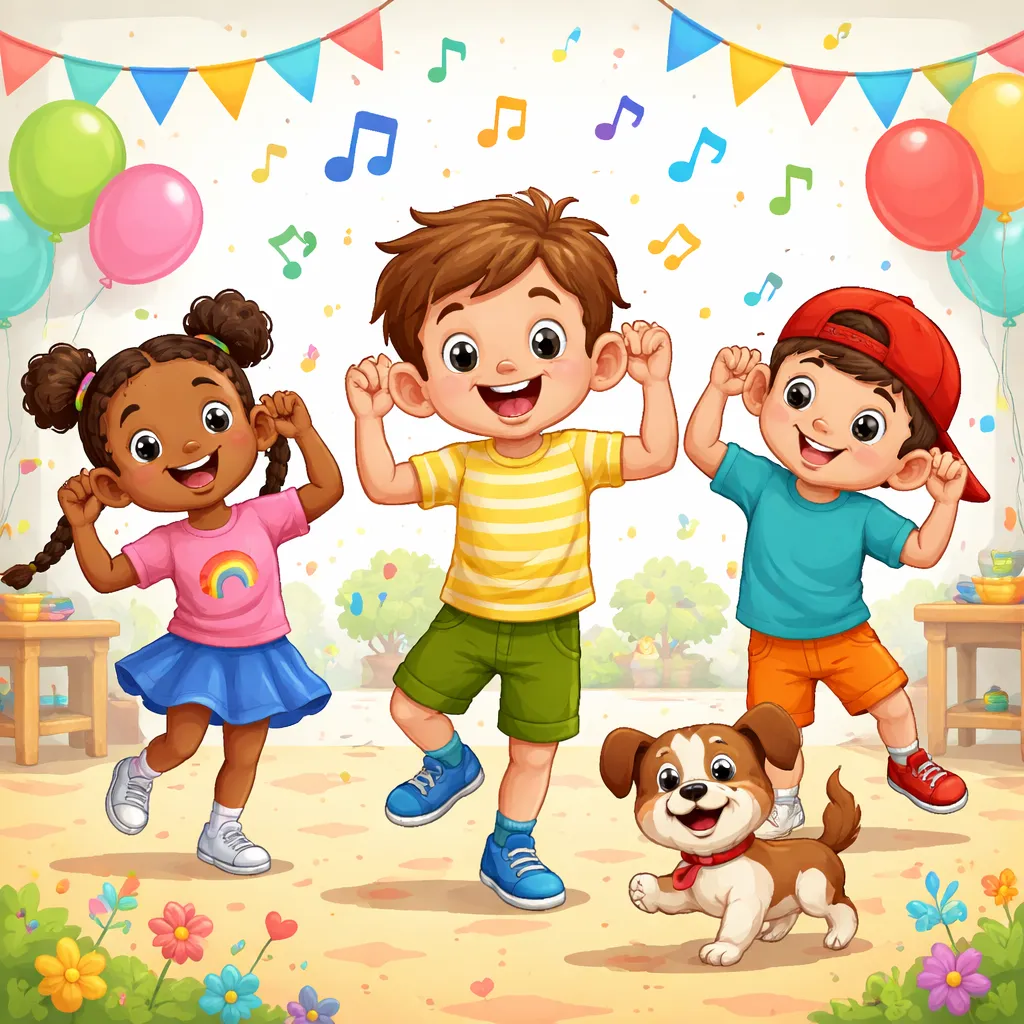

What is the Story "Do Your Ears Hang Low?"
"Do Your Ears Hang Low?" is a playful and silly English song that children absolutely adore. The song asks a series of funny questions about ears and what they can do. Can they flop up and down? Can you tie them in a knot? Can you throw them over your shoulder? The English song: Do Your Ears Hang Low? started as a camp song and became popular with children everywhere. The tune is the same as the Civil War song "When Johnny Comes Marching Home." Children love the ridiculous images of tying ears in knots and throwing them over shoulders. The song invites movement and imagination. It makes children think about their own bodies in silly new ways. Best of all, it encourages everyone to wiggle and giggle together.
The Complete Lyrics of the Nursery Rhyme
Let us look at the words together. The song has several funny verses.
Do your ears hang low?
Do they wobble to and fro?
Can you tie them in a knot?
Can you tie them in a bow?
Can you throw them over your shoulder
Like a continental soldier?
Do your ears hang low?
Do your ears hang high?
Do they reach up to the sky?
Do they droop when they are wet?
Do they stiffen when they're dry?
Can you wave them at your neighbor
With a minimum of labor?
Do your ears hang high?
Vocabulary Learning from the Song
This English song: Do Your Ears Hang Low? introduces children to words about body parts, movement, and silly actions. Each word builds their understanding of language and imagination.
First, the song teaches about "ears." Ears are the body parts we use to hear. Most people's ears do not hang low like a dog's ears. This is what makes the song so silly.
The song teaches movement words. "Hang low" means dangling down. "Wobble to and fro" means moving back and forth. "Reach up to the sky" means going very high. These words help children describe how things move.
The song asks silly questions. "Can you tie them in a knot?" Of course you cannot tie your ears! "Can you throw them over your shoulder?" Impossible! This absurdity makes children laugh.
"A continental soldier" refers to soldiers who fought in the American Revolutionary War. They wore uniforms with fringes on their shoulders. This is a little history lesson hidden in the silly song.
The second verse asks about ears hanging high and drooping when wet. This adds more silly images for children to imagine.
Phonics Points to Practice
Let us listen for special sounds in the song. Phonics helps children connect letters to the sounds they hear. This English song: Do Your Ears Hang Low? gives us many sounds to explore.
Listen to the "d" sound at the beginning of "do." It is a soft sound made with the tongue behind the teeth. Say "do your ears" slowly. Feel your tongue move. Practice other "d" words like "dog," "daddy," and "door."
The "y" sound appears in "your." It is a consonant sound made with the tongue. Practice other "y" words like "yes," "yellow," and "yummy."
Listen to the "h" sound in "hang" and "high." It is a gentle breath sound. Put your hand in front of your mouth and say "hang." Feel the air. Practice other "h" words like "happy," "house," and "hello."
The "w" sound in "wobble" and "wet" is made with rounded lips. Practice other "w" words like "water," "window," and "wagon."
The long "o" sound in "low" and "throw" says its own name. You can hear it in words like "go," "no," and "hello."
Grammar Patterns We Can Learn
This silly song teaches important grammar in a very natural way. The English song: Do Your Ears Hang Low? introduces question forms, action verbs, and the phrase "can you."
The song uses question forms throughout. "Do your ears hang low?" "Can you tie them in a knot?" These are questions that can be answered yes or no. You can practice asking questions. "Do you like ice cream?" "Can you jump high?"
The phrase "can you" asks about ability. It asks whether someone is able to do something. You can practice using "can" in daily life. "I can run fast." "Can you reach that toy?" "You can sing beautifully!"
The song uses action verbs. "Hang," "wobble," "tie," "throw," "wave." These are all things we can do with our bodies (even if not with our ears!). You can practice doing these actions with other body parts.
Learning Activities to Do at Home
Bringing this English song: Do Your Ears Hang Low? into your daily life is simple and joyful. Here are some activities you can try with materials you already have.
A wonderful activity is the "Ear Wiggling" game. Try to wiggle your ears. Most people cannot! But you can try. Touch your ears and pretend they are long and floppy like a dog's. Act out all the silly actions. Pretend to tie them, throw them, wave them. This brings the song to life through physical play.
Another activity is the "Silly Action" game. Do all the actions from the song with different body parts. Can you wobble your arms to and fro? Can you tie your fingers in a knot? Can you throw your hands over your shoulder? This builds body awareness and imagination.
You can also have a "Dog Ear" craft. Make a headband with long floppy ears attached. Wear it while singing the song. This builds creativity and connects to the song's silly image.
Printable Materials for Learning
Creating simple printables can make this English song: Do Your Ears Hang Low? more visual and engaging. You can make these materials together with your child.
A silly face coloring page is perfect. Draw a face with extremely long, floppy ears that can be tied in a bow. Let your child color the silly face. Write "Do Your Ears Hang Low?" at the top. Display their artwork proudly.
Action cards help with movement. Draw simple pictures of each action. Ears hanging low. Ears wobbling. Ears tied in knot. Ears thrown over shoulder. Ears waving. Your child can look at the cards and do the actions. This builds comprehension and following directions.
You can also create simple word cards. Write words from the song on cards. "Ears," "hang," "low," "wobble," "fro," "tie," "knot," "bow," "throw," "shoulder," "soldier," "high," "sky," "droop," "wet," "stiffen," "dry," "wave," "neighbor." Show each card as you sing that word. This builds early reading skills.
A body parts review page helps with vocabulary. Draw a simple body outline. Label ears, shoulders, and other parts mentioned in the song.
Educational Games for Deeper Learning
Games make learning active and exciting. They encourage children to use the language from the English song: Do Your Ears Hang Low? in new and creative ways.
The "New Body Parts" game encourages creativity. Ask your child, "What if we asked about a different body part?" Do your toes wiggle low? Can your nose reach the sky? Create new verses. "Do your toes wiggle low? Do they wiggle to and fro? Can you wiggle them in rhythm? Can you point them in a row?" This shows children how to adapt the song pattern.
The "Can You?" game practices ability. Ask questions about what your child can do. "Can you touch your nose?" "Can you hop on one foot?" "Can you whistle?" Take turns asking and answering. This builds language and self-awareness.
The "Soldier March" adds history and movement. Learn about continental soldiers. March like a soldier. Salute. Practice throwing something over your shoulder (a scarf or cloth). This builds historical understanding and gross motor skills.
The "Wet and Dry" science experiment connects to the verse about ears getting wet and dry. Get a paper towel wet. How does it feel? Let it dry. How does it change? This builds science observation skills.
The "Tie a Knot" fine motor practice is valuable. Use a shoelace or piece of yarn. Practice tying simple knots and bows. This builds fine motor skills and patience.
The "Wobble Dance" adds movement. Wobble different body parts. Wobble your arms. Wobble your legs. Wobble your whole body. This builds body awareness and coordination.
The "Neighbor Wave" social game practices greeting others. Wave to your neighbor. Say hello. Learn your neighbor's name. This builds social skills.
The "Continental Soldier" history lesson can be expanded. Show pictures of soldiers from long ago. Talk about how they dressed and fought for freedom. This builds historical knowledge.