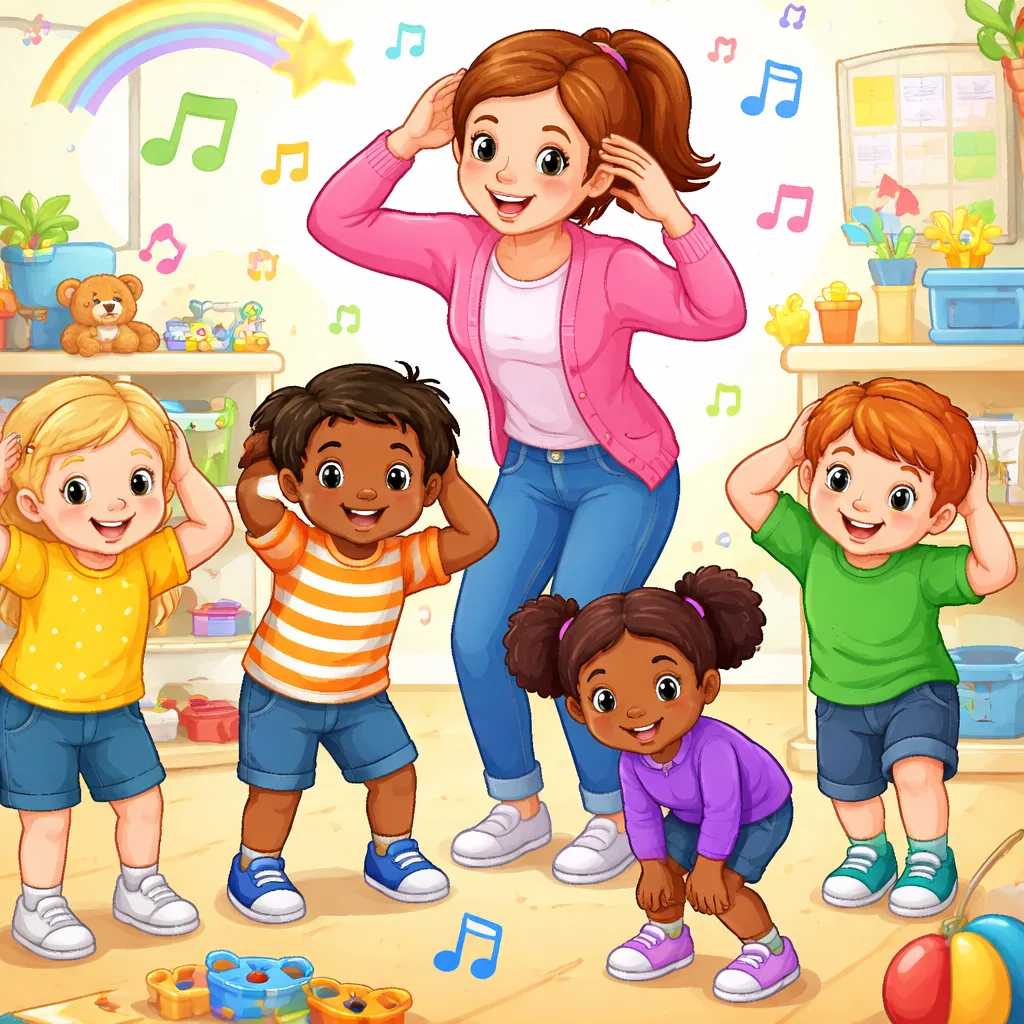

What is the Rhyme "Head, Shoulders, Knees and Toes"?
"Head, Shoulders, Knees and Toes" is an energetic and beloved English nursery rhyme that does more than entertain. It teaches children the names of their body parts through joyful movement. The song follows a simple pattern. It names body parts from the top of the head down to the toes. As children sing, they touch each part. The tempo often speeds up with each repetition, turning the song into a happy challenge. This English song: Head, Shoulders, Knees and Toes turns language learning into a full-body experience. Children do not just hear the words. They feel them through touch and movement. This kinesthetic connection helps the vocabulary stick in young minds in a deep and lasting way.
The Complete Lyrics of the Nursery Rhyme
Let us look at the words together. The verses are very simple. The magic happens when you add the movements.
Head, shoulders, knees, and toes, knees and toes!
Head, shoulders, knees, and toes, knees and toes!
And eyes and ears and mouth and nose!
Head, shoulders, knees, and toes, knees and toes!
Many families enjoy singing it again and again, each time a little faster. Some versions leave out a word each time, touching the part silently. This adds fun and builds memory.
Vocabulary Learning from the Song
This English song: Head, Shoulders, Knees and Toes teaches essential body part vocabulary. These are words children use every day to talk about themselves.
The song names eight body parts. "Head" is at the very top. "Shoulders" are below the neck. "Knees" bend in the middle of our legs. "Toes" are at the very bottom of our feet. Then the song adds "eyes" for seeing, "ears" for hearing, "mouth" for speaking and eating, and "nose" for smelling.
You can build on this vocabulary throughout the day. While dressing, say, "Let's put your shirt over your head." While bathing, say, "I am washing your knees." While playing, say, "Point to your nose." These daily connections reinforce the song's words in real contexts.
The song also teaches singular and plural forms naturally. "Head" is one. "Shoulders" are two. "Knees" are two. "Toes" are many. Children absorb this grammar without any formal lessons.
Phonics Points to Practice
Let us listen for special sounds in the song. Phonics helps children connect letters to the sounds they hear. This English song: Head, Shoulders, Knees and Toes gives us many sounds to explore.
Listen to the "h" sound at the beginning of "head." It is a gentle breath sound. Put your hand in front of your mouth and say "head." Feel the air? Practice other "h" words like "hand," "happy," and "house."
The "sh" sound in "shoulders" is very important. Put your finger to your lips and say "shhh." That is the sound! Practice other "sh" words like "shoe," "ship," and "fish."
Listen to the long "ee" sound in "knees" and "feet." This sound says its own name. You can hear it in words like "bee," "tree," and "green." The "n" in "knees" is silent, which is a special spelling pattern. You can explain that in "knee" and "knife," the "k" is quiet.
The "t" sound at the end of "feet" and "toes" ending with "z" sound gives practice with final consonants. Saying these clearly helps with pronunciation and later spelling.
Grammar Patterns We Can Learn
This action song teaches important grammar in a very natural way. The English song: Head, Shoulders, Knees and Toes introduces nouns and the concept of listing without connecting words.
The song simply lists body parts one after another. "Head, shoulders, knees, and toes." This teaches children how we list items in English. We name each item and put "and" before the last one. You can practice this pattern in daily life. "For lunch we have apples, bananas, and grapes." "At the park we saw swings, slides, and sand."
The song also teaches the conjunction "and" naturally. It appears between "eyes and ears and mouth and nose." Children learn that "and" connects words and ideas. This is a foundation for building longer sentences.
When children touch each part as they sing, they demonstrate comprehension without needing to explain. They understand that each word names a specific body part. This is meaning-based learning at its best.
Learning Activities to Do at Home
Bringing this English song: Head, Shoulders, Knees and Toes into your daily life is simple and joyful. Here are some activities you can try with no special materials needed.
A wonderful activity is the "Slow and Fast" game. Sing the song very slowly, touching each part carefully. Then sing it a little faster. Then faster still. Laugh together when you get tangled up. This builds coordination and listening skills while creating joyful connection.
Another activity is the "Missing Word" challenge. Sing the song but leave out one body part. Touch your head, shoulders, knees, and toes but stay silent for "knees." See if your child notices and fills in the missing word with their touch. This builds memory and active listening.
You can also play "Body Part Detective." Say, "I am touching something on my head. What is it?" Touch your ear. Your child guesses "ear!" Then let your child be the detective and touch a part for you to guess. This builds vocabulary in a playful conversation.
Printable Materials for Learning
Creating simple printables can make this English song: Head, Shoulders, Knees and Toes more visual and engaging. You can make these materials together with your child.
A body parts chart is perfect for this song. Draw a simple outline of a child's body. Together with your child, draw and label the parts from the song. Head at the top. Shoulders. Knees. Toes. Then add eyes, ears, mouth, and nose on the face. Hang the chart where you can see it and sing the song while pointing to each part.
Flashcards are another useful tool. Draw each body part on a separate card. A picture of a head on one card. Shoulders on another. Mix up the cards and ask your child to touch the part shown on each card. This builds word recognition and comprehension.
You can also create a "Body Parts" coloring page. Draw a simple child figure. Let your child color each body part with different colors. "Let's color the head red. Let's color the shoulders blue." This adds color words to your body part practice.
Educational Games for Deeper Learning
Games make learning active and exciting. They encourage children to use the language from the English song: Head, Shoulders, Knees and Toes in new and creative ways.
The "Touch and Name" game builds speed and recognition. Call out a body part. Your child touches it as fast as they can. Then switch roles. Let your child call out parts for you to touch. This game builds listening skills and body awareness. It also gives children the joy of being the leader.
The "New Verses" game expands vocabulary. Ask your child, "What other body parts shall we add?" Maybe "fingers" and "elbows" and "chin." Create a new verse together. "Fingers, elbows, chin, and toes!" Sing your new version with actions. This shows children that they can be creators, not just learners.
The "Mirror Game" builds observation and coordination. Stand facing your child. Sing the song together while touching your parts. Your child watches and copies, like looking in a mirror. Then let your child lead while you copy. This builds attention and creates a sweet connection between you.
The "Body Part Song" for daily routines extends learning. Create simple songs for other times of day. "Shoes, socks, pants, and shirt" for dressing. "Milk, spoon, bowl, and cup" for breakfast. Using the same tune with new words shows children how language patterns can be flexible and fun. This builds confidence and creativity that will serve them well as they grow.