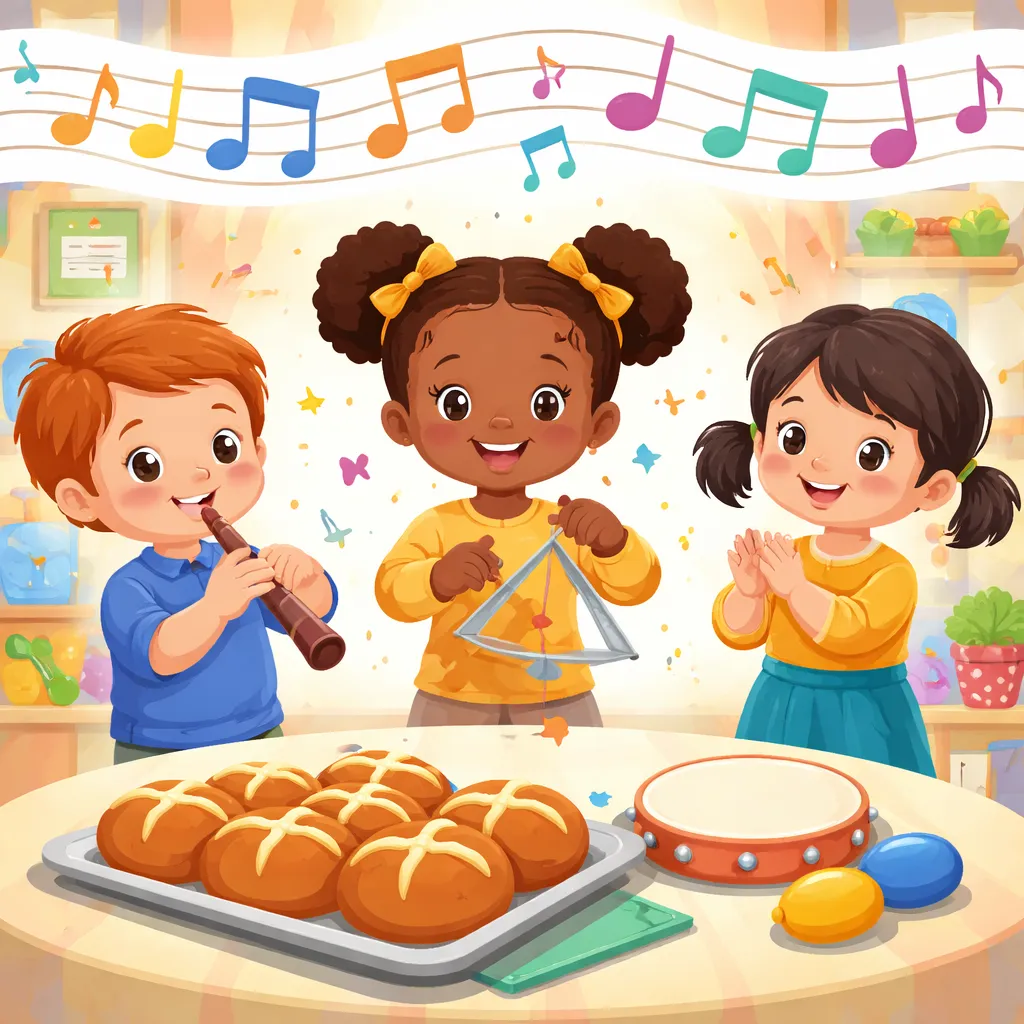

Some songs carry the warmth of fresh bread and happy mornings. The English song: Hot Cross Buns does exactly that. This simple nursery rhyme has been sung by children for hundreds of years. It tells about a spicy treat sold on street corners. For families learning English together, this song offers a wonderful way to explore food words, simple rhymes, and the joy of shared meals. Let us discover what makes this traditional song so special for young learners.
What Is the Story Behind This Famous Song?
The English song: Hot Cross Buns is a traditional nursery rhyme that dates back centuries. Hot cross buns are sweet, spiced buns marked with a cross on top. People traditionally eat them on Good Friday, but bakeries now sell them throughout the spring season.
In old England, street vendors would call out to sell their goods. They sang simple rhymes to attract customers. "Hot cross buns, hot cross buns, one a penny, two a penny" was a real street cry. People would hear this call and come running to buy fresh buns.
The rhyme first appeared in print around 1798. Since then, it has become one of the most famous English nursery rhymes. Children learn it as one of their first songs. The simple three-note melody also serves as the first song many children learn on recorder or piano.
This song teaches children about old traditions and simple economics. One bun costs a penny. Two buns cost two pennies. The math is simple and clear. Understanding this背景 helps families appreciate the song's place in English cultural history.
The Complete Lyrics of the Song
Reading the words helps us understand the song's simple beauty. Here are the lyrics to the English song: Hot Cross Buns. Let us look at them in sections.
Hot cross buns, hot cross buns
One a penny, two a penny
Hot cross buns
If you have no daughters, give them to your sons
One a penny, two a penny
Hot cross buns
Learning New Words from the Song
The English song: Hot Cross Buns introduces several useful words. Let us explore them together.
First, "hot" means having high temperature. These buns are fresh from the oven. Children learn this common adjective that appears everywhere in English.
"Cross" refers to the shape marked on top of the buns. A cross has two lines that intersect. This word also appears in other contexts. "Cross the street" or "don't be cross" meaning angry.
"Buns" are small, round breads. They can be sweet or savory. Hamburger buns are different from hot cross buns, but the word connects them.
The song mentions "a penny". A penny is a small coin. In old England, a penny could buy a bun. Today children learn about money through this song. One penny, two pennies teaches counting and value.
"Daughters" and "sons" are important family words. A daughter is a girl child. A son is a boy child. The song says if you have no daughters, give the buns to your sons. This means share with all children equally.
The song uses the phrase "give them to" which teaches giving and sharing. This is an important social concept for young children.
Exploring Pronunciation and Rhythm
The English song: Hot Cross Buns offers perfect practice with English rhythm. The simple three-note melody makes it easy to feel the beat.
Listen to the opening "Hot cross buns, hot cross buns". The rhythm goes HOT cross BUNS, HOT cross BUNS. The strongest beats fall on "hot" and "buns". Clapping along helps children feel this pattern. English speakers emphasize certain syllables, and songs train our ears to hear them.
The line "One a penny, two a penny" has a different rhythm. ONE a PEN-ny, TWO a PEN-ny. The numbers get the strongest stress. Practicing this line helps children emphasize the right words when speaking.
The repetition in the song builds confidence. Each line comes back to "hot cross buns". Children can master this phrase and feel successful.
Finding Grammar Patterns in the Lyrics
The English song: Hot Cross Buns offers simple grammar examples for young learners. One pattern appears in the counting structure. "One a penny, two a penny" uses "a" to mean "for" or "each". This old usage teaches children how prices were quoted.
The song uses the present simple tense. "Have" in "if you have no daughters" describes a current situation. We use present simple for things that are true now.
Another pattern appears with the conditional "if". "If you have no daughters" introduces a possibility. We use "if" to talk about things that might happen. For example, "If it rains, we stay inside" or "If you're hungry, eat a snack".
The imperative "give" appears in "give them to your sons". This is a command or suggestion. Even in this old song, children learn how to use this important verb form.
The song also uses pronouns. "Them" refers to the buns. "Your" shows possession. These small words appear constantly in English. Learning them through song makes them stick.
Fun Learning Activities for the Whole Family
Listening to the English song: Hot Cross Buns can inspire many family activities. Here are some ideas to try together.
First, bake hot cross buns together. Find a simple recipe online. Read the ingredients and steps in English. "We need flour, sugar, spices, and raisins." "Mix the dough and let it rise." This connects the song to real cooking experience. The kitchen becomes an English classroom.
Second, have a pretend market day. Set up a small shop with play food or real snacks. Practice the street cry from the song. Take turns being the vendor and the customer. "Hot cross buns, one a penny!" "I'll take two, please." This builds conversational skills through play.
Third, practice counting with pennies. Use real or play coins. Count them out while singing. One penny, two pennies, three pennies. This connects the song to math skills. Children learn English numbers while counting real objects.
Creating Printable Materials at Home
Families can make simple learning tools based on the English song: Hot Cross Buns. These activities help reinforce new ideas.
Create bun-shaped flashcards with numbers. Cut circles from brown paper. Write numbers on them from one to ten. Practice counting while singing. "One a penny" hold up one bun. "Two a penny" hold up two buns. This builds number recognition and vocabulary.
Make a family words chart. Draw pictures of daughters and sons. Write the words under each. Count how many daughters and sons in your family. Use sentences like "We have two daughters" or "We have one son". This builds family vocabulary.
Create a fill-in-the-blank page using song lyrics. Remove key words like "hot", "cross", "buns", "penny", "daughters", and "sons". Leave blanks where those words belong. Listen to the song together and fill in the missing words. This builds listening and spelling skills.
Connecting the Song to Daily Life
The English song: Hot Cross Buns connects to daily life through food and family. Food brings people together. This song celebrates a special treat that families share.
Talk with your children about special foods your family enjoys. Do you have treats for holidays or weekends? Use English to describe them. "We eat pancakes on Saturday" or "Grandma makes cookies for us". This connects the song's theme to personal experience.
The song also teaches about sharing. Give buns to daughters and sons equally. In family life, we share everything. Use the song to talk about fairness. "We share the cookies equally" or "Everyone gets one treat".
Parents can model the song's simple economics. When shopping, talk about prices in English. "This costs one dollar" or "These apples are two for a dollar". Children learn real-world language through these conversations.
Educational Games to Play Together
Games make learning with the English song: Hot Cross Buns exciting. Here are some simple games to try.
Play the penny toss game. Place cups or bowls labeled with numbers. Toss pennies and try to land them in the cups. Count how many pennies land in each. Use English sentences. "I got three pennies in the number two cup" or "You got one penny in the number five cup". This builds counting and sentence skills.
Try the bun shop game. One person runs a shop selling hot cross buns. Others come to buy. Use English for the transaction. "How much are your buns?" "One a penny." "I'll take three, please." "That will be three pennies." This builds conversational skills.
Play the family word game. One person says a family word like "mother" or "brother". Others use it in a sentence. "My mother loves hot cross buns" or "My brother wants two buns". This builds vocabulary and sentence construction.
Why This Song Helps English Learning
The English song: Hot Cross Buns helps learners in special ways. The simple vocabulary matches what beginners need. Words like hot, buns, one, two, give, have, daughters, and sons appear in early lessons. Learning them through song makes them easy to recall.
The repetition in the song reinforces key phrases. "Hot cross buns" repeats throughout. "One a penny, two a penny" repeats. Repetition builds memory without effort.
The counting element teaches numbers naturally. Children learn one and two while singing. They can extend this to three, four, and beyond with simple variations.
The connection to food makes learning meaningful. Children care about food. They want to talk about what they eat. This song gives them words for those conversations.
Making Music Part of Your Routine
Families can make songs a regular part of English time. Choose one song each week to explore together. Listen during snack time or while cooking.
The English song: Hot Cross Buns works perfectly for food-related moments. Sing it while baking or eating. Let the song remind everyone of the joy of sharing meals together.
Remember that language learning happens best in warm, cozy moments. When children associate English with fresh buns and family time, they want more. They learn that English is not just lessons. It is the language of kitchen tables and shared treats.
Keep singing, keep baking, and keep sharing the simple joys of language together. In the great kitchen of English learning, every new word is like a fresh bun, warm and sweet and meant to be shared.