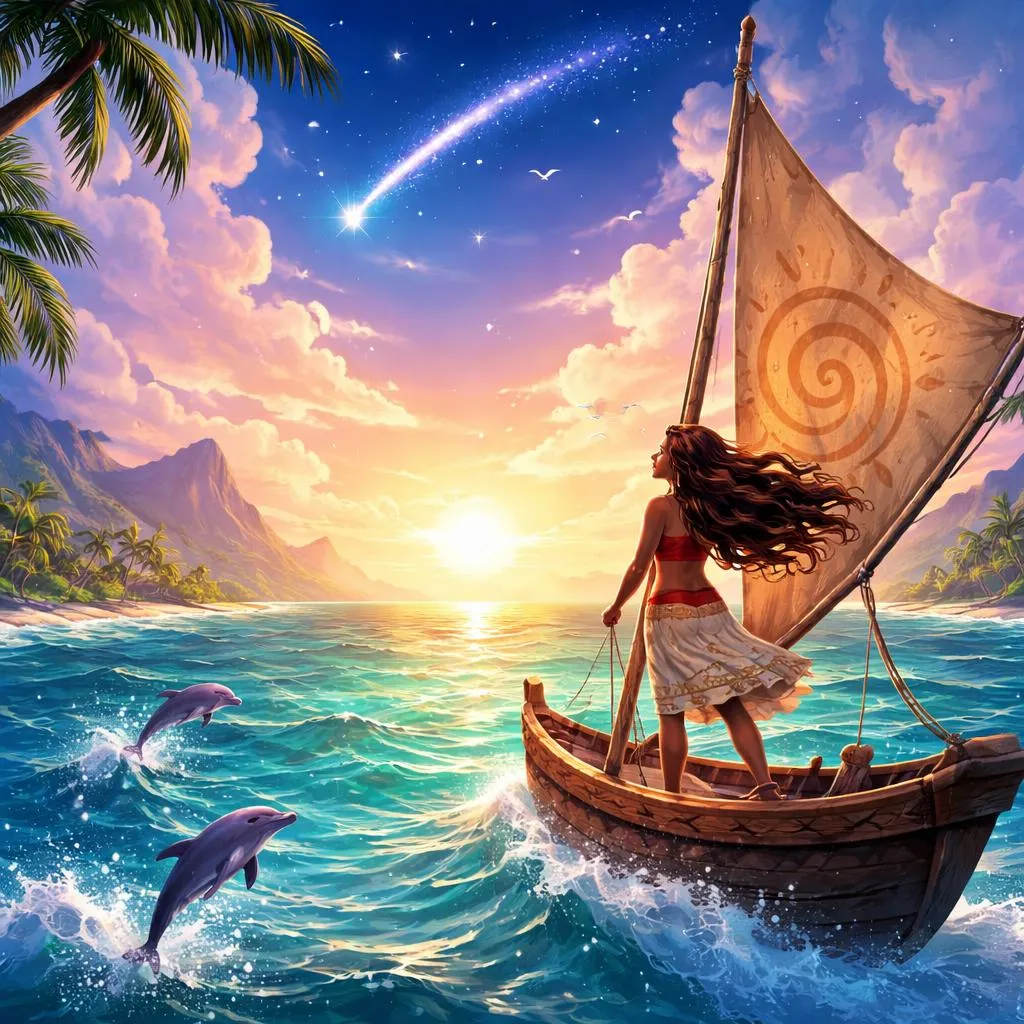

What is the Story Behind "How Far I'll Go" from Moana?
"How Far I'll Go" is the inspiring song from Disney's Moana that captures the heart of the entire movie. Moana sings it as she feels pulled toward the ocean, even though her father wants her to stay safe on the island. The English song: How Far I'll Go expresses her longing to discover what lies beyond the reef. Moana loves her people and her home, but something inside her keeps calling her to the sea. The song is about that feeling we all get sometimes—the desire to explore, to find our purpose, to see how far we can go. Children connect deeply with Moana's journey of self-discovery. The beautiful melody and powerful lyrics teach about courage, following your heart, and honoring who you truly are.
The Complete Lyrics of the Song
Let us look at some key parts of the song. The lyrics tell Moana's inner struggle.
I've been staring at the edge of the water
Long as I can remember, never really knowing why.
I wish I could be the perfect daughter,
But I come back to the water, no matter how hard I try.
Every turn I take, every trail I track,
Every path I make, every road leads back
To the place I know, where I cannot go,
Where I long to be.
See the line where the sky meets the sea? It calls me.
And no one knows, how far it goes.
If the wind in my sail on the sea stays behind me,
One day I'll know, how far I'll go.
Vocabulary Learning from the Song
This English song: How Far I'll Go (from Moana) introduces children to beautiful words about the ocean, dreams, and inner feelings. Each word builds their understanding of language and emotions.
First, the song teaches about the "ocean" and "sea." The ocean is the big body of water that covers much of our planet. Moana feels drawn to it. You can talk about the ocean with your child. Have you ever seen the ocean? What lives in it?
The song uses the phrase "edge of the water." This means the shoreline, where the land meets the sea. Moana has been looking at this line her whole life.
Moana sings about being "the perfect daughter." This means doing what her parents want, staying safe on the island. Many children understand wanting to make their parents happy.
The song teaches about following dreams. "How far I'll go" means how much can I achieve? How far can my dreams take me? This is a powerful concept for children.
"The line where the sky meets the sea" is the horizon. It's beautiful and mysterious. It calls to Moana, pulling her toward adventure.
Phonics Points to Practice
Let us listen for special sounds in the song. Phonics helps children connect letters to the sounds they hear. This English song: How Far I'll Go (from Moana) gives us many sounds to explore.
Listen to the "h" sound at the beginning of "how" and "far." It is a gentle breath sound. Put your hand in front of your mouth and say "how far." Feel the air. Practice other "h" words like "happy," "house," and "hello."
The "f" sound appears in "far." It is made by putting top teeth on bottom lip and blowing air. Practice other "f" words like "fish," "fun," and "family."
Listen to the "g" sound in "go." It is made at the back of the throat. Practice other "g" words like "game," "garden," and "good."
The "s" sound in "sea" and "sky" is a soft sound made by pushing air through the teeth. Practice other "s" words like "sun," "sing," and "see."
The long "i" sound in "I'll" and "sky" and "sea" has different vowels but "I'll" gives us the long "i." You can hear it in words like "kite," "bike," and "my."
Grammar Patterns We Can Learn
This dream song teaches important grammar in a very natural way. The English song: How Far I'll Go (from Moana) introduces future tense, questions, and the phrase "how far."
The song uses future tense. "I'll know" means "I will know." "How far I'll go" means "how far I will go." This teaches children how to talk about the future. You can practice using future tense. "I'll see you tomorrow." "We'll go to the park." "You'll be great!"
The song asks implicit questions. "How far I'll go" is really wondering about the future. You can practice asking "how" questions. "How high can you jump?" "How fast can you run?" "How far can you throw?"
The phrase "the place where I cannot go" uses "where" to describe a location. You can practice using "where." "This is the park where we play." "That's the store where we buy milk."
Learning Activities to Do at Home
Bringing this English song: How Far I'll Go (from Moana) into your daily life is simple and joyful. Here are some activities you can try with materials you already have.
A wonderful activity is the "Horizon Drawing" art project. Give your child paper and crayons. Draw the line where the sky meets the sea. Add a boat, the sun, and maybe Moana on the shore. Talk about what might be beyond the horizon. This builds creativity and imagination.
Another activity is the "Dream Discussion." Ask your child, "What do you dream about? What do you wonder about?" Listen without judgment. Share your own dreams too. This builds emotional connection and validates their inner world.
You can also have a "Boat Craft" activity. Make a simple boat from foil, clay, or paper. Float it in water. Talk about how Moana sailed across the ocean. Where would your boat go? This builds creativity and fine motor skills.
Printable Materials for Learning
Creating simple printables can make this English song: How Far I'll Go (from Moana) more visual and engaging. You can make these materials together with your child.
Horizon cards help with the song's imagery. Draw different horizon scenes. Ocean meeting sky at sunrise, sunset, with clouds, with stars. Talk about how the horizon always calls us forward.
A coloring page is always popular. Draw Moana standing at the edge of the water, looking out at the horizon. Add a boat and the ocean. Let your child color the scene. Write "How Far I'll Go" at the top. Display their artwork proudly.
You can also create simple word cards. Write key words from the song on cards. "Water," "edge," "remember," "perfect," "daughter," "path," "road," "place," "sky," "sea," "wind," "sail," "far," "go." Show each card as you sing that word. This builds early reading skills.
A dream journal helps children explore their own dreams. Each day, draw or write about a dream or wonder. What do you wonder about today?
Educational Games for Deeper Learning
Games make learning active and exciting. They encourage children to use the language from the English song: How Far I'll Go (from Moana) in new and creative ways.
The "My Dreams" game encourages self-expression. Ask your child, "What is something you really want to do?" Draw a picture of that dream. Write or dictate a sentence about it. This builds goal-setting and self-awareness.
The "Ocean Exploration" game builds science knowledge. Learn about the ocean. What lives there? How deep is it? Why is it salty? Watch videos of ocean creatures. This builds curiosity about the natural world.
The "Perfect Daughter" discussion explores family expectations. Moana wanted to be the perfect daughter but also follow her heart. Talk about balancing what others want with what you want. This builds emotional intelligence.
The "Horizon Walk" is a simple outdoor activity. Go for a walk and look at the horizon. Notice how it always seems far away. Talk about how horizons remind us there is always more to discover.
The "Boat Racing" game adds friendly competition. Make simple boats from foil or paper. Race them in a tub of water. Blow on them to make them move. Who's boat goes farthest? This builds engineering thinking and fun.
The "Island Life" discussion explores different ways of living. Moana lived on an island. How is that different from where you live? What would it be like? This builds cultural awareness.
The "Wind in My Sail" metaphor helps children understand support. What gives you "wind in your sail"? Encouragement from family? Believing in yourself? This builds understanding of motivation.
The "How Far Challenge" sets small goals. How far can you jump? How far can you throw? How far can you walk? Measure and celebrate progress. This builds math skills and self-confidence.