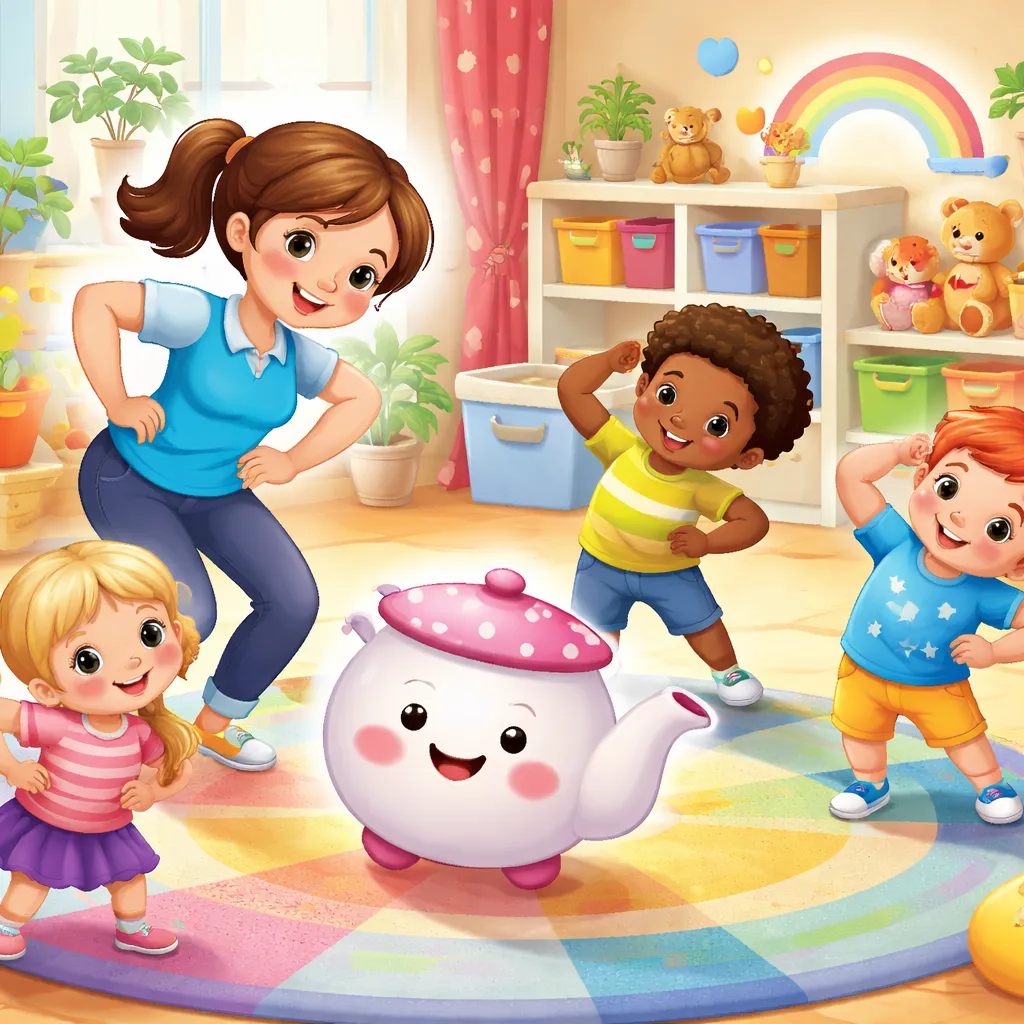

What is the Rhyme "I'm a Little Teapot"?
"I'm a Little Teapot" is a playful and beloved English nursery rhyme that combines singing with movement. The song imagines a child becoming a little teapot. They stand with one hand on their hip like a handle and the other arm bent like a spout. When it is time to pour, they tip to one side. The English song: I'm a Little Teapot has delighted children for generations. It teaches body awareness through simple actions. Children learn to identify their own hands, arms, and hips as teapot parts. The song builds coordination as they tip and pour. The cheerful tune makes everyone want to join in. This song turns a simple kitchen object into a fun game that gets children moving and laughing.
The Complete Lyrics of the Nursery Rhyme
Let us look at the words together. The song is short and easy to remember.
I'm a little teapot, short and stout,
Here is my handle, here is my spout.
When I get all steamed up, hear me shout,
"Tip me over and pour me out!"
Vocabulary Learning from the Song
This English song: I'm a Little Teapot introduces children to words about kitchen objects, body parts, and actions. Each word builds their understanding of language and the world.
First, the song teaches about a "teapot." A teapot is a container used to make and pour tea. It has a handle to hold and a spout to pour from. You can show your child a real teapot if you have one. Let them see the handle and spout. This connects the song to a real object.
The words "short and stout" describe the teapot's shape. Short means not tall. Stout means wide and solid. You can talk about other things that are short and stout. A little bear. A chubby pumpkin. This builds descriptive vocabulary.
The song teaches body parts in a playful way. "Here is my handle" means put one hand on your hip. "Here is my spout" means extend the other arm like a spout. Children learn to connect words to physical positions.
Action words appear in the song. "Steamed up" means getting hot inside. "Shout" means calling out loudly. "Tip me over" means tilting to one side. "Pour me out" means letting liquid flow out. These verbs come alive through the actions.
Phonics Points to Practice
Let us listen for special sounds in the song. Phonics helps children connect letters to the sounds they hear. This English song: I'm a Little Teapot gives us many sounds to explore.
Listen to the long "i" sound in "I'm" and "little" has a short "i" but "I'm" gives us the long "i." It says its own name. You can hear it in words like "ice," "kite," and "my."
The "t" sound appears in "teapot" and "little" and "stout." It is a quick sound made with the tongue behind the teeth. Practice other "t" words like "toy," "table," and "tickle."
Listen to the "sh" sound in "short" and "shout." Put your finger to your lips and say "shhh." That is the sound! Practice other "sh" words like "shoe," "ship," and "fish."
The "sp" blend in "spout" is important. Say "spout" slowly. First the "s," then quickly the "p." Practice other "sp" words like "spoon," "spin," and "spot."
The "ou" sound in "stout" and "shout" and "out" is a diphthong. You can hear it in words like "house," "mouse," and "cloud."
Grammar Patterns We Can Learn
This action song teaches important grammar in a very natural way. The English song: I'm a Little Teapot introduces contractions, imperatives, and descriptive adjectives.
The song begins with "I'm," which is a contraction for "I am." This teaches children how we join words together in speaking. You can practice using contractions in daily life. "I'm hungry." "You're funny." "We're playing." This builds natural spoken English.
The song uses descriptive adjectives. "Little" describes size. "Short" describes height. "Stout" describes shape. These words help children describe things. You can practice using adjectives throughout the day. "See the big dog." "Feel the soft blanket." "Look at the round ball."
The phrase "tip me over" is an imperative, telling someone to do something. Children hear imperatives all day. "Come here." "Sit down." "Eat your lunch." The song adds a playful imperative to the mix.
Learning Activities to Do at Home
Bringing this English song: I'm a Little Teapot into your daily life is simple and joyful. Here are some activities you can try with materials you already have.
A wonderful activity is the "Teapot Pose" itself. Stand up with your child. Put one hand on your hip to be the handle. Extend the other arm out with your wrist bent down to be the spout. When the song says "tip me over," lean to the side like you are pouring. Do it together and laugh when you almost tip over. This builds coordination and body awareness.
Another activity is the "Real Teapot" exploration. If you have a teapot, bring it out during snack time. Let your child hold it. Find the handle and spout. Talk about how tea is made. Pour warm (not hot) water into cups. This connects the song to a real-life experience.
You can also have a "Tea Party" pretend play. Use a toy teapot or a regular one. Set out cups and pretend to pour tea for stuffed animals. Sing the song while you pour. This builds imagination and social skills.
Printable Materials for Learning
Creating simple printables can make this English song: I'm a Little Teapot more visual and engaging. You can make these materials together with your child.
A teapot coloring page is perfect. Draw a simple teapot shape with a handle and spout. Add steam coming out. Let your child color it. Write "I'm a Little Teapot" at the top. Display their artwork proudly.
Body position cards help with the actions. Draw simple stick figures showing the teapot pose. One card for standing ready. One card for tipped over pouring. Your child can look at the cards and practice the poses. This builds visual comprehension and body awareness.
You can also create simple word cards. Write words from the song on cards. "Teapot," "short," "stout," "handle," "spout," "steamed," "shout," "tip," "pour." Show each card as you sing that word. This builds early reading skills in a gentle, supportive way.
A matching game pairs body parts with teapot parts. Draw a hand on one card and a teapot handle on another. Draw an arm on one card and a teapot spout on another. Your child matches the body part to the teapot part. This builds understanding of the comparison in the song.
Educational Games for Deeper Learning
Games make learning active and exciting. They encourage children to use the language from the English song: I'm a Little Teapot in new and creative ways.
The "New Kitchen Objects" game encourages creativity. Ask your child, "What if you were a different kitchen object?" A frying pan? A mixing bowl? A coffee cup? Create new verses and poses together. "I'm a little frying pan, round and flat, here is my handle, here is my spatula. When I get all heated up, hear me sizzle, flip the pancake and watch it drizzle!" This shows children how to extend the pattern.
The "Temperature Game" explores hot and cold. Talk about what "steamed up" means. The teapot gets hot inside. Practice showing hot and cold with your body. Shiver for cold. Fan yourself for hot. Make steaming sounds. This builds understanding of temperature concepts.
The "Pouring Practice" game uses real water. Give your child a small pitcher or cup and a larger container. Practice pouring water carefully from one to another. Talk about how the teapot pours. This builds fine motor skills and connects to the song.
The "Sound Effects" game adds fun sounds. Make a whistling sound for the steam. Make a pouring sound for the water. Make a tipping sound effect when you tip over. This builds vocal play and creativity.
The "Follow the Leader" game uses the teapot pose. Take turns being the leader. The leader does the teapot pose and the others copy. The leader can add variations. Tilt to one side. Tilt to the other. Steam up slowly. This builds observation and coordination.
The "Teapot Parade" adds movement. March around the room in teapot pose. When the leader shouts "tip me over," everyone tips and pours. Then march again. This builds gross motor skills and listening.
The "Opposite Game" explores opposites from the song. Short and tall. Hot and cold. Pour in and pour out. Handle and spout are different parts. Talk about opposites while playing. This builds vocabulary through contrast.
The "Tea Party Manners" conversation extends learning. When we have tea, we use good manners. Please and thank you. Passing carefully. Sipping gently. Practice tea party manners while playing. This builds social skills in a fun context.
The "Bedtime Wind-Down" uses a gentle version of the song. Sing it softly and do the movements slowly at the end of the day. This transitions from active play to calm rest while keeping the joy of the song alive.