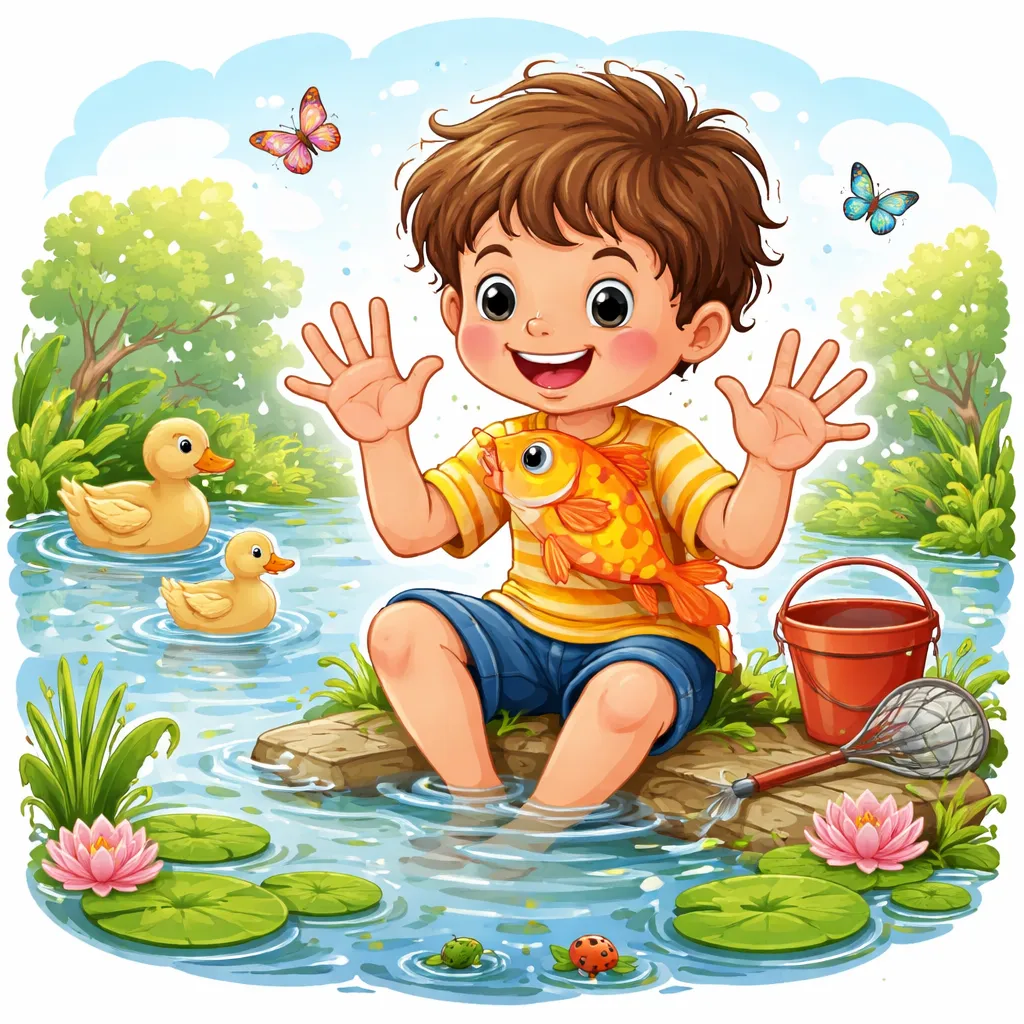

What is the Rhyme "Once I Caught a Fish Alive"?
"Once I Caught a Fish Alive" is a delightful English nursery rhyme that combines counting with finger play. The song tells the story of catching a fish and holding it, then letting it go again. The little finger gets bitten! The English song: Once I Caught a Fish Alive has been loved by children for generations. The simple counting from one to ten is easy to remember. The finger play adds a physical element that children adore. Holding up fingers to count, then wiggling the little finger at the end makes everyone giggle. This rhyme teaches numbers, sequencing, and body awareness all in one playful package. The image of a fish biting a finger is silly enough to make children laugh every time.
The Complete Lyrics of the Nursery Rhyme
Let us look at the words together. The rhyme is short and easy to learn.
One, two, three, four, five,
Once I caught a fish alive.
Six, seven, eight, nine, ten,
Then I let it go again.
Why did you let it go?
Because it bit my finger so.
Which finger did it bite?
This little finger on my right.
Vocabulary Learning from the Song
This English song: Once I Caught a Fish Alive introduces children to number words, action words, and body parts. Each word builds their understanding of language and the world.
First, the song teaches number words from one to ten. Children hear them in order, which helps with memorization. Counting forward is an important early math skill.
The song teaches about "caught." This means catching something, like a fish. "Let it go" means releasing it again. These action words help children describe events.
A "fish" is an animal that lives in water. You can show your child pictures of fish or visit an aquarium. Talk about where fish live and what they need.
The song teaches body parts. "Finger" is the most important word. "This little finger" means the smallest finger, the pinky. "On my right" tells which hand. You can practice identifying fingers and left and right hands.
The question "Why did you let it go?" teaches question words and answers. "Because it bit my finger so" gives the reason. This simple conversation pattern helps children understand questions and answers.
Phonics Points to Practice
Let us listen for special sounds in the song. Phonics helps children connect letters to the sounds they hear. This English song: Once I Caught a Fish Alive gives us many sounds to explore.
Listen to the "f" sound in "five" and "fish." It is made by putting top teeth on bottom lip and blowing air. Say "five fish" slowly. Feel the air. Practice other "f" words like "fun," "family," and "finger."
The "b" sound appears in "bit" and "because." It is a strong sound made by pressing lips together. Practice other "b" words like "ball," "book," and "baby."
Listen to the "c" sound in "caught" and "came" but here it is "caught." It is made at the back of the throat. Practice other "c" words like "cat," "cake," and "car."
The "l" sound in "let" and "little" is a light sound made with the tongue touching the roof of the mouth. Practice other "l" words like "lamb," "leaf," and "lullaby."
The "r" sound in "right" and "finger" has an "r" in the middle but "right" gives us the beginning "r." Practice other "r" words like "rabbit," "red," and "run."
Grammar Patterns We Can Learn
This finger play song teaches important grammar in a very natural way. The English song: Once I Caught a Fish Alive introduces past tense verbs, question and answer patterns, and conjunctions.
The song uses past tense. "Once I caught a fish alive." "I let it go." "It bit my finger." These are all past tense verbs. You can talk about past events in daily life. "You caught a ball." "I let the dog out." "The bug bit me."
The song uses a question and answer pattern. "Why did you let it go?" "Because it bit my finger so." "Which finger did it bite?" "This little finger on my right." This teaches children how to ask and answer questions. You can practice this pattern. "Why are you happy? Because we are playing!" "Which toy do you want? This little car!"
The word "because" gives a reason. It connects two ideas. You can practice using "because" in daily life. "We are eating because we are hungry." "I am happy because you are here."
Learning Activities to Do at Home
Bringing this English song: Once I Caught a Fish Alive into your daily life is simple and joyful. Here are some activities you can try with materials you already have.
A wonderful activity is the "Finger Play" itself. Hold up your fingers as you count from one to five. Pretend to catch a fish. Then count from six to ten on your other hand. When you get to the question, wiggle your little finger. Let your child wiggle their little finger too. This builds fine motor skills and body awareness.
Another activity is the "Fishing Game." Make a simple fishing rod from a stick, string, and a magnet. Cut out paper fish and attach paper clips. Go fishing together. Count how many fish you catch. Then let them go again. This brings the song to life through active play.
You can also have a "Right and Left" practice. Help your child learn which hand is right and which is left. Put a small sticker on their right hand to help them remember. Practice holding up the right little finger when the song asks.
Printable Materials for Learning
Creating simple printables can make this English song: Once I Caught a Fish Alive more visual and engaging. You can make these materials together with your child.
Number cards from one to ten are essential. Write each number on a separate card. As you sing, hold up the correct number. This builds number recognition.
A coloring page is always popular. Draw a child holding a fish, with numbers one to ten around them. Add a little finger highlighted. Let your child color the scene. Write "Once I Caught a Fish Alive" at the top. Display their artwork proudly.
You can also create simple word cards. Write words from the song on cards. "One," "two," "three," "four," "five," "caught," "fish," "alive," "six," "seven," "eight," "nine," "ten," "let," "go," "why," "because," "bit," "finger," "right." Show each card as you sing that word. This builds early reading skills.
A right hand coloring page helps with left-right discrimination. Draw an outline of a right hand. Label the fingers. Point to the little finger. Your child can color the little finger a special color.
Educational Games for Deeper Learning
Games make learning active and exciting. They encourage children to use the language from the English song: Once I Caught a Fish Alive in new and creative ways.
The "New Animal" game encourages creativity. Ask your child, "What if you caught something different?" A frog? A bug? A bird? Create new verses. "One, two, three, four, five, once I caught a frog alive. Six, seven, eight, nine, ten, then I let it go again. Why did you let it go? Because it jumped away you know!" This shows children how to adapt the pattern.
The "Which Finger?" game practices finger names. Hold up different fingers and ask, "Which finger is this?" Teach thumb, pointer, middle, ring, little. This builds body part vocabulary.
The "Counting Catch" game practices numbers. Throw a soft ball or toy back and forth. Count each catch. Try to catch ten times. This builds coordination and counting skills.
The "Because Game" practices reasoning. Ask your child "why" questions and encourage them to answer with "because." "Why are you wearing a coat?" "Because it is cold outside." This builds language and thinking skills.
The "Left and Right Dance" adds movement. Play music and call out "right hand" or "left foot." Your child moves that body part. This builds body awareness and following directions.
The "Fish Craft" is a fun project. Make paper plate fish. Decorate them with scales. Use them in the fishing game. This builds creativity and fine motor skills.
The "Ocean Life" conversation extends learning. Talk about where fish live. What do they eat? What other animals live in the ocean? This builds science knowledge.
The "Biting Finger" drama is silly fun. Pretend a fish bites your finger. Act surprised. Let your child pretend to be the fish. This builds imagination and social play.