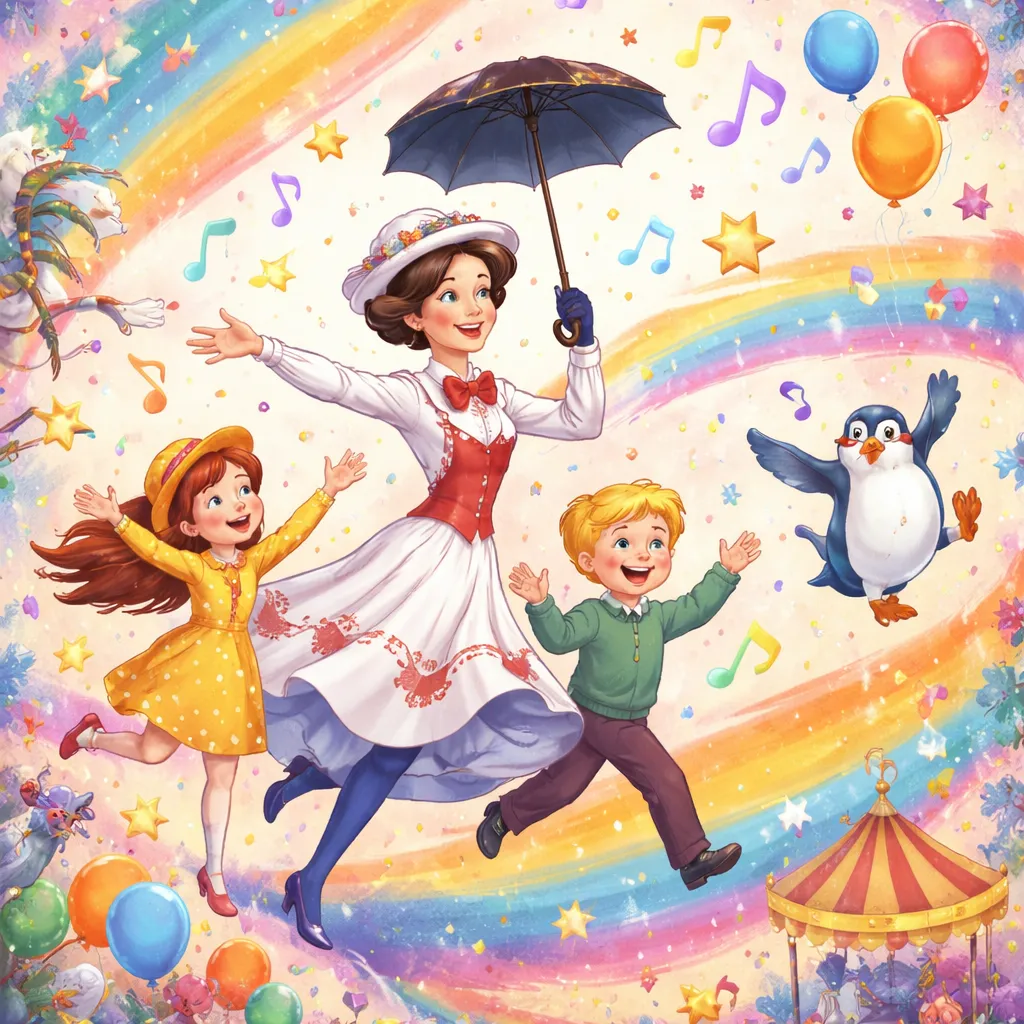

Some words make us smile just by hearing them. The English song: Supercalifragilisticexpialidocious (from Mary Poppins) does exactly that. This famous word and song come from the beloved movie about the magical nanny who visits the Banks family in London. The song celebrates a word so long and playful that it feels like a game. For families learning English together, this song offers a joyful way to explore sounds, syllables, and the pure fun of language. Let us discover how this playful tune can brighten your family's English journey.
What Is the Story Behind This Famous Song?
The English song: Supercalifragilisticexpialidocious (from Mary Poppins) appears in the 1964 Disney film Mary Poppins. Julie Andrews plays the magical nanny, and Dick Van Dyke plays Bert the chimney sweep. In the movie, Mary Poppins takes the children, Jane and Michael, to visit her uncle, Mr. Dawes Sr. He floats in the air because of his laughter. During this visit, they sing about this extraordinary word.
The song explains that when you have nothing good to say, you can use this long word instead. It sounds impressive, and it makes people smile. The word itself has no real meaning. It exists purely for fun. The Sherman Brothers, Richard and Robert, wrote this song. They created a word that children around the world love to try and say. The song teaches us that language can be playful. We do not always need serious words. Sometimes we can invent new ones just for the joy of it.
The Complete Lyrics of the Song
Reading the lyrics helps us appreciate the song's cleverness. Here are the words to the English song: Supercalifragilisticexpialidocious (from Mary Poppins). Let us look at them in sections.
Um diddle diddle diddle um diddle ay
Um diddle diddle diddle um diddle ay
Because I was afraid to speak when I was just a lad
Me father gave me nose a tweak and told me I was bad
But then one day I learned a word that saved me achin' nose
The biggest word you ever heard and this is how it goes
Oh, supercalifragilisticexpialidocious
Even though the sound of it is something quite atrocious
If you say it loud enough, you'll always sound precocious
Supercalifragilisticexpialidocious
Um diddle diddle diddle um diddle ay
Um diddle diddle diddle um diddle ay
He traveled all around the world and everywhere he went
He'd use his word and all would say there goes a clever gent
When dukes or maharajas pass the time of day with me
I say me special word and then they ask me out to tea
Oh, supercalifragilisticexpialidocious
Even though the sound of it is something quite atrocious
If you say it loud enough, you'll always sound precocious
Supercalifragilisticexpialidocious
Um diddle diddle diddle um diddle ay
Um diddle diddle diddle um diddle ay
So when the cat has got your tongue, there's no need for dismay
Just summon up this word and then you've got a lot to say
But better use it carefully or it could change your life
For example, yes I once met a girl who sent me to a wife
Oh, supercalifragilisticexpialidocious
Even though the sound of it is something quite atrocious
If you say it loud enough, you'll always sound precocious
Supercalifragilisticexpialidocious
Um diddle diddle diddle um diddle ay
Um diddle diddle diddle um diddle ay
Learning the Big Word and Its Parts
The English song: Supercalifragilisticexpialidocious (from Mary Poppins) centers on one enormous word. Let us break it down into smaller pieces. This makes it easier to say and remember.
The word has fourteen syllables. We can split it like this: Su-per-cal-i-frag-il-is-tic-ex-pi-al-i-do-cious. Practicing each part slowly helps children master the whole word.
Some people think the word comes from real parts. "Super" means above or beyond. "Fragilistic" might come from fragile, meaning delicate. "Expiali" could connect to expiate, which means to make amends. "Docious" might relate to docile, meaning teachable. Together, these pieces suggest something like "atoning for educability through delicate beauty". But really, the word has no official meaning. It exists to make us smile.
The song also uses the word "atrocious". This means very bad or unpleasant. The song jokes that the big word sounds quite atrocious, but we love it anyway. Another fun word is "precocious". This describes a child who shows advanced abilities at a young age. The song says using this big word makes you sound precocious.
Exploring Pronunciation and Rhythm
The English song: Supercalifragilisticexpialidocious (from Mary Poppins) offers wonderful practice with English rhythm. The song moves quickly in some parts and slowly in others. This helps learners feel the natural beat of the language.
Listen to the repeated line "Um diddle diddle diddle um diddle ay". This has no real meaning. It is scat singing, like jazz musicians use. But it teaches the rhythm of English syllables. The pattern of stressed and unstressed sounds helps children feel how English flows.
The big word itself has a clear rhythm. Say it slowly: Su-per-ca-li-fra-gi-lis-ti-ex-pi-a-li-do-cious. Some syllables are stronger than others. The strongest stress falls on "docious" at the end. Practicing this rhythm builds confidence with longer words.
The song also plays with sounds. The "f" and "s" sounds repeat throughout. This alliteration makes the word fun to say. Children love the way their mouths move when pronouncing these sounds.
Finding Grammar Patterns in the Lyrics
The English song: Supercalifragilisticexpialidocious (from Mary Poppins) offers chances to explore grammar too. One clear pattern appears in the line "I was afraid to speak". This uses the past tense of "to be" with an adjective. "Was" tells us this happened before. We use this structure to describe past feelings. For example, "I was happy" or "She was tired".
The song also uses the past continuous. "Me father gave me nose a tweak" uses simple past. But the story describes things happening over time. This helps children see how we tell stories about the past.
Another pattern appears in conditional sentences. "If you say it loud enough, you'll always sound precocious" uses an if-clause. The first part describes a condition. The second part describes the result. We use this structure all the time. For example, "If you practice, you will learn" or "If we listen, we will understand".
The song also uses the imperative form. "Just summon up this word" gives a command or suggestion. We use this form to encourage or instruct. It appears often in songs and stories.
Fun Learning Activities for the Whole Family
Listening to the English song: Supercalifragilisticexpialidocious (from Mary Poppins) can inspire many playful activities. Here are some ideas to try together.
First, have a word-building challenge. Take the big word and see how many smaller words you can find inside it. Words like "super", "calm", "rag", "list", "tic", and "docile" might appear. Write them down and celebrate each discovery. This builds spelling and word recognition skills.
Second, try a syllable stomp game. Say the big word slowly. Take turns stomping your feet for each syllable. Su-per-ca-li-fra-gi-lis-ti-ex-pi-a-li-do-cious. This connects movement with language learning. Children remember better when they move while learning.
Third, invent your own long word together. Think of a feeling or idea you want to express. Combine real word parts to make something new. Write it down and practice saying it. Create a song or chant for your new word. This builds creativity and confidence with language.
Creating Printable Materials at Home
Families can make simple learning tools based on the English song: Supercalifragilisticexpialidocious (from Mary Poppins). These activities help reinforce new skills.
Create a syllable puzzle. Write the big word on a long strip of paper. Cut it between each syllable. Mix up the pieces and put them back in order. This builds awareness of word structure and spelling patterns.
Make a word search puzzle using words from the song. Include words like "super", "father", "nose", "word", "sound", and "loud". Finding these words in a puzzle builds reading skills in a fun way.
Create a pronunciation practice card. Write the big word with syllable breaks. Practice saying it faster each time. Time yourselves to see who can say it fastest while still saying it clearly. This builds oral fluency and confidence.
Connecting the Song to Daily Life
The English song: Supercalifragilisticexpialidocious (from Mary Poppins) teaches us that language can be playful. In daily life, we can embrace this playfulness. When children struggle to find words, remind them of this song. Sometimes we can invent words or use silly sounds to express ourselves.
The song also teaches us not to take ourselves too seriously. Language learning involves making mistakes. We might pronounce words wrong or forget vocabulary. That is okay. The Mary Poppins word reminds us to laugh and keep trying.
Parents can model this playful attitude. When you encounter a long word while reading, break it into syllables together. Celebrate when anyone says a difficult word correctly. Use the big word from the song as a fun greeting or goodbye. "Supercalifragilisticexpialidocious" can mean "hello" or "good job" in your family.
Educational Games to Play Together
Games make learning with the English song: Supercalifragilisticexpialidocious (from Mary Poppins) exciting. Here are some simple games to try.
Play the tongue twister challenge. Take turns saying the big word three times fast. See who can say it most clearly. Then try other tongue twisters like "She sells seashells" or "Peter Piper picked peppers". This builds pronunciation skills through friendly competition.
Try a word race game. Set a timer for one minute. See how many times each person can say the big word correctly. Count each clear attempt. This builds speed and accuracy with difficult sounds.
Play the sound game. Take the "um diddle diddle" part of the song. Create new silly syllables to replace it. Sing your new versions together. This builds phonological awareness and creativity with sounds.
Why This Song Helps English Learning
The English song: Supercalifragilisticexpialidocious (from Mary Poppins) helps language learners in special ways. The playful nature reduces anxiety. When we laugh, we learn better. The song creates a safe space for trying difficult sounds.
The song also builds phonological awareness. Breaking long words into syllables helps children understand how English works. They learn that even big words are just small pieces put together. This skill helps with reading and spelling.
The repetition in the song reinforces learning. The big word appears many times. Each repetition strengthens memory. By the end of the song, most listeners can say at least part of the word. This builds confidence for tackling other difficult words.
Making Music Part of Your Routine
Families can make playful songs a regular part of English learning. Choose one fun song each week to explore. Listen during car rides or while doing chores. Sing along and laugh together.
The English song: Supercalifragilisticexpialidocious (from Mary Poppins) can become a family favorite. After you master it, explore other playful songs from movies or children's albums. Each song adds new sounds and words to your family's collection.
Remember that language learning thrives on joy. When children associate English with laughter and play, they want to learn more. Celebrate every attempt to say difficult words. Clap for successes and laugh together at mistakes. The Mary Poppins word teaches us the most important lesson of all. Language is not just for communicating. It is for playing, connecting, and sharing joy. Keep singing, keep laughing, and keep enjoying the wonderful sounds of English together.