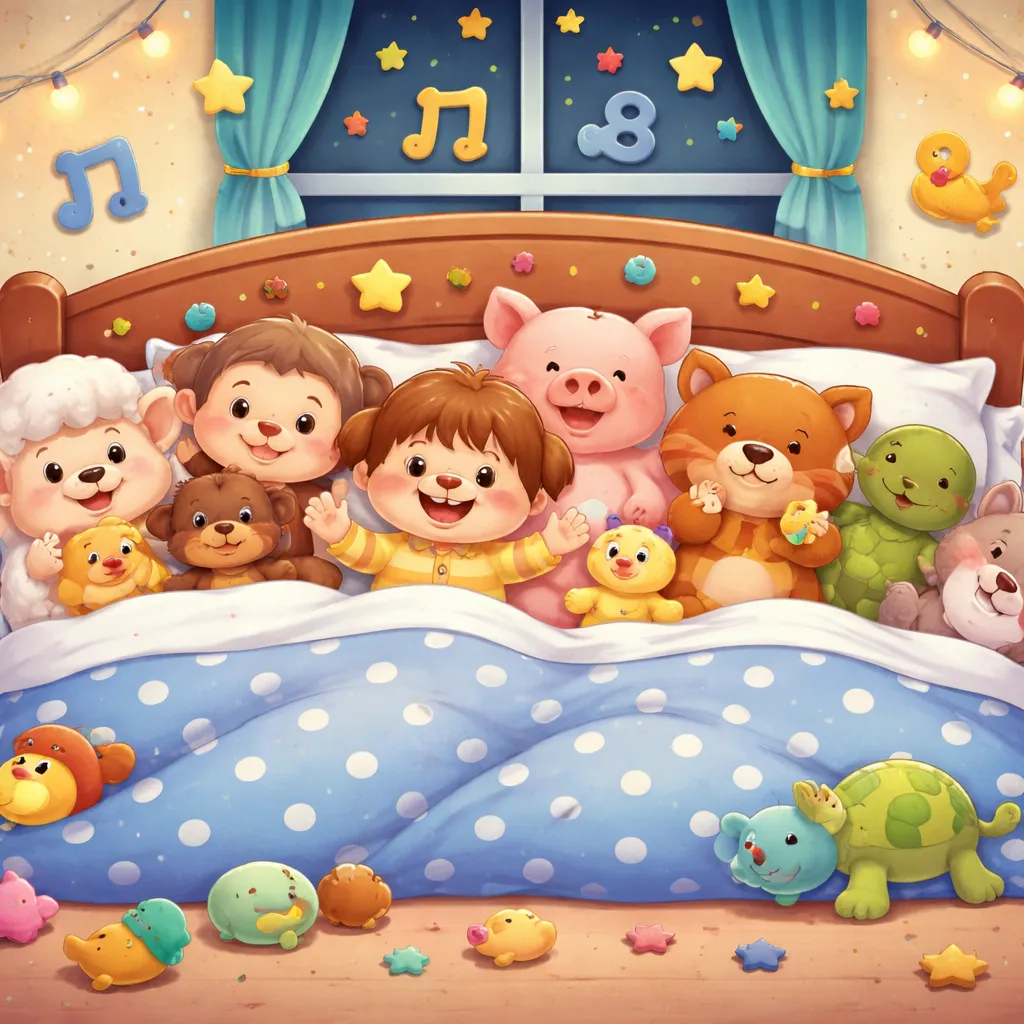

What is the Rhyme "Ten in the Bed"?
"Ten in the Bed" is a playful and popular English nursery rhyme that helps children learn to count backward. The song tells the story of ten children or toys in a bed. One by one, they roll over and fall out until only one is left. The little one says, "Good night!" The English song: Ten in the Bed has been loved by generations of children. The repetitive pattern makes it easy to learn and join in. Children love the gentle counting down from ten to one. The idea of rolling over and falling out of bed is silly and fun. The ending with "good night" makes it perfect for bedtime. This rhyme turns counting practice into a joyful game that children want to play again and again.
The Complete Lyrics of the Nursery Rhyme
Let us look at the words together. The song counts down from ten to one.
There were ten in the bed and the little one said,
"Roll over, roll over."
So they all rolled over and one fell out.
There were nine in the bed and the little one said,
"Roll over, roll over."
So they all rolled over and one fell out.
Continue counting down until:
There was one in the bed and the little one said,
"Good night!"
Vocabulary Learning from the Song
This English song: Ten in the Bed introduces children to number words, action phrases, and bedtime language. Each word builds their understanding of language and daily routines.
First, the song teaches number words from ten down to one. Children hear each number repeated in order. This helps them learn to count backward, which is harder than counting forward. The repetition makes it natural and fun.
The song teaches the phrase "in the bed." A bed is where we sleep. You can talk about your child's own bed. Who sleeps in it? Just one child, not ten! This connects the song to real life.
"Roll over" means turning your body from one side to the other. This is an action children can practice. Rolling over in bed is something many children do as they sleep.
The phrase "fell out" means dropped out of bed. This is the funny part of the song. Children giggle at the idea of someone falling out.
The ending "good night" is what we say at bedtime. This makes the song perfect for the end of the day.
Phonics Points to Practice
Let us listen for special sounds in the song. Phonics helps children connect letters to the sounds they hear. This English song: Ten in the Bed gives us many sounds to explore.
Listen to the "t" sound at the beginning of "ten." It is a quick sound made with the tongue behind the teeth. Say "ten in the bed" slowly. Feel your tongue move. Practice other "t" words like "toy," "table," and "tickle."
The "b" sound appears in "bed" and "little." It is a strong sound made by pressing lips together. Practice other "b" words like "ball," "book," and "baby."
Listen to the "r" sound in "roll" and "over." It is a rolling sound made with the tongue. Practice other "r" words like "rabbit," "red," and "run."
The "l" sound in "little" and "roll" is a light sound made with the tongue touching the roof of the mouth. Practice other "l" words like "lamb," "leaf," and "lullaby."
The long "e" sound in "said" has a different sound but "little" has the short "i." The "ow" sound in "roll" is the long "o." Pointing out these sounds builds phonemic awareness.
Grammar Patterns We Can Learn
This counting song teaches important grammar in a very natural way. The English song: Ten in the Bed introduces past tense verbs, reported speech, and counting patterns.
The song uses past tense throughout. "There were ten in the bed." "They all rolled over." "One fell out." These are all past tense forms. You can talk about past events in daily life. "There were cookies on the plate." "You rolled over in your sleep." "The toy fell out of the box."
The song uses reported speech. "The little one said, 'Roll over, roll over.'" This shows how we tell what someone said. You can practice this pattern. "You said, 'I want a snack.'" "Mommy said, 'Time for bed.'"
The counting pattern teaches subtraction naturally. Ten become nine, then eight, then seven. Each verse takes one away. This is beginning math thinking without any formal teaching.
Learning Activities to Do at Home
Bringing this English song: Ten in the Bed into your daily life is simple and joyful. Here are some activities you can try with materials you already have.
A wonderful activity is the "Roll Over" game. Lie on the floor or bed with your child. Pretend to be the ten in the bed. Sing the song and roll over together. When someone "falls out," they can giggle and lie nearby. This brings the song to life through physical play.
Another activity is the "Toy Bed" game. Use ten small stuffed animals or toys. Line them up on a cushion or in a box as the bed. As you sing each verse, one toy "falls out" and is moved aside. Count how many are left each time. This makes the counting visual and tangible.
You can also have a "Bedtime Routine" connection. Sing the song as part of your nightly routine. After bath and stories, sing "Ten in the Bed" while tucking your child in. End with "one in the bed and the little one said, 'Good night!'" This creates a loving bedtime ritual.
Printable Materials for Learning
Creating simple printables can make this English song: Ten in the Bed more visual and engaging. You can make these materials together with your child.
Number cards from ten to one are essential. Write each number on a separate card. As you sing, hold up the correct number. Start with ten, then nine, and so on. This builds number recognition.
A bed scene coloring page is perfect. Draw a big bed with ten little children or toys in it. Let your child color the scene. Write "Ten in the Bed" at the top. Display their artwork proudly.
You can also create simple word cards. Write words from the song on cards. "Ten," "bed," "little," "said," "roll," "over," "fell," "out," "nine," "eight," "good," "night." Show each card as you sing that word. This builds early reading skills.
A counting strip helps with number order. Write the numbers ten through one in a line. Your child can point to each number as you sing that verse. This builds number sequence understanding.
Educational Games for Deeper Learning
Games make learning active and exciting. They encourage children to use the language from the English song: Ten in the Bed in new and creative ways.
The "New Number" game encourages counting higher or lower. Ask your child, "What if we started with five in the bed?" Or "What if we started with twenty?" Count down together. This extends the counting practice.
The "Different Actions" game adds variety. Instead of rolling over, what else could they do? Jump over? Slide out? Wiggle out? Create new verses. "There were ten in the bed and the little one said, 'Jump over, jump over.'" This shows children how to adapt the pattern.
The "Stuffed Animal Count" uses real toys. Gather ten stuffed animals. Line them up. Sing the song and remove one each time. Count how many are left. This builds one-to-one correspondence.
The "Good Night" ritual uses the ending. After singing, say good night to each family member or each toy. "Good night, teddy bear. Good night, dolly. Good night, Mommy." This builds language and social skills.
The "Roll Over Practice" is a gross motor activity. Practice rolling over on a soft surface. Can you roll over slowly? Quickly? Quietly? This builds body awareness and coordination.
The "What Comes Next?" game builds prediction skills. Pause before the number. "There were seven in the bed and the little one said... what comes next?" Your child fills in "roll over." This builds memory and participation.
The "Bedtime Conversation" explores the idea of sleeping. Why do we sleep in beds? Why is it good to have your own bed? What do you do if you cannot sleep? This builds understanding of healthy routines.
The "Good Night Song" makes a complete bedtime routine. Sing "Ten in the Bed" and then follow with other gentle lullabies. This creates a peaceful transition to sleep that children look forward to each night.