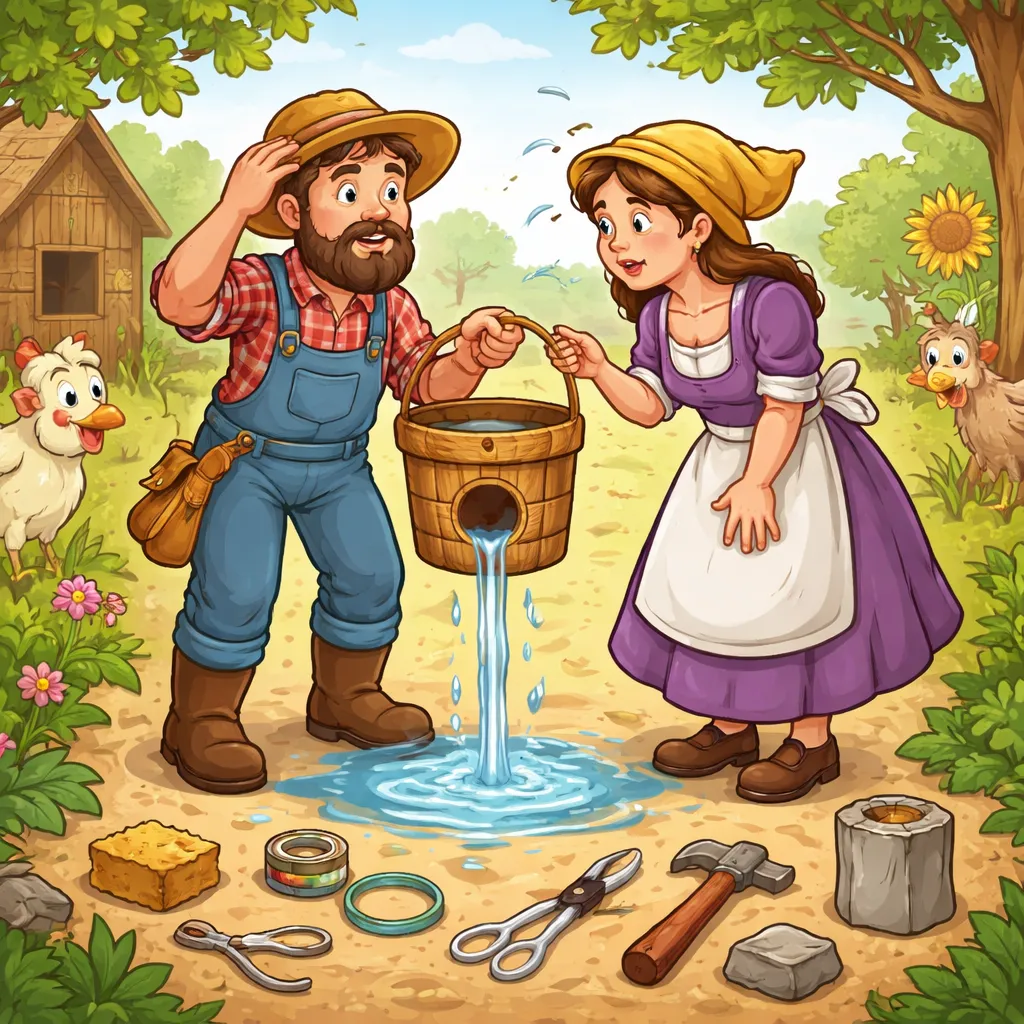

What is the Story "There's a Hole in the Bucket"?
"There's a Hole in the Bucket" is a classic American folk song that tells a funny story through dialogue. The song is a conversation between two people, Henry and Liza. Henry wants to fetch water but discovers a hole in his bucket. He asks Liza how to fix it. She gives him instructions, but each solution creates a new problem. The English song: There's a Hole in the Bucket has been making children laugh for generations with its circular logic. To fix the hole, Henry needs straw. To cut the straw, he needs a knife. To sharpen the knife, he needs a stone. To wet the stone, he needs water. But to get water, he needs a bucket without a hole! Children love the silly never-ending loop. The song teaches problem-solving, listening carefully, and the humor of circular thinking.
The Complete Lyrics of the Nursery Rhyme
Let us look at the words together. The song is a back-and-forth conversation.
Henry: There's a hole in the bucket, dear Liza, dear Liza,
There's a hole in the bucket, dear Liza, a hole.
Liza: Then fix it, dear Henry, dear Henry, dear Henry,
Then fix it, dear Henry, dear Henry, fix it.
Henry: With what shall I fix it, dear Liza, dear Liza?
With what shall I fix it, dear Liza, with what?
Liza: With straw, dear Henry, dear Henry, dear Henry,
With straw, dear Henry, dear Henry, with straw.
Henry: The straw is too long, dear Liza, dear Liza...
Liza: Then cut it, dear Henry...
Henry: With what shall I cut it, dear Liza?...
Liza: With a knife, dear Henry...
Henry: The knife is too dull, dear Liza...
Liza: Then sharpen it, dear Henry...
Henry: With what shall I sharpen it, dear Liza?...
Liza: With a stone, dear Henry...
Henry: The stone is too dry, dear Liza...
Liza: Then wet it, dear Henry...
Henry: With what shall I wet it, dear Liza?...
Liza: With water, dear Henry...
Henry: But how shall I get it? dear Liza, dear Liza?
The well is dry, dear Liza, dear Henry? That's the end!
Vocabulary Learning from the Song
This English song: There's a Hole in the Bucket introduces children to words about tools, materials, and problem-solving. Each word builds their understanding of everyday objects.
First, the song teaches about a "bucket." A bucket is a container used to carry water or other things. You can show your child a real bucket. Talk about what buckets are used for.
A "hole" is an opening or break. A bucket with a hole cannot hold water. This is the central problem of the song.
The song teaches about materials and tools. "Straw" is dried plant stems. "A knife" is a tool for cutting. "A stone" is a rock that can be used for sharpening. "Water" is what Henry needs to get.
The song has two characters. "Dear Liza" and "dear Henry" are talking to each other. "Dear" is a friendly way to address someone.
The song uses the word "fix" which means to repair something broken. This is an important concept for children. When something breaks, we can try to fix it.
Phonics Points to Practice
Let us listen for special sounds in the song. Phonics helps children connect letters to the sounds they hear. This English song: There's a Hole in the Bucket gives us many sounds to explore.
Listen to the "h" sound at the beginning of "hole" and "Henry." It is a gentle breath sound. Put your hand in front of your mouth and say "hole." Feel the air. Practice other "h" words like "happy," "house," and "hello."
The "b" sound appears in "bucket." It is a strong sound made by pressing lips together. Practice other "b" words like "ball," "book," and "baby."
Listen to the "l" sound in "Liza" and "hole" and "long." It is a light sound made with the tongue touching the roof of the mouth. Practice other "l" words like "lamb," "leaf," and "lullaby."
The "s" sound in "straw" and "stone" is a soft sound made by pushing air through the teeth. Practice other "s" words like "sun," "sand," and "sing."
The long "i" sound in "knife" and "dry" says its own name. You can hear it in words like "kite," "bike," and "sky."
Grammar Patterns We Can Learn
This dialogue song teaches important grammar in a very natural way. The English song: There's a Hole in the Bucket introduces the phrase "there is," imperatives, and question and answer patterns.
The song begins with "there's a hole." "There's" is short for "there is." This is used to say that something exists. You can practice using this pattern. "There's a bird." "There's a toy." "There's a problem."
The song uses imperatives. "Fix it." "Cut it." "Sharpen it." "Wet it." These are commands telling someone what to do. Children hear imperatives every day. "Eat your food." "Wash your hands." "Come here."
The song uses question and answer patterns. Henry asks a question, and Liza gives an answer. This teaches children how conversations work. You can practice this pattern. "What shall we play?" "Let's play blocks." "How do we build it?" "Stack them up."
Learning Activities to Do at Home
Bringing this English song: There's a Hole in the Bucket into your daily life is simple and joyful. Here are some activities you can try with materials you already have.
A wonderful activity is the "Fix It" pretend play. Get a bucket or container with a pretend hole. Use play tools to try to fix it. Use straw, a knife (toy), a stone, and water. Act out the conversation between Henry and Liza. Take turns being each character. This builds problem-solving and imagination.
Another activity is the "Circular Story" game. The song goes in a circle and never ends. Create your own circular stories. "I need to draw but my crayon is broken. To fix it I need a sharpener. But the sharpener is lost. To find it I need a light. But the light needs batteries..." This builds creativity and logical thinking.
You can also have a "Water Experiment." Use a real bucket or cup. Poke a small hole in a disposable cup. Try to fill it with water. Watch the water leak out. Talk about why Henry needed to fix his bucket. This builds science understanding.
Printable Materials for Learning
Creating simple printables can make this English song: There's a Hole in the Bucket more visual and engaging. You can make these materials together with your child.
Conversation cards are perfect for this song. Draw simple pictures on separate cards. Henry with bucket. Liza pointing. Straw. Knife. Stone. Water. Well. Your child can hold up the cards as each item is mentioned. This builds comprehension and participation.
A coloring page is always popular. Draw Henry and Liza with a bucket that has a hole in it. Add straw, knife, stone, and well in the background. Let your child color the scene. Write "There's a Hole in the Bucket" at the top. Display their artwork proudly.
You can also create simple word cards. Write words from the song on cards. "Hole," "bucket," "Liza," "Henry," "fix," "straw," "long," "cut," "knife," "dull," "sharpen," "stone," "dry," "wet," "water," "well." Show each card as you sing that word. This builds early reading skills.
A problem-solving flow chart helps visualize the circular story. Draw boxes connected by arrows showing each step and how it leads back to the beginning.
Educational Games for Deeper Learning
Games make learning active and exciting. They encourage children to use the language from the English song: There's a Hole in the Bucket in new and creative ways.
The "New Problem" game encourages creativity. Ask your child, "What if there was a different problem?" A hole in my sock? A broken toy? Create new circular conversations. "There's a hole in my sock, dear Mama." "Then sew it, dear child." "With what shall I sew it?" "With a needle." "The needle is too small..." This shows children how to adapt the pattern.
The "Tool Match" game teaches about tools and their uses. Match each tool to what it does. Straw fixes holes. Knife cuts. Stone sharpens. Water wets. This builds practical knowledge.
The "Why Questions" game explores cause and effect. Why does Henry need straw? To fix the hole. Why does he need a knife? To cut the straw. Keep asking "why" to build a chain. This builds critical thinking.
The "Bucket Relay" game adds movement. Set up a water relay race with cups. If your cup has a hole, you must fix it before continuing. This builds problem-solving under pressure.
The "Well Water" discussion explores where water comes from. Long ago, people got water from wells. Today we have faucets. Talk about water sources. This builds science and history knowledge.
The "Fix It" life skills practice is valuable. When something breaks at home, involve your child in fixing it (safely). This builds practical skills and confidence.
The "Dear Henry/Liza" role play practices polite conversation. Use "dear" as a friendly address. Practice having polite conversations using names. This builds social skills.
The "Circular Logic" discussion helps children understand the humor. The song never ends because each solution needs something else. This is silly and fun. Can you think of other circular problems? This builds abstract thinking.