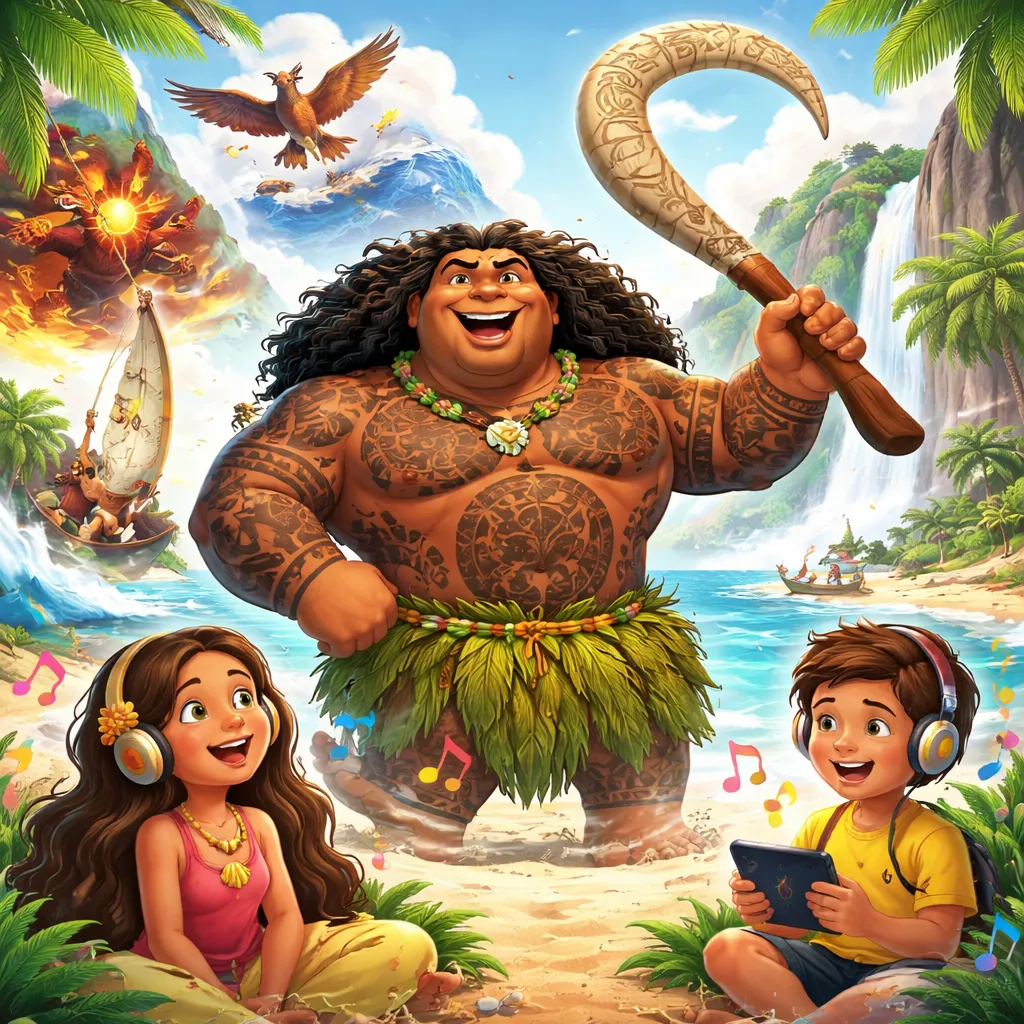

What is the Story Behind "You're Welcome" from Moana?
"You're Welcome" is a lively and entertaining song from the Disney movie Moana. The demigod Maui sings it to Moana after she finds him on a deserted island. The English song: You're Welcome (from Moana) is Maui's way of bragging about all the amazing things he has done for humanity. He claims credit for creating the sky, the sun, the wind, and even coconuts! The song is full of humor, energy, and Maui's larger-than-life personality. Children love the catchy rhythm and Maui's confident attitude. The song introduces Polynesian mythology and the character of Maui, a beloved figure in Pacific Island cultures. It teaches about gratitude, storytelling, and the importance of saying "you're welcome" when someone thanks you.
The Complete Lyrics of the Song
Let us look at some key parts of the song. The lyrics are fast and fun.
What can I say except you're welcome?
For the tides, the sun, the sky?
Hey, it's okay, it's okay, you're welcome.
I'm just an ordinary demiguy.
I pulled up the sky so you could have sunlight.
I lassoed the sun so it would give you night.
I split the shoreline in two with my hook.
Made the oceans rise, made the islands, just took a look.
I killed an eel, I buried its guts,
Sprouted a tree, now you've got coconuts.
What's the lesson? What is the take-away?
Don't mess with Maui when he's on a break-away.
Vocabulary Learning from the Song
This English song: You're Welcome (from Moana) introduces children to words about mythology, nature, and gratitude. Each word builds their understanding of language and stories.
First, the song teaches the phrase "you're welcome." This is what we say when someone thanks us. It is an important social phrase. You can practice using it in daily life. "Thank you for the cookie." "You're welcome!"
The song introduces "Maui." Maui is a demigod in Polynesian mythology. A demigod is part human and part god. He is known for his amazing strength and magical fish hook.
The song teaches about natural phenomena. "Tides" are the rising and falling of the ocean. "Lassoed the sun" means he caught the sun with a rope to slow it down. This is a myth explaining why days have light and dark.
The song mentions Maui's "hook." His magical fish hook allows him to shape-shift and perform incredible feats.
"I killed an eel" and "sprouted a tree" refer to a myth about how coconuts came to be. This introduces children to storytelling and mythology.
Phonics Points to Practice
Let us listen for special sounds in the song. Phonics helps children connect letters to the sounds they hear. This English song: You're Welcome (from Moana) gives us many sounds to explore.
Listen to the "y" sound at the beginning of "you're." It is a consonant sound made with the tongue. Practice other "y" words like "yes," "yellow," and "yummy."
The "w" sound appears in "welcome." It is made with rounded lips. Practice other "w" words like "water," "window," and "wagon."
Listen to the "m" sound in "Maui" and "my." It is a humming sound made with lips together. Practice other "m" words like "mommy," "milk," and "moon."
The "s" sound in "sun" and "sky" is a soft sound made by pushing air through the teeth. Practice other "s" words like "sand," "sing," and "see."
The long "i" sound in "sky" and "night" and "I" says its own name. You can hear it in words like "kite," "bike," and "my."
Grammar Patterns We Can Learn
This song teaches important grammar in a very natural way. The English song: You're Welcome (from Moana) introduces contractions, past tense verbs, and rhetorical questions.
The song uses contractions. "You're" is short for "you are." "It's" is short for "it is." Contractions are common in spoken English. Practice using them. "I'm hungry." "We're playing." "That's funny."
The song uses past tense verbs. "I pulled up the sky." "I lassoed the sun." "I split the shoreline." "I killed an eel." These are all past tense actions. You can talk about past events. "I pulled the wagon." "You lassoed the toy." "We split the snack."
The song uses rhetorical questions. "What can I say except you're welcome?" This is a question that doesn't need an answer. It's a way of making a point. You can find other examples in stories and songs.
Learning Activities to Do at Home
Bringing this English song: You're Welcome (from Moana) into your daily life is simple and joyful. Here are some activities you can try with materials you already have.
A wonderful activity is the "Thank You and You're Welcome" practice. Throughout the day, practice saying "thank you" and "you're welcome." When your child gives you something or helps you, say "thank you." Encourage them to say "you're welcome." This builds polite social skills.
Another activity is the "Maui's Hook" craft. Make a simple fish hook shape from cardboard. Cover it with aluminum foil. Decorate with markers or paint. Pretend to be Maui and do amazing things with your hook. This builds creativity and fine motor skills.
You can also have a "Nature Creation" storytelling session. Maui claims he created many things. Ask your child, "What would you create if you were a demigod?" A new flower? A special animal? A rainbow bridge? Draw pictures and tell stories. This builds imagination and narrative skills.
Printable Materials for Learning
Creating simple printables can make this English song: You're Welcome (from Moana) more visual and engaging. You can make these materials together with your child.
Maui character cards are perfect for this song. Draw or print pictures of Maui doing different things. Pulling up the sky, lassoing the sun, splitting the shoreline, making coconuts. Hold up each card as you sing that part. This builds comprehension and sequencing.
A coloring page is always popular. Draw Maui with his magical hook, standing proudly. Add the sun, sky, and ocean in the background. Let your child color the scene. Write "You're Welcome" at the top. Display their artwork proudly.
You can also create simple word cards. Write words from the song on cards. "Welcome," "tides," "sun," "sky," "ordinary," "demiguy," "pulled," "lassoed," "split," "shoreline," "hook," "ocean," "islands," "eel," "coconuts." Show each card as you sing that word. This builds early reading skills.
A gratitude chart helps practice saying thank you. Each day, write or draw something you are thankful for. Practice saying "thank you" for these things.
Educational Games for Deeper Learning
Games make learning active and exciting. They encourage children to use the language from the English song: You're Welcome (from Moana) in new and creative ways.
The "New Creations" game encourages creativity. Ask your child, "What else could Maui have created?" A special fruit? A new animal? A magical place? Create new verses in Maui's style. "I made the mango, sweet and yellow, I made it for you, such a nice fellow!" This shows children how to extend the pattern.
The "Polynesian Myths" exploration builds cultural knowledge. Read simple stories about Maui from Polynesian mythology. Learn about his adventures and his magical powers. This builds appreciation for different cultures.
The "Gratitude Circle" game practices thankfulness. Sit in a circle and take turns saying something you are thankful for. After each person speaks, everyone says "thank you." The person responds "you're welcome." This builds gratitude and social skills.
The "Ordinary Demiguy" discussion explores the word "ordinary." Maui calls himself an ordinary demiguy, but he is anything but ordinary! Talk about what makes each person special and extraordinary. This builds self-esteem.
The "Coconut Creation" snack time is fun. If possible, try coconut water, coconut meat, or coconut treats. Talk about the myth of Maui creating coconuts. This connects the song to real food.
The "Hook Shape" drawing practices lines and curves. Draw different hook shapes. Decorate them with patterns. This builds pre-writing skills.
The "Tide Pool" science discussion explores tides. The ocean tides go in and out. Look at pictures of tide pools. What creatures live there? This builds science knowledge.
The "Sun and Moon" astronomy talk explores day and night. The sun gives us light during the day. The moon and stars come out at night. Maui's myths explain these things in story form. Compare myths with scientific facts. This builds critical thinking.