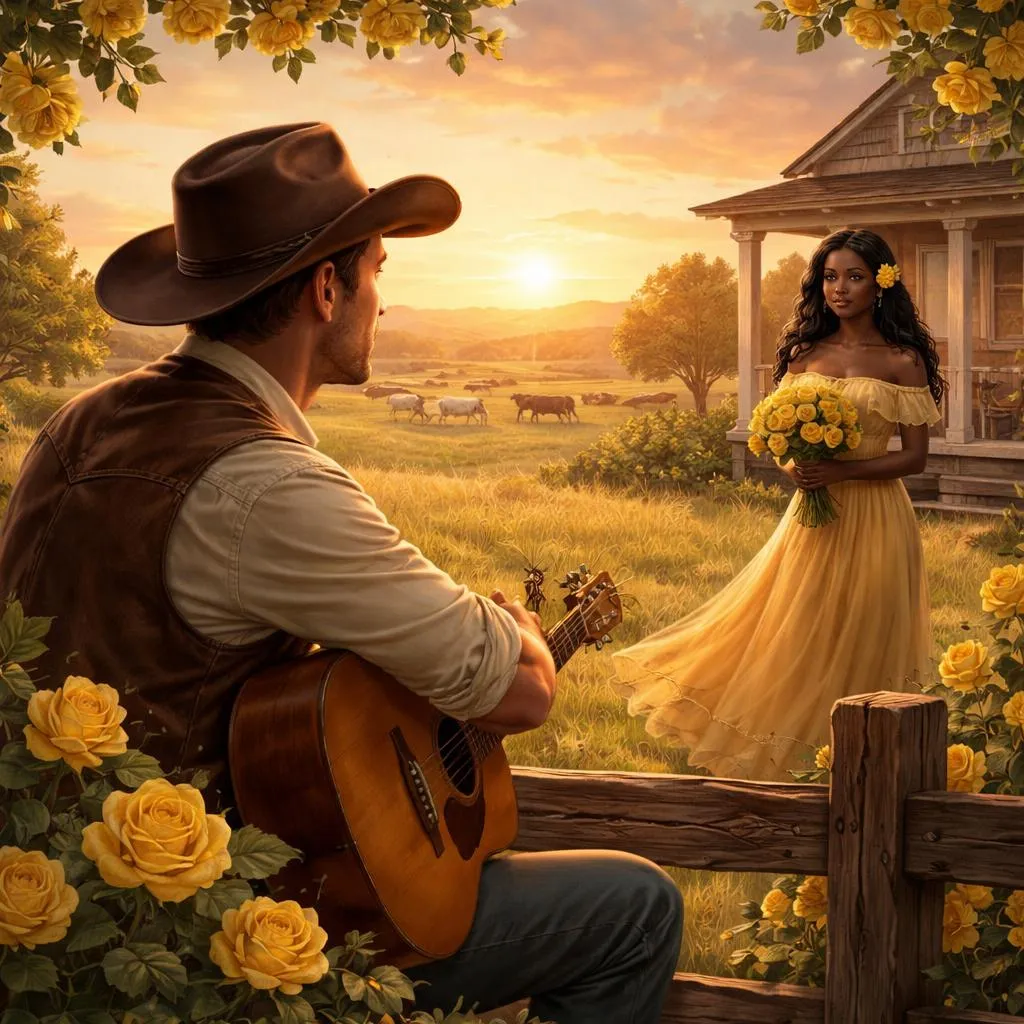

Have you ever missed someone so much that you think about them all the time? Maybe a family member who is far away, or a friend from a past summer. Sometimes, we use a special object or a place to remind us of that person. There is a famous, old song about a soldier who is far from home, and he thinks of one special person as a beautiful, unique flower. Let’s learn about the folk song “The Yellow Rose of Texas.”
About the Song
Let’s read the longing, marching words of this classic song.
There’s a yellow rose in Texas that I am going to see,
No other soldier knows her, no soldier only me;
She cried so when I left her, it like to broke my heart,
And if I ever find her, we nevermore will part.
She’s the sweetest rose of color this soldier ever knew,
Her eyes are bright as diamonds, they sparkle like the dew;
You may talk about your dearest May and sing of Rosa Lee,
But the Yellow Rose of Texas is the only girl for me.
Where the Rio Grande is flowing, and the starry skies are bright,
She walks along the river in the quiet summer night;
I know that she remembers, when we parted long ago,
I promise to return again, and not to leave her so.
This song is a traditional American folk song, first published in the 1850s. It became widely popular during the American Civil War (1861-1865) as a marching song for soldiers from Texas. The song is sung from the perspective of a soldier who is far from home, likely fighting in the war. He sings about a woman he calls the “Yellow Rose of Texas,” describing her beauty and his promise to return to her. The “yellow rose” is a metaphor for this special person. The song expresses homesickness, loyalty, and the hope of reunion. Over time, the “Yellow Rose of Texas” has become a symbol of Texan pride and folklore.
What the Song is About
The song paints a picture of a soldier’s faithful memory. The soldier is far away, perhaps in a camp or on a march. He is thinking of home in Texas and one particular woman he loves. He calls her the “yellow rose,” a flower that stands out as rare and beautiful.
He remembers how sad she was when he left, and it almost broke his heart. He promises that if he can find her again, they will never part. He describes her as the sweetest and most beautiful he has known, with eyes like diamonds and dew. He says that even if other soldiers sing about other women, his “Yellow Rose” is the only one for him. In the last verse, he imagines her back home, walking by the Rio Grande river under the starry sky, remembering him and waiting for his return. The whole song is about holding onto a loving memory during a difficult, lonely time.
Who Made It & Its Story
“The Yellow Rose of Texas” is a traditional folk song, so its original author is unknown. It was first published in 1858, and the original lyrics were written in a style that reflected the minstrel shows of the time. The song’s history is intertwined with the myth of Emily D. West, a free woman of color who, according to legend, helped Texas win the Battle of San Jacinto in 1836. While the historical connection is debated, the story contributed to the song’s legendary status. The song became a massive hit during the Civil War, especially with the Texas Brigade. In the 20th century, it was recorded by many artists, like Mitch Miller, and became an official state song of Texas. Its catchy, marching tune and themes of love and state pride made it endure.
This song has remained popular for three compelling reasons. First, its melody is a catchy, upbeat march that is easy to remember and sing, making it perfect for groups and parades. Second, it tells a simple, universal story of love and longing that anyone separated from a loved one can understand. Third, it has become a powerful symbol of Texan identity and history, connecting personal emotion to state pride and making people feel a sense of place and belonging.
When to Sing It
This song is perfect for moments of remembrance and pride. You can sing it on a family road trip, especially if you are driving through or talking about Texas. You can hum it when you are missing someone, as a way to feel connected to them. You can also march around the room to its steady beat, pretending to be a soldier or a pioneer on a long journey home.
What Children Can Learn
This historical, emotional song is a garden of lessons. Let’s explore what it teaches.
Vocabulary
The song teaches us descriptive and geographical words. A “rose” is a beautiful, fragrant flower that often symbolizes love. “Yellow” is a bright, sunny color. “Texas” is a large state in the southern United States. The “Rio Grande” is a major river that forms part of the border between Texas and Mexico. “Starry skies” are night skies filled with stars. “Dew” is the small drops of water that form on plants in the morning. “Nevermore” is an old, poetic way of saying “never again.”
Let’s use these words! You can say, “The starry skies were clear and beautiful last night.” Or, “The grass was wet with morning dew.” New word: Metaphor. This is when you describe one thing as being another to show they are alike. The song uses a “yellow rose” as a metaphor for a beloved person.
Language Skills
This song is a great lesson in using the present tense to describe enduring qualities and the future tense for promises. The song uses the present tense to describe the woman’s lasting beauty: “She is the sweetest rose… Her eyes are bright…” This shows that his memory of her is fixed and constant.
The soldier uses the future tense to make a promise: “I am going to see her… we nevermore will part.” The line “it like to broke my heart” uses an informal, old-fashioned structure meaning “it almost broke my heart.” The song also uses similes for description: “bright as diamonds,” “sparkle like the dew.”
Sounds & Rhythm Fun
Listen to the steady, marching, confident rhythm of the melody. The song is in a strong 4/4 time, perfect for marching. The verses have a clear, rolling rhyme scheme: “see” and “me,” “heart” and “part,” “knew” and “dew,” “Lee” and “me,” “bright” and “night,” “ago” and “so.”
The rhythm is upbeat and jaunty. Try marching in place: There’s a YEL-low ROSE in TEX-as THAT I AM go-ING to SEE. The melody is based on a simple, repeating pattern that is easy to learn and sing with feeling. This simple, repetitive, and marching musical pattern is what made the song so popular with soldiers and singers. You can write your own “longing” song! Use the same marching rhythm. Try: “There’s a tall tree in my backyard that I am going to climb, it’s the greatest one I know, and it’s been there a long time. Its branches are as strong as arms, they reach up to the sun, and climbing in that tree is the most peaceful, happy fun.”
Culture & Big Ideas
“The Yellow Rose of Texas” is a key piece of American and Texan cultural heritage. It comes from the 19th-century folk tradition and reflects the experience of soldiers during the Civil War, a defining period in U.S. history. The song connects to the Texan values of independence, loyalty, and state pride. The legend of Emily West ties the song to the Texas Revolution, a foundational event. The song is also an example of how folk music travels and changes, starting as a minstrel song and evolving into a symbol of universal longing and regional identity. It shows how music can tell both personal and historical stories.
The song conveys three important ideas. First, it’s about the power of memory and fidelity. The soldier holds onto the image of his love to sustain him through hardship, showing that thinking of loved ones can give us strength. Second, it expresses homesickness and the connection to a specific landscape. The Rio Grande and the Texas skies are part of what he misses, teaching that love is often tied to a sense of place. Third, it highlights idealization and symbolism. The woman is not just a person; she becomes a perfect symbol (the yellow rose) of everything he is fighting to return to, which is a way people often cope with distance and danger.
Values & Imagination
Imagine you are the soldier marching far from home. What do you see around you? Other soldiers? A dusty road? What sounds do you hear? Now, imagine the “Yellow Rose.” What does she look like? Is she wearing a yellow dress? How does she feel waiting by the river? Imagine the Rio Grande at night. Is it calm? Can you hear the water? Draw a picture that shows both the soldier and the woman. On one side, draw the soldier looking at a small picture or thinking. On the other side, draw the woman by the river under starry skies. Connect the two sides with a winding path or a ribbon labeled “memory.” This shows the connection across the distance.
The song encourages loyalty, appreciation for home, and using positive memories for comfort. A lovely idea is to have a “Symbol of Home” activity. With your family, talk about what one thing (a food, a smell, a place) makes you think of home or a loved one. Draw that symbol. Then, share your drawings and stories. This connects the song’s metaphor to your own life.
So, as the last promise to return fades, think about the journey this song describes. It is a vocabulary lesson in description and place. It is a grammar lesson in present truths and future promises. It is a music lesson in a steady, marching rhythm. From the first line about the yellow rose to the final image of the river, it wraps lessons in fidelity, homesickness, and the comfort of symbols in a tune that makes you want to march and remember. “The Yellow Rose of Texas” teaches us that love can be a guiding light, that home is worth singing about, and that even the simplest flower can hold a world of meaning.
Your Core Takeaways
You are now an expert on the song “The Yellow Rose of Texas.” You know it is a 19th-century American folk song about a soldier’s longing for his love, who symbolizes Texas. You’ve learned words like “Rio Grande” and “nevermore,” and you’ve practiced using the present tense for descriptions and the future for promises. You’ve felt its marching rhythm and created your own longing verse. You’ve also discovered the song’s role in Civil War and Texan history and its messages about the power of memory, the pain of homesickness, and the use of symbols to represent love and place.
Your Practice Missions
First, stage a “Soldier’s March.” With your family, form a line and march around your living room or yard. Sing the song as you march, keeping your steps in time with the beat. Talk about how the marching rhythm might have helped real soldiers keep going. This connects the song’s melody to its original use.
Second, design a “State Symbol” poster. The “Yellow Rose” is a symbol of Texas. Think about your own state, province, or city. What is its symbol? A flower? A bird? An animal? If you don’t know, choose one you think fits. Create a colorful poster celebrating that symbol. Explain why it represents your home. This activity lets you think about symbols and pride in your own community, just like the song.