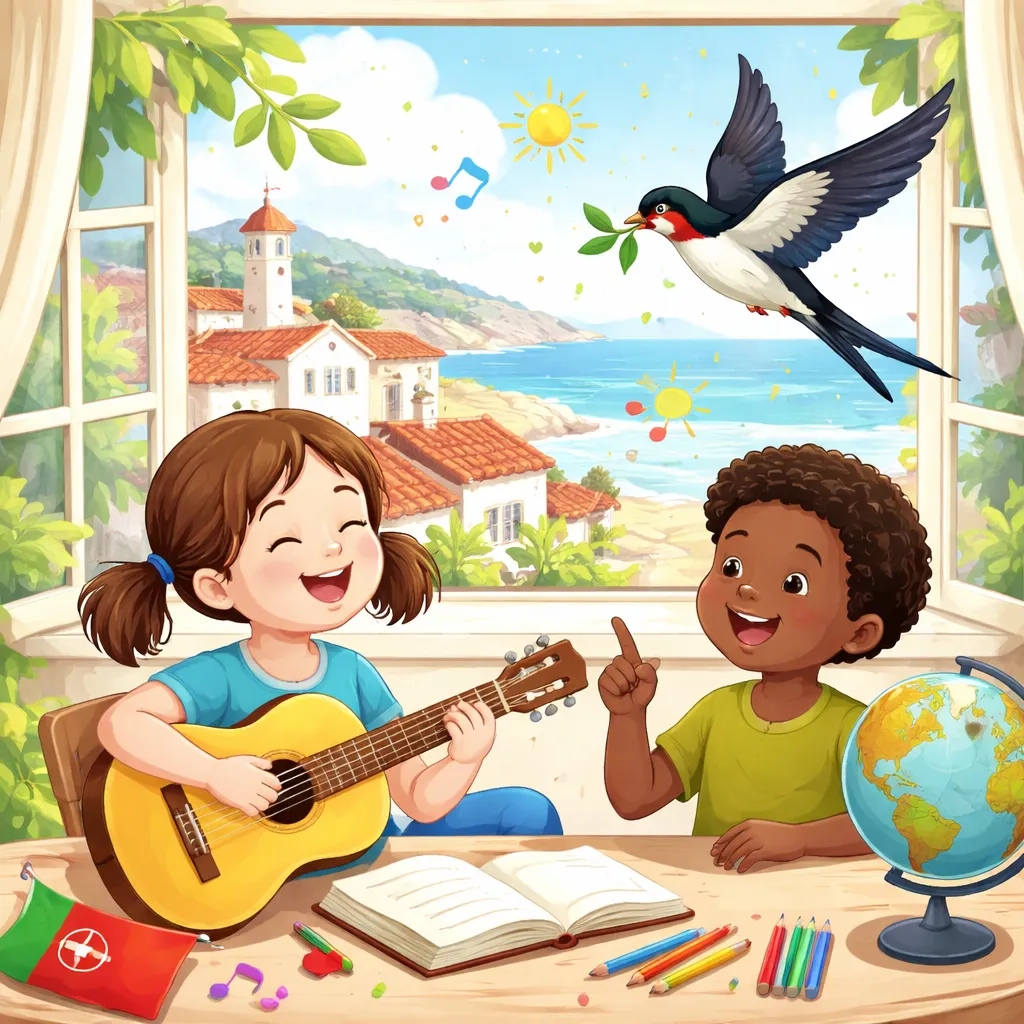

A swallow returns each spring with a message of warmth and renewal. A children’s song can return to a child’s mind with that same gentle familiarity. Today, we explore a traditional Portuguese rhyme called “A Andorinha,” which means “The Little Swallow.” This graceful song follows a swallow as she flies across the sky and returns home. We will use this melody as a soaring path into English. Together, we will learn new words, explore important sounds, and discover how a simple song can make language learning feel like a bird’s journey across an open sky. The swallow knows when to leave and when to return. Your child can learn that language skills also grow and return with practice.
What is the rhyme? “A Andorinha” is a beloved nursery rhyme in Portuguese-speaking cultures. It tells the story of a little swallow who flies far away and then returns when spring arrives. The song has a flowing, soaring rhythm. Children often use hand movements. They spread their arms like wings. They swoop and glide around the room. They make soft chirping sounds. The song celebrates the changing seasons and the joy of coming home. When we bring this song to English learning, we keep its soaring spirit. We use the familiar melody to introduce English words in a way that feels like a gentle flight across new horizons.
The lyrics of nursery rhymes To appreciate this song, we first look at the original Portuguese words. Then we see how they translate into English. This shows children that the same graceful story of coming and going can be told in different languages. You do not need to know Portuguese to enjoy the flowing, soaring rhythm of the words.
Original Version (Portuguese)
A andorinha, a andorinha Vai voar, vai voar Para longe, para longe Vai voltar, vai voltar
English Version
The little swallow, the little swallow Will fly, will fly Far away, far away Will return, will return
A second verse often continues the story, describing the swallow’s return with spring.
Original Version (Portuguese)
Chega a primavera, chega a primavera Flores a brotar, flores a brotar A andorinha, a andorinha Vem nos visitar, vem nos visitar
English Version
Spring arrives, spring arrives Flowers start to bloom, flowers start to bloom The little swallow, the little swallow Comes to visit us, comes to visit us
As you read these words, notice the flowing repetition. The rhythm moves like wings in flight. The story is simple and hopeful. A swallow flies far away. She will return. Spring arrives. Flowers bloom. The swallow comes to visit. This narrative invites children to think about seasons, journeys, and homecoming.
Vocabulary learning This song offers a beautiful set of words that connect to seasons, travel, and the natural world. We can explore these words through conversation, pictures, and observations of the changing seasons.
Start with the main character: the swallow. In Portuguese, it is andorinha. In English, we say “little swallow.” Swallows are birds known for their long migrations. They fly to warm places in winter and return in spring. You can look at pictures of swallows together. Notice their forked tails and graceful flight.
Here are the key words to focus on from the song:
Swallow: A bird that migrates. Explain that swallows travel to find warmth and then come back.
Fly: To move through the air. Stretch your arms and pretend to fly.
Far away: A great distance. Point to the horizon. Talk about places that are far away.
Return: To come back. This is an important concept. Talk about returning home after a walk.
Spring: The season after winter. Look outside. Talk about what happens in spring.
Arrive: To reach a place. The swallow arrives when spring comes. Practice saying “we arrive home.”
Bloom: When flowers open. Look for flowers blooming in your garden or neighborhood.
Visit: To go see someone. The swallow comes to visit. Talk about people who visit you.
Use these words in natural moments. When you return home, say “we return, just like the little swallow.” When spring comes, point to new flowers and say “the flowers bloom. The swallow will visit.” These connections make the vocabulary meaningful.
Phonics points Phonics helps children understand the sounds that build English words. This song gives us several clear sounds to explore in a flowing, graceful way.
First, focus on the ‘sw’ blend at the beginning of “swallow.” This is two consonants together. Say “s” like a snake, then quickly add “w.” Then add “allow.” Practice with “sweet,” “swing,” and “swallow.” This blend appears in many words about movement.
Next, notice the long ‘a’ sound in “swallow” and “away.” The ‘a’ in “swallow” is a short ‘a’ actually. Let us focus on the long ‘a’ in “away” and “arrive.” The ‘a’ in “away” sounds like “uh-way.” For “arrive,” the ‘a’ is a schwa sound. A clearer sound is the long ‘a’ in “spring.” Say “ay” like in “say.” Then say “spring.” Practice with “day,” “play,” and “spring.”
The word “return” contains the ‘ur’ sound. Say “ur” like in “fur.” Then say “return.” Practice with “burn,” “turn,” and “return.” This sound is made with rounded lips.
Finally, look at the ‘bl’ blend in “bloom.” Say “b” and then quickly add “l.” Then add “oom.” Practice with “blue,” “black,” and “bloom.” The song also has “visit,” which contains the ‘v’ sound. This is a voiced sound made with the top teeth on the bottom lip.
Grammar patterns Even a simple song contains grammar that we can introduce gently. We do not need to use technical terms. Instead, we show how words work together through examples and play.
The song uses the future tense with the word “will.” “Will fly” means the swallow plans to fly. You can explain this simply. “Will” is a helper word that tells us something is going to happen. Practice by talking about the seasons. “Spring will come.” “Flowers will bloom.” This gives children a tool to talk about future events.
The second verse uses the present tense. “Spring arrives” describes what happens now when spring comes. You can practice by talking about the current season. “It is spring. Flowers bloom.” This helps children understand time in language.
Notice the repetition of phrases. “Far away, far away” repeats for emphasis. Children can use this pattern to express strong feelings. “So far, so far.” “So high, so high.”
Also, look at the verb phrase “comes to visit.” This shows purpose. The swallow comes for a reason. You can practice with other purpose phrases. “We go to play.” “We sing to learn.” This builds understanding of “to” showing purpose.
Learning activities Activities bring the song into the body and the imagination. They transform listening into active participation. These ideas are simple and require little preparation.
Swallow Flight Play the song and pretend to be the swallow. Spread your arms like wings. Fly around the room. When the song says “fly far away,” move to the other side of the room. When it says “will return,” fly back. When it says “spring arrives,” stop and look around. When it says “flowers bloom,” open your hands like flowers. This activity builds listening skills and understanding of the song’s story.
Season Walk Go for a walk together. Look for signs of the current season. In spring, look for flowers blooming. In other seasons, talk about what is happening. Say “spring will come. The swallow will return.” This connects the song to the real world.
Homecoming Game Go on a short walk or drive. Then return home. When you arrive, say “we return, just like the little swallow.” Talk about how it feels to come home. This connects the song’s theme to daily life.
Printable materials Printable resources offer a quiet way to reinforce the song’s vocabulary. They are perfect for moments when children want to create or focus calmly.
Flashcards Create a set of flashcards. One card shows the swallow. One shows wings for “fly.” One shows a distant horizon for “far away.” One shows a returning arrow for “return.” One shows a flower blooming for “spring.” One shows a door for “visit.” Use these cards for a matching game. Sing a line from the song and ask your child to find the matching card. This builds word recognition.
Coloring Page Draw a simple scene from the song. Show the little swallow flying in the sky. Draw flowers blooming on the ground. Add a sun in the sky. Children can color the scene with bright spring colors. As they color, talk about the scene. “Where is the swallow flying?” “What season is it?” This keeps the language flowing naturally.
Season Wheel Create a simple wheel with four seasons. Draw a swallow near the spring section. Your child can color each season. Talk about what happens in each season. This builds understanding of the seasonal cycle.
Educational games Games encourage repetition without boredom. They invite children to use the language in new and creative ways.
Swallow Says Play a game similar to “Simon Says.” Give commands using the song’s vocabulary. “The swallow says fly far away.” “The swallow says return to me.” “The swallow says find a flower.” If you give a command without saying “the swallow says,” the child does not move. This game builds listening skills.
Migration Game Place two areas in the room. One is “far away” (winter home). One is “home” (spring home). Take turns being the swallow. Fly to the far away place. Then return home when spring comes. Say “I fly far away. I return in spring.” This builds understanding of migration.
Flower Bloom Race Draw or place paper flowers around the room. When you say “spring arrives,” children run to “bloom” the flowers (open their hands or turn the flowers over). This connects the song’s vocabulary to active play.
As you share “A Andorinha” with your child, remember that you are building an understanding of cycles and homecoming. The little swallow flies far away, but she always returns. Learning a new language can feel like a journey. Sometimes we learn new words. Sometimes we revisit old ones. Sometimes we feel far away from confidence. But with practice and patience, we always return. Let the graceful swallow be your guide. Sing the song when you begin something new. Sing it when you come back to something familiar. Let the returning spirit of the swallow remind you both that every language journey has a homecoming, and every word learned is a place you can always return to.