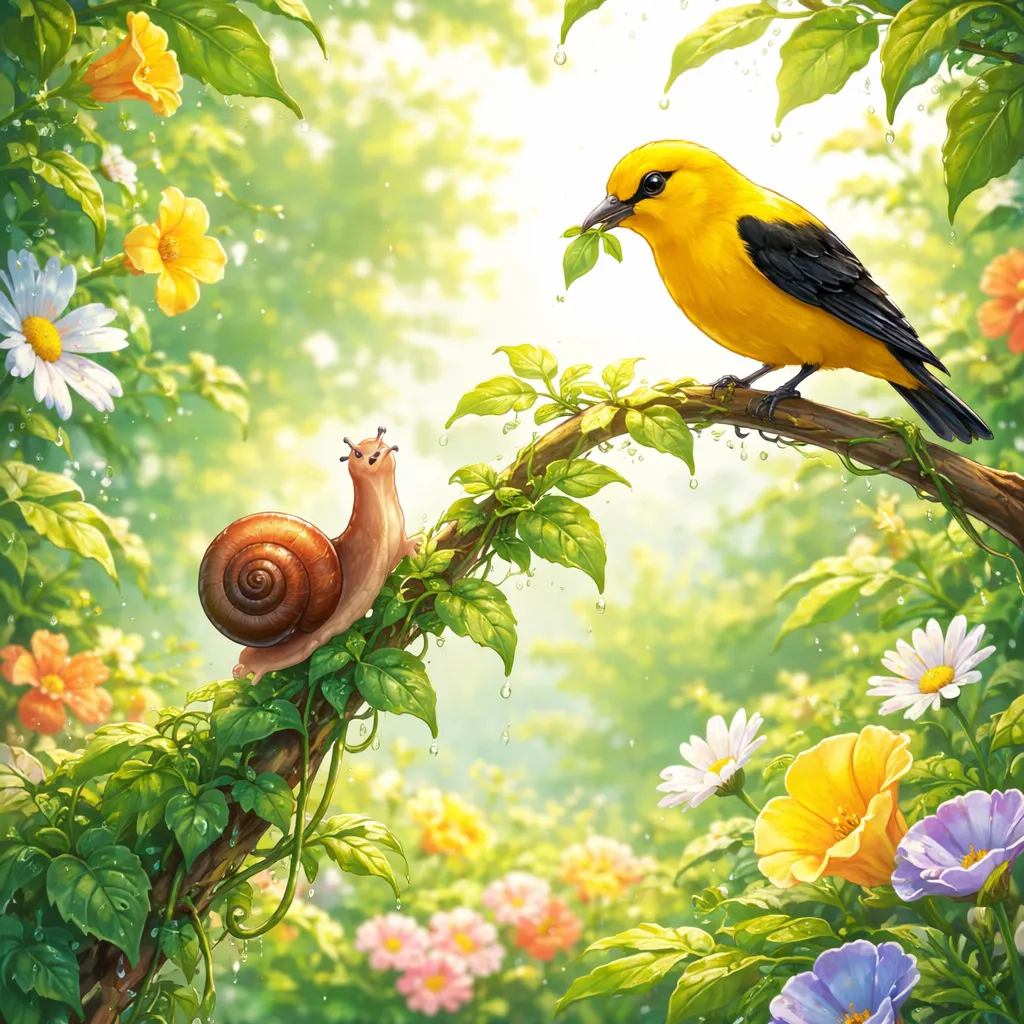

Have you ever tried to learn something new, like tying your shoes or riding a bike? It can feel very slow and difficult at first. Sometimes, others might do it faster and seem to laugh. But what if going slow is just part of your own smart plan? A famous song from Taiwan, China, tells a story about just that, using two very different animals. Let’s listen to the wise and catchy tune “Snail and the Oriole” (蜗牛与黄鹂鸟, Wōniú yǔ Huánglíniǎo).
About the Song
Let’s read the conversational, clever words of this famous song.
阿门阿前一棵葡萄树,
阿嫩阿嫩绿地刚发芽。
蜗牛背着那重重的壳呀,
一步一步地往上爬。
阿树阿上两只黄鹂鸟,
阿嘻阿嘻哈哈在笑它。
葡萄成熟还早得很哪,
现在上来干什么?
阿黄阿黄鹂儿不要笑,
等我爬上它就成熟了。
English Translation:
In front of the gate, a grapevine,
Tender, tender green, it just sprouted.
The snail carries its heavy shell,
Step by step, it climbs up.
In the tree, two orioles,
Hee-hee, ha-ha, they are laughing at it.
“The grapes won’t be ripe for a long time,
Why are you coming up now?”
“Ah, orioles, please don’t laugh,
By the time I get up there, they will be ripe.”
This song is a popular children’s folk song from Taiwan, China. It became widely known across the Chinese-speaking world in the late 20th century. The song is a short musical fable, structured as a dialogue. It has a cheerful, talking melody. A small, slow snail begins climbing a grapevine that has just sprouted leaves. Two quick, singing orioles in the tree laugh at the snail, thinking it is silly to start so early when the grapes are not ripe yet. The snail calmly replies that by the time it slowly reaches the top, the grapes will be ready. The song is a playful and profound lesson about patience, perseverance, and smart planning.
What the Song is About
The song paints a simple scene and a conversation. First, we see a young grapevine, green and fresh, just beginning to grow. Then, we meet the main character: a snail. The snail is carrying its home, a heavy shell, on its back. It is moving very slowly, taking one step at a time, climbing up the vine.
High up in the tree, two yellow oriole birds see the snail. They start to laugh. They think the snail is being silly. They call down, saying the sweet grapes are not ready to eat yet, so why is the snail starting its climb now? The snail does not get angry or give up. It looks up and gives a wise answer. It tells the orioles not to laugh. It explains that it climbs so slowly that by the time it finally reaches the top of the vine, the grapes will have grown and become perfectly ripe and juicy. The snail has a plan!
Who Made It & Its Story
“Snail and the Oriole” is a Taiwanese children’s folk song. The lyrics are attributed to Chen Hongwen (陈弘文) and the music was composed by Lin Jianchang (林建昌). It was created as a modern musical fable for children. The song draws from the long tradition of using animal stories to teach lessons, much like Aesop’s fables. It became extremely popular in mainland China and around the world because it was simple, catchy, and carried a clear, positive message. The song is a staple in kindergartens and elementary schools, often performed with hand motions. It teaches children that speed is not everything, and that steady, persistent effort is a powerful way to succeed.
This little fable-song has remained beloved for three clever reasons. First, its melody is incredibly catchy, repetitive, and easy to learn, with a bouncy rhythm that makes the conversation fun to sing. Second, it presents a relatable conflict through two familiar animals, making the deep lesson about patience and perseverance easy for children to understand and remember. Third, it empowers the “underdog.” The slow snail is the hero who has the last, wise word, teaching children that being different or slower is not a weakness if you have a plan and keep going.
When to Sing It
This song is perfect for moments that require encouragement and a long-term view. You can sing it when you or a friend are learning something new and it feels too hard or too slow, to remember the snail’s persistence. You can chant it together after finishing a small part of a big project, celebrating that “step by step” progress. You can also sing it playfully in the garden or park when you see a real snail, imagining its big journey.
What Children Can Learn
This clever, conversational song is a wonderful teacher about life, language, and rhythm.
Vocabulary
The song teaches us nature and action words. A “snail” (蜗牛, wōniú) is a small, slow animal with a spiral shell on its back. An “oriole” (黄鹂鸟, huánglíniǎo) is a yellow songbird. A “grapevine” (葡萄树, pútáo shù) is the plant that grapes grow on. To “sprout” (发芽, fāyá) means a plant starts to grow from a seed. “Ripe” (成熟, chéngshú) means fruit is ready and good to eat. “Step by step” (一步一步地, yī bù yī bù de) means doing something slowly, one small part at a time.
Let’s use these words! You can say, “The seed will sprout in a few days.” Or, “I learned to skate step by step.” New word: Perseverance. This means continuing to try to do something even though it is difficult. The snail shows great perseverance.
Language Skills
This song is a brilliant lesson in direct speech and dialogue and using time clauses. The whole song is built as a conversation. The orioles speak directly to the snail: “葡萄成熟还早得很哪,现在上来干什么?” The snail replies directly: “阿黄阿黄鹂儿不要笑,等我爬上它就成熟了.” This shows how to write and sing a talk between characters.
The snail’s wise reply uses a time clause with “等…就…” (děng… jiù…), which means “when… then…” or “by the time… then…”. “等我爬上它就成熟了” means “By the time I climb up, then it (the grape) will be ripe.” This grammar is perfect for explaining plans and future results.
Sounds & Rhythm Fun
Listen to the bouncy, talking, back-and-forth rhythm of the melody. The song is in a lively 4/4 time. The melody for the narrator’s verses is smooth, but the parts for the orioles and the snail have a special, singsong, talking quality. The song uses fun, nonsense syllables “阿门阿前” (ā mén ā qián) and “阿嘻阿嘻哈哈” (ā xī ā xī hāha) to mimic sounds and laughter, making it very playful.
The rhythm is steady and marching, like the snail’s steps. Try saying with a steady beat: 蜗 牛 背 着 那 重 重 的 壳 呀 (wō niú bēi zhe nà zhòng zhòng de ké ya). The melody is simple and repeats, with a clear question-and-answer pattern that makes it easy to remember who is singing. This repetitive, conversational musical pattern is what makes the song so engaging and perfect for performing. You can write your own animal dialogue song! Use the same bouncy, talking rhythm. Try: “The little turtle on the ground, moving slowly without a sound. The rabbit hopped and laughed out loud, ‘Why move so slow, you’ll miss the crowd!’ The turtle said, ‘Just you wait and see, steady and sure will win for me!’”
Culture & Big Ideas
“Snail and the Oriole” is a perfect example of a modern Chinese musical fable. It continues the ancient tradition of 寓言 (yùyán), or fables, which use short stories, often with animals, to teach a moral lesson. This connects to famous stories like “The Tortoise and the Hare.” The song reflects the cultural value of persistence (毅力, yìlì) and long-term thinking (长远打算). It also teaches the idea of “笨鸟先飞” (bèn niǎo xiān fēi), which means “a slow bird must start flying early”—a perfect description of the snail’s strategy! The song encourages children to think ahead, work steadily, and not be discouraged by others’ teasing or faster pace.
The song conveys three important life ideas. First, it’s about the power of persistence and steady effort. Big goals are reached through small, consistent steps. Second, it expresses the importance of planning and starting early. The snail is not late; it is perfectly on time for its own plan. Third, it highlights not judging others by your own speed or standards. The orioles judged the snail as silly because they are fast, but the snail’s different pace was exactly right for its goal.
Values & Imagination
Imagine you are the snail. Your shell feels heavy on your back. The vine leaves are soft and green. What does the bark feel like under your foot? You hear the orioles laughing high above. How do you feel? Do you feel determined? Calm? Now, imagine you are an oriole looking down. The snail looks so tiny and slow from up there. Why do you laugh? Do you understand its plan now? Draw a four-panel comic strip of the song. Panel 1: Snail at the bottom, vine small. Panel 2: Orioles laughing. Panel 3: Snail climbing. Panel 4: Snail at the top, eating a big, ripe grape, with orioles looking surprised. This tells the whole story visually.
The song encourages patience, self-confidence, and respecting different ways of doing things. A lovely idea is to make a “Step by Step” goal chart. Think of one thing you want to learn or achieve that seems big, like reading a long book or building a big model. Draw a big grapevine on a poster. Each time you practice for 10 minutes or finish a page, color in one leaf or draw your snail a little higher. This makes your own perseverance visible, just like the snail’s journey.
So, as the last note of the snail’s wise reply fades, think about the powerful lesson in this simple tune. It is a vocabulary lesson in nature and persistence. It is a grammar lesson in dialogue and time clauses. It is a music lesson in a bouncy, conversational rhythm. From the first sprout to the final prediction of ripe grapes, it wraps lessons in perseverance, smart planning, and self-confidence in a melody that makes you want to march and talk along. “Snail and the Oriole” teaches us that slow and steady can win the race, that a good plan takes time, and that the last laugh belongs to the one who keeps climbing, step by step.
Your Core Takeaways
You are now an expert on the song “Snail and the Oriole” (蜗牛与黄鹂鸟). You know it is a Taiwanese Chinese fable-song about a slow snail and laughing birds, with a lesson about perseverance. You’ve learned words like “grapevine,” “sprout,” and “step by step,” and you’ve practiced writing dialogue and using “by the time…” sentences. You’ve felt its bouncy, talking rhythm and created your own animal conversation song. You’ve also discovered its link to fable traditions and its messages about steady effort, planning ahead, and not judging others.
Your Practice Missions
First, perform a “Snail and Oriole” play. With a friend or family member, act out the song. One person is the snail, moving slowly. One or two people are the orioles in a “tree” (on a chair), laughing and asking the question. Then, the snail gives the wise reply. Use simple costumes or props! This brings the dialogue and lesson to life.
Second, start a “Snail’s Journey” journal. For one week, choose one small, simple task to do every day, like making your bed or reading for 5 minutes. Each day you do it, draw a little snail a bit higher on a drawing of a vine. At the end of the week, draw a bunch of ripe grapes at the top! This mission puts the song’s core value of “step by step” progress into real action.