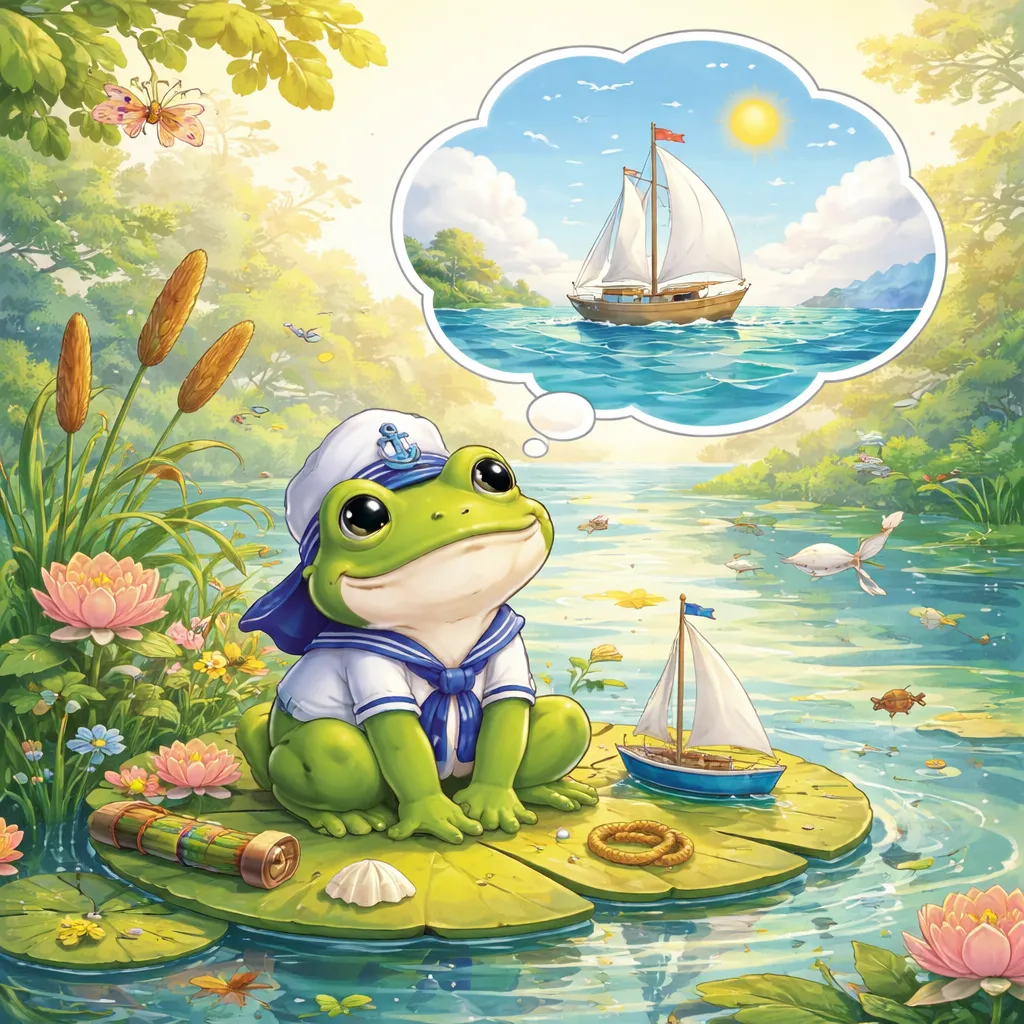

Have you ever dreamed of being something amazing when you grow up? Maybe a pilot, a scientist, or an explorer. What if you were a small pond animal with a very big dream of the wide, open sea? In China, there is a funny and inspiring song about a little frog with exactly that huge dream. Let’s leap into the story of “The Frog That Wants to Be a Sailor” (小青蛙想当水手, Xiǎo qīngwā xiǎng dāng shuǐshǒu).
About the Song
Let’s read the hopeful, adventurous words of this playful song.
小青蛙,穿绿褂,
整天住在池塘下。
它有一个大梦想,
想当一名小水手。
告别了它的泥巴家,
朝着大河就出发。
风也大,浪也大,
差点打翻小青蛙。
小青蛙,不害怕,
紧紧抱住小木筏。
总有一天我要说,
我是一名真正的水手啦!
English Translation:
Little frog, wears a green coat,
Lives all day under the pond.
It has a big dream,
Wants to be a little sailor.
It said goodbye to its muddy home,
And set off towards the big river.
The wind was big, the waves were big,
They almost capsized the little frog.
Little frog, not afraid,
Hugged its little raft tightly.
Someday I will say,
I am a real sailor!
This song is a modern Chinese children’s song that tells a story of aspiration and adventure. The song personifies a little green frog who lives a typical frog life in a muddy pond. But this frog is different—it dreams of becoming a sailor on the vast waters. The song follows the frog’s brave decision to leave home, its scary encounter with big river waves, and its determined promise to keep going until its dream comes true. The melody is cheerful and storytelling, with a rhythm that rises and falls like waves. It’s a song about having big dreams, facing fears, and the courage to pursue something new, even when you’re small.
What the Song is About
The song paints a picture of a brave dreamer. We meet a little frog in its green “coat,” living quietly at the bottom of a pond. But inside, it holds a “big dream”: it doesn’t just want to swim; it wants to be a sailor on a boat, exploring big rivers and seas.
To follow this dream, the frog must be brave. It leaves its safe, muddy home and starts a journey toward the big river. The journey is not easy. Right away, it meets challenges. The wind is strong. The waves are huge. The water is so rough that the frog’s tiny raft almost flips over! But the frog does not give up. It is not afraid. It holds onto its raft as tightly as it can. The song ends with the frog’s hopeful voice. It promises itself that “someday” it will achieve its dream and be able to proudly say, “I am a real sailor!” The song is about the journey toward a goal, including the scary parts, and the determination needed to keep going.
Who Made It & Its Story
“The Frog That Wants to Be a Sailor” is a contemporary Chinese children’s song, likely composed in the late 20th or early 21st century. It is part of a genre of Chinese children’s music that focuses on encouraging creativity, ambition, and resilience. While specific composer credits are not widely publicized, the song is popular in Chinese kindergartens and early elementary education. The story taps into the classic theme of “the small hero on a big adventure,” similar to tales in many cultures. It reflects modern educational values that encourage children to have aspirations, to try new things, and to be persistent even when faced with setbacks. The frog’s dream of being a sailor, a job so different from its pond life, teaches that it’s okay to dream beyond your immediate surroundings.
This song is popular for three encouraging reasons. First, its melody is catchy, narrative, and easy to follow, making the story fun to listen to and sing. Second, it presents a very relatable metaphor for a child’s own aspirations and fears. The frog is small, the world (the river) is big and scary, but the dream is exciting. Third, it balances challenge with hope. The song doesn’t pretend the journey is easy (the big waves), but it absolutely celebrates the courage to try and the belief in “someday,” which is a powerful message for children.
When to Sing It
This song is perfect for empowering and imaginative moments. You can sing it when you or a friend are trying something new and feeling a little nervous, to be as brave as the frog. You can chant it as a family before starting a fun project or going on a trip, pretending you’re all sailors on an adventure. You can also sing it playfully at a pond or lake, imagining the dreams of the creatures living there.
What Children Can Learn
This aspirational story-song teaches about dreams, language, and courage.
Vocabulary
The song teaches us words about dreams, nature, and adventure. A “frog” (青蛙, qīngwā) is a green amphibian that lives near water. A “pond” (池塘, chítáng) is a small, still body of water. A “dream” (梦想, mèngxiǎng) is a strong hope or wish for the future. A “sailor” (水手, shuǐshǒu) is a person who works on ships. A “raft” (木筏, mùfá) is a simple boat made of logs tied together. “Wind” (风, fēng) and “waves” (浪, làng) are moving air and water. “Someday” (总有一天, zǒngyǒu yītiān) means at an unknown time in the future.
Let’s use these words! You can say, “She had a dream to become a painter.” Or, “The raft floated gently down the stream.” New word: Aspiration. This is a hope or ambition to achieve something. The frog has a big aspiration.
Language Skills
This song is a great lesson in expressing desires and future goals and describing challenges. The frog states its desire using “想” (xiǎng, want to): “想当一名小水手” (Wants to be a little sailor). This is a common way to talk about wishes.
The song then uses the structure “风也大,浪也大” (The wind was big, the waves were also big). The “也…也…” pattern means “both… and…,” which is useful for listing multiple qualities or problems. Finally, the frog talks about the future: “总有一天我要说…” (Someday I will say…). The “要” (yào) here indicates a future intention or will, showing its determination.
Sounds & Rhythm Fun
Listen to the bouncy, storytelling rhythm of the melody. The song has a clear verse structure, with a melody that rises with hope and dips with the drama of the waves. The rhythm is steady, like paddling or hopping. The lyrics have a playful, clear rhyme in Chinese, like “褂” (guà) and “下” (xià), “想” (xiǎng) and “手” (shǒu), “家” (jiā) and “发” (fā), “大” (dà) and “怕” (pà).
The rhythm is upbeat and determined. Try a light, hopping step: 小 青 蛙,穿 绿 褂 (xiǎo qīngwā, chuān lǜ guà). The melody makes the story exciting and easy to remember. This narrative, slightly dramatic, and hopeful musical pattern is perfect for acting out the story. You can write your own “I want to be” song! Use the same storytelling style. Try: “Little mouse in a tiny house, dreams of flying like a bat. Spread its arms and gave a leap, but then it almost went splat! Little mouse, not dismayed, on a paper plane it stayed. Someday I will shout and say, I’ve learned to fly today!”
Culture & Big Ideas
“The Frog That Wants to Be a Sailor” reflects modern Chinese educational values that encourage children to have 梦想 (mèngxiǎng, dreams) and 勇气 (yǒngqì, courage). It connects to the idea of exploring beyond one’s familiar environment, which in a large country like China is a common theme. While not tied to a specific festival, the spirit of adventure aligns with the excitement of new beginnings, like the start of a school year. The song also subtly teaches about adaptation and resilience—a frog is already a water creature, but it wants to master a different kind of water life. This mirrors how people can build on their strengths to reach new goals. The story champions the individual’s dream while acknowledging the very real obstacles, promoting a balanced and gritty kind of optimism.
The song conveys three important ideas. First, it’s about the validity of big dreams, no matter who you are. Even a small pond frog can dream of the sea. Second, it expresses that the path to a dream involves difficulty and fear. Leaving home and facing “big waves” is scary, but it’s part of the adventure. Third, it highlights perseverance and self-belief. The key is not to never be afraid, but to “hold on tightly” and believe in “someday.” Success is a future goal you work toward.
Values & Imagination
Imagine you are the little frog at the bottom of the pond. What does your muddy home look like? Cozy? Dark? Now, imagine looking up through the water and dreaming of the huge, sunny world above. What do you think the big river is like? Now, imagine the scary waves. How do they toss your raft? How do you hold on? Draw a three-part “Dream Journey” map. On the left, draw the small pond and the frog dreaming. In the middle, draw the frog on its raft in huge, wavy waters. On the right, draw the frog wearing a tiny sailor hat, standing proudly on the bow of a big ship. Label the parts: Dream, Challenge, Goal.
The song encourages children to identify their dreams, to be brave in taking the first step, and to be persistent when things get hard. A lovely family activity is “Dream Sharing.” Each family member draws or names one “big dream” they have (it can be silly or serious, like the frog’s). Then, each person names one “big wave” (a challenge) they might face and one “raft” (a strength or tool) they have to hold onto. This makes the song’s metaphor personal and practical.
So, as the final hopeful note about being a “real sailor” fades, think about the empowering message in this story. It is a vocabulary lesson in aspirations and nature. It is a grammar lesson in expressing wants and future intentions. It is a music lesson in a narrative, adventurous rhythm. From the first dream in the pond to the determined hold on the raft, it wraps lessons in dreaming big, accepting challenges, and persevering in a tune that makes you want to set sail on your own adventures. “The Frog That Wants to Be a Sailor” teaches us that it’s good to dream beyond your pond, that storms are part of the voyage, and that “someday” is built by holding on tight today.
Your Core Takeaways
You are now an expert on the song “The Frog That Wants to Be a Sailor” (小青蛙想当水手). You know it is a modern Chinese song about a frog who dreams of sailing and bravely faces challenges. You’ve learned words like “aspiration,” “sailor,” and “raft,” and you’ve practiced saying what you “want to be” and talking about future goals. You’ve felt its storytelling rhythm and created your own dreamer verse. You’ve also discovered the song’s message about the importance of big dreams, the reality of difficulties, and the power of perseverance.
Your Practice Missions
First, perform a “Frog’s Voyage” play. With your family, act out the song. One person is the narrator/singer. One is the frog (hopping, then pretending to paddle a raft). Others can be the wind and waves (waving sheets or making whooshing sounds). Act out leaving home, the storm, and holding on tight. End with the frog striking a proud “sailor” pose. This dramatic play embodies the story.
Second, create a “Dream & Raft” poster. Fold a paper in half. On the left side, titled “My Dream,” draw or write about one thing you aspire to be or do. On the right side, titled “My Raft,” draw or write about the things that will help you hold on when it gets tough (e.g., “practicing,” “my family’s help,” “not giving up”). Decorate it. Hang it up. This mission turns the song’s metaphor into a personal plan for resilience.