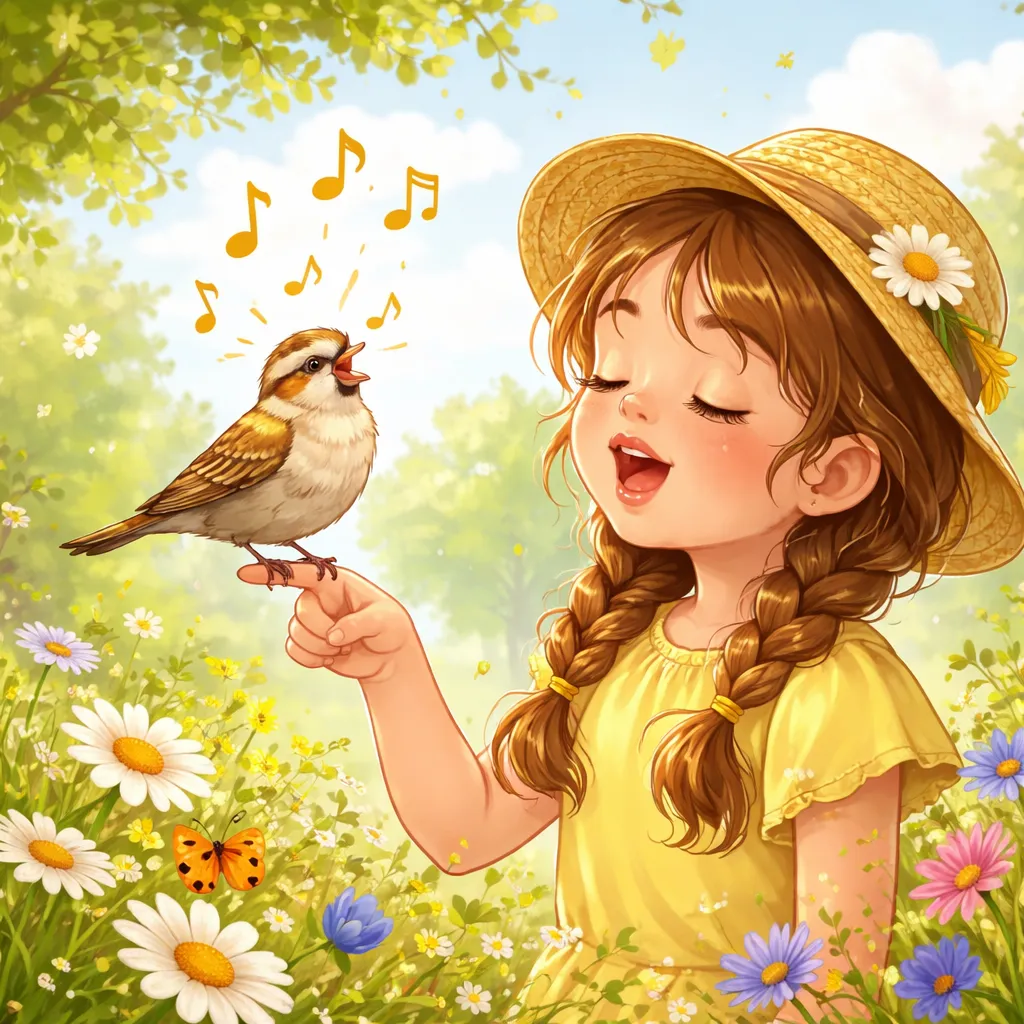

Have you ever learned the names for all the parts of your body? You know your head, shoulders, knees, and toes. But how about the parts of a bird? A long time ago, people made a fun, musical game to learn just that! It’s a catchy song that talks directly to a little bird. Let’s learn the famous song “Alouette.”
About the Song
“Alouette” is a special song. It is almost always sung in its original French, even by people who don’t speak French! Here are the classic words. We’ll learn what they mean.
Alouette, gentille alouette,
Alouette, je te plumerai.
Je te plumerai la tête,
Je te plumerai la tête,
Et la tête, et la tête,
Alouette, alouette.
Ah!
Alouette, gentille alouette,
Alouette, je te plumerai.
Je te plumerai le bec,
Je te plumerai le bec,
Et le bec, et le bec,
Et la tête, et la tête,
Alouette, alouette.
Ah!
(The song continues, adding a new body part each verse: le nez (the nose), les yeux (the eyes), le cou (the neck), les ailes (the wings), le dos (the back), les pattes (the legs), la queue (the tail)).
This song is a traditional French-Canadian folk song. It is a lively, playful call-and-response song. The singer is talking to a little lark (“alouette”), telling it in a teasing way that they are going to pluck its feathers from different parts of its body. It is not a scary song; it’s a funny, rhythmic game for remembering words. The song comes from the French settlers and fur traders (called voyageurs) in Canada hundreds of years ago. They sang it to keep rhythm while paddling their canoes across vast lakes and rivers. The English version is simply the French words sung as-is; the meaning is learned separately, which is part of the fun!
What the Song is About
The song creates a funny, repetitive picture. A person sees a small, gentle lark (“gentille alouette”). They call out to the bird. They tell the bird, “I will pluck you.” This sounds strange, but it’s part of the game.
Then, the singer starts a list. They point to the bird’s head and sing, “I will pluck your head.” They sing it twice. Then they point and repeat, “And the head, and the head,” before calling the bird’s name again. In the next verse, they add a new part: the beak. They sing, “I will pluck your beak,” twice. Then, they must remember all the previous parts in reverse order! They sing, “And the beak, and the beak, and the head, and the head, Alouette!” Each new verse adds another part (eyes, nose, neck, wings, back, legs, tail), and the singer has to remember the whole growing list backwards. It’s a fantastic memory game set to music.
Who Made It & Its Story
“Alouette” is a traditional folk song, so it has no single author. It was created by the French-Canadian voyageurs and fur traders in the 19th century as a work song. The steady, strong rhythm was perfect for coordinating their paddling strokes on long journeys. The song’s topic—plucking a bird—might seem odd, but it likely comes from a common practice of preparing game birds for food after hunting. The song turned this everyday task into a fun, social activity to pass the time and build teamwork.
This song became a worldwide favorite for three main reasons. First, its melody is incredibly energetic, catchy, and easy to sing loudly, perfect for groups. Second, it is a brilliant teaching tool. It teaches French vocabulary for body parts in a way that is impossible to forget because of the repetitive, cumulative structure. Third, it is a participatory game. The call-and-response format and the memory challenge make it active and engaging, not just a song you listen to.
When to Sing It
This song is perfect for energetic, group moments. You can sing it on a long family car trip, taking turns choosing the next body part to “pluck.” You can sing it in the playground with friends, marching around and pointing to the parts on your own body as you sing them. You can also chant it as a clapping game, clapping on the beat and getting faster with each new verse for a fun challenge.
What Children Can Learn
This lively, cumulative song is a powerhouse of learning. Let’s discover all the knowledge packed into its playful verses.
Vocabulary
The song is a fun way to learn French words for body parts! “Alouette” means “lark,” a type of small songbird. “Gentille” means “nice” or “gentle.” “Je te plumerai” means “I will pluck you.” “Plumer” means to remove feathers.
Now, the body parts (with the French definite article: le for masculine, la for feminine):
la tête - the head
le bec - the beak
le nez - the nose
les yeux - the eyes
le cou - the neck
les ailes - the wings
le dos - the back
les pattes - the legs/feet
la queue - the tail
New word: Cumulative Song. This is a song where each verse adds a new line or element, and you must remember all the previous ones. “Alouette” is a famous cumulative song.
Language Skills
This song is a masterclass in the Future Tense and Direct Object Pronouns in French. The future tense is used to talk about what will happen. The key phrase is “Je te plumerai.” Let’s break it down: “Je” means I. “Te” is the direct object pronoun meaning “you.” “Plumerai” is the future tense of the verb “plumer” (to pluck). So, “I will pluck you.”
The structure is repeated for each body part: “Je te plumerai la tête.” This means “I will pluck your head.” (Literally: I you will-pluck the head). In French, you say “the head” instead of “your head” in this context. The song also practices the imperative mood (giving commands) in a playful way, as the singer is declaring what they will do to the bird. The repetitive listing also teaches the definite articles (le, la, les) that go with every noun in French.
Sounds & Rhythm Fun
Listen to the energetic, driving pattern of the song. It uses lots of call-and-response, where a leader sings a line and others repeat. The melody has a strong, bouncing rhythm that makes you want to move. The “Ah!” at the end of each verse is a fun, shouted release of energy.
The rhythm is steady, strong, and march-like, perfect for paddling or walking. Try patting your knees in time: A-lou-ETTE, gen-TILLE a-lou-ETTE. The melody is simple, built on a scale, and very repetitive, which is why it’s so easy to learn and hard to forget. This powerful, work-song rhythm acts like a metronome, locking the sequence of foreign words into your memory through muscle and sound. You can create your own cumulative song! Use the same structure but in English. Try: “My backpack, my friendly backpack, I will pack you today. I will pack my pencil, I will pack my pencil, and my pencil, and my pencil, my backpack, my backpack, hey!” Then add “my book,” “my lunch,” etc.
Culture & Big Ideas
“Alouette” is a beautiful window into the culture of French Canada and the life of the voyageurs. These were the explorers and fur traders who traveled by canoe across North America. Singing was vital for morale and coordination during their exhausting journeys. This song connects us to a time of exploration, trade, and a lifestyle deeply connected to rivers, forests, and wildlife.
The song communicates three interesting ideas. First, it’s about interaction with nature for sustenance. The song comes from a context where hunting and preparing birds for food was a normal part of life, teaching us about historical ways of living off the land. Second, it highlights the importance of rhythm and music in work. The song shows how people used music to make hard, repetitive tasks feel easier and more communal. Third, it’s a celebration of memory and mental challenge. Remembering the ever-growing list of body parts backwards is a fun cognitive workout, showing that learning can be a game.
Values & Imagination
Let your imagination fly with the alouette. Imagine you are a voyageur in a giant birchbark canoe. The water is sparkling. The pine forests go on forever. You and your friends paddle in perfect time, singing this song. What does the little lark look like flying over the water? Is it brown and quick? Instead of thinking of the song as scary, imagine it as a silly, playful tease to a bird that is much too fast to ever catch. Draw a picture of a friendly lark, and label all its body parts in French: la tête, le bec, les yeux. Give it a cheerful expression.
The song can inspire respect for cultural traditions and languages. A simple idea is to play a “Gentille Alouette” game with a stuffed animal. Take a favorite stuffed bird or animal. Gently point to its different body parts as you sing the French words. This turns the song into a gentle, loving game of naming, not plucking, celebrating the creature and the new words you’ve learned.
So, as we reach the end of our journey with this song, think about the path it has traveled. It started in the canoes of French-Canadian fur traders, helping them paddle in unison across wild lakes. It became a playful way for children around the world to learn French words and challenge their memories. The song “Alouette” is more than a list of body parts. It is a lesson in future tense wrapped in a work chant. It is a vocabulary drill disguised as a teasing game. It is a history lesson about explorers, sung to a bouncing, unforgettable tune. From the first call of “Alouette!” to the final, triumphant listing of all its body parts, the song teaches us that language learning can be active, that music has the power to coordinate and connect people, and that even the simplest folk songs carry stories of a whole way of life within their lively, repetitive verses.
Your Core Takeaways
You are now a friend to the song “Alouette.” You know it is a traditional French-Canadian voyageur song that teaches body parts through a cumulative, call-and-response game. You’ve learned French words for la tête (head) and le bec (beak), and you understand the future tense phrase “je te plumerai.” You’ve felt its strong, paddling rhythm and even started your own cumulative song. You’ve also explored its connection to Canadian history, the use of music in work, and the fun of a good memory challenge.
Your Practice Missions
First, be a voyageur canoeist. Find a stick or a spoon to be your “paddle.” Sit on the floor and pretend to paddle a canoe. Sing “Alouette” out loud, making one paddle stroke for each major beat of the song. See if you can make it all the way to la queue (the tail) without stopping! This helps you feel the song’s original purpose.
Second, play the “Alouette Memory Challenge” with a friend or family member. Stand facing each other. The first person starts by singing the first verse and touching their own head. The next person sings the next verse, touching their head and their chin (for le bec). Each person adds a new body part and must remember and touch all the previous ones in order. How many verses can your group complete without a mistake? This turns the song into an active, physical memory game.