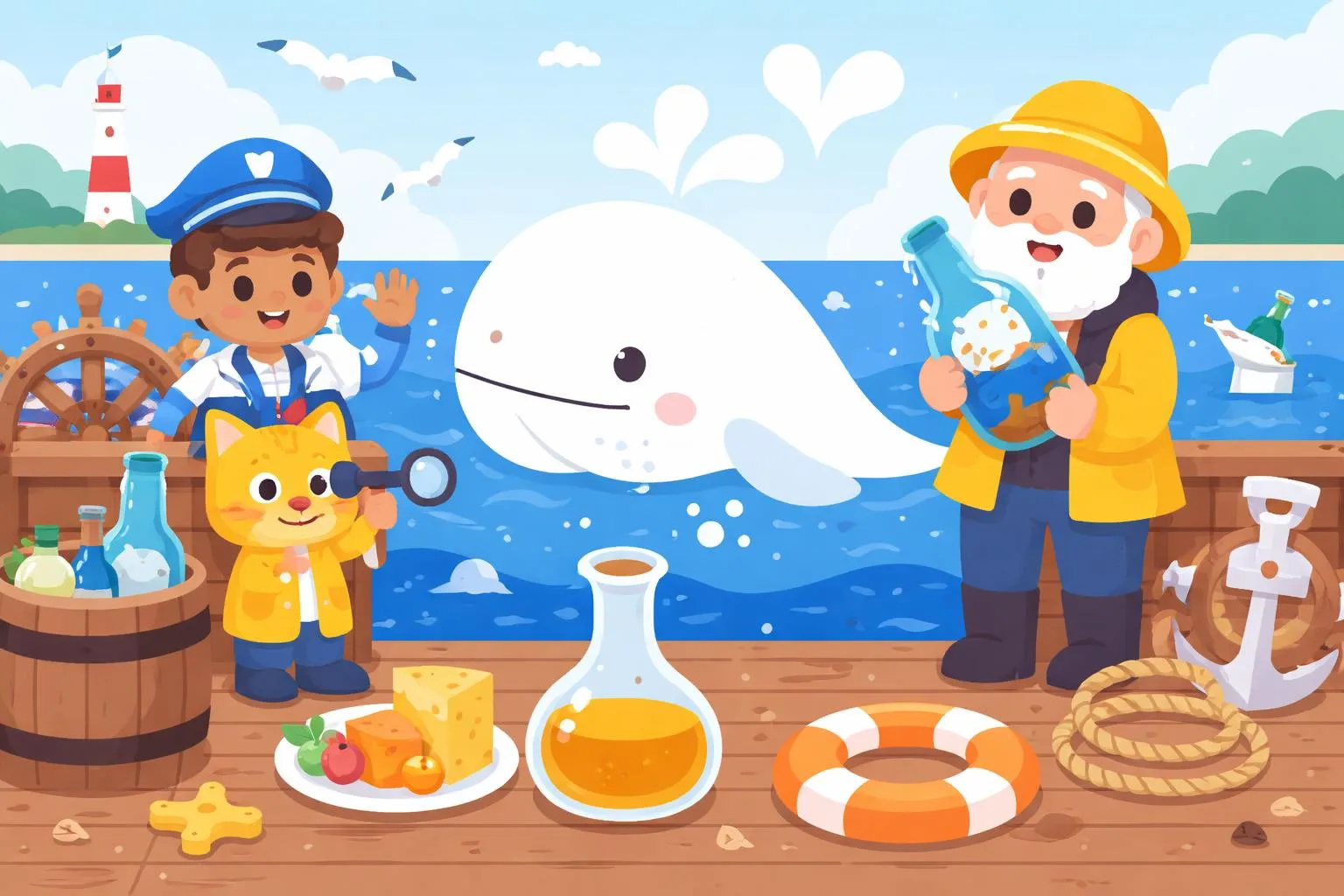

Original Story:
Ere the English ship fades from sight be it set down here, that she hailed from London, and was named after the late Samuel Enderby, merchant of that city, the original of the famous whaling house of Enderby & Sons; a house which in my poor whaleman’s opinion, comes not far behind the united royal houses of the Tudors and Bourbons, in point of real historical interest. How long, prior to the year of our Lord 1775, this great whaling house was in existence, my numerous fish-documents do not make plain; but in that year (1775) it fitted out the first English ships that ever regularly hunted the Sperm Whale; though for some score of years previous (ever since 1726) our valiant Coffins and Maceys of Nantucket and the Vineyard had in large fleets pursued the Leviathan, but only in the North and South Atlantic: not elsewhere. Be it distinctly recorded here, that the Nantucketers were the first among mankind to harpoon with civilized steel the great Sperm Whale; and that for half a century they were the only people of the whole globe who so harpooned him.
In 1778, a fine ship, the Amelia, fitted out for the express purpose, and at the sole charge of the vigorous Enderbys, boldly rounded Cape Horn, and was the first among the nations to lower a whale-boat of any sort in the great South Sea. The voyage was a skilful and lucky one; and returning to her berth with her hold full of the precious sperm, the Amelia’s example was soon followed by other ships, English and American, and thus the vast Sperm Whale grounds of the Pacific were thrown open. But not content with this good deed, the indefatigable house again bestirred itself: Samuel and all his Sons- how many, their mother only knows- and under their immediate auspices, and partly, I think, at their expense, the British government was induced to send the sloop-of-war Rattler on a whaling voyage of discovery into the South Sea. Commanded by a naval Post-Captain, the Rattler made a rattling voyage of it, and did some service; how much does not appear. But this is not all. In 1819, the same house fitted out a discovery whale ship of their own, to go on a tasting cruise to the remote waters of Japan. That ship- well called the “Syren”- made a noble experimental cruise; and it was thus that the great Japanese Whaling Ground first became generally known. The Syren in this famous voyage was commanded by a Captain Coffin, a Nantucketer.
All honor to the Enderbies, therefore, whose house, I think, exists to the present day; though doubtless the original Samuel must long ago have slipped his cable for the great South Sea of the other world.
The ship named after him was worthy of the honor, being a very fast sailer and a noble craft every way. I boarded her once at midnight somewhere off the Patagonian coast, and drank good flip down in the forecastle. It was a fine gam we had, and they were all trumps- every soul on board. A short life to them, and a jolly death. And that fine gam I had- long, very long after old Ahab touched her planks with his ivory heel- it minds me of the noble, solid, Saxon hospitality of that ship; and may my parson forget me, and the devil remember me, if I ever lose sight of it. Flip? Did I say we had flip? Yes, and we flipped it at the rate of ten gallons the hour; and when the squall came (for it’s squally off there by Patagonia), and all hands- visitors and all- were called to reef topsails, we were so top-heavy that we had to swing each other aloft in bowlines; and we ignorantly furled the skirts of our jackets into the sails, so that we hung there, reefed fast in the howling gale, a warning example to all drunken tars. However, the masts did not go overboard; and by and by we scrambled down, so sober, that we had to pass the flip again, though the savage salt spray bursting down the forecastle scuttle, rather too much diluted and pickled it for my taste.
The beef was fine- tough, but with body in it. They said it was bullbeef; others, that it was dromedary beef; but I do not know, for certain, how that was. They had dumplings too; small, but substantial, symmetrically globular, and indestructible dumplings. I fancied that you could feel them, and roll them about in you after they were swallowed. If you stooped over too far forward, you risked their pitching out of you like billiard-balls. The bread- but that couldn’t be helped; besides, it was an anti-scorbutic, in short, the bread contained the only fresh fare they had. But the forecastle was not very light, and it was very easy to step over into a dark corner when you ate it. But all in all, taking her from truck to helm, considering the dimensions of the cook’s boilers, including his own live parchment boilers; fore and aft, I say, the Samuel Enderby was a jolly ship; of good fare and plenty; fine flip and strong; crack fellows all, and capital from boot heels to hat-band.
But why was it, think ye, that the Samuel Enderby, and some other English whalers I know of- not all though- were such famous, hospitable ships; that passed round the beef, and the bread, and the can, and the joke; and were not soon weary of eating, and drinking, and laughing? I will tell you. The abounding good cheer of these English whalers is matter for historical research. Nor have I been at all sparing of historical whale research, when it has seemed needed.
The English were preceded in the whale fishery by the Hollanders, Zealanders, and Danes; from whom they derived many terms still extant in the fishery; and what is yet more, their fat old fashions, touching plenty to eat and drink. For, as a general thing, the English merchant-ship scrimps her crew; but not so the English whaler. Hence, in the English, this thing of whaling good cheer is not normal and natural, but incidental and particular; and, therefore, must have some special origin, which is here pointed out, and will be still further elucidated.
During my researches in the Leviathanic histories, I stumbled upon an ancient Dutch volume, which, by the musty whaling smell of it, I knew must be about whalers. The title was, “Dan Coopman,” wherefore I concluded that this must be the invaluable memoirs of some Amsterdam cooper in the fishery, as every whale ship must carry its cooper. I was reinforced in this opinion by seeing that it was the production of one “Fitz Swackhammer.” But my friend Dr. Snodhead, a very learned man, professor of Low Dutch and High German in the college of Santa Claus and St. Potts, to whom I handed the work for translation, giving him a box of sperm candles for his trouble- this same Dr. Snodhead, so soon as he spied the book, assured me that “Dan Coopman” did not mean “The Cooper,” but “The Merchant.” In short, this ancient and learned Low Dutch book treated of the commerce of Holland; and, among other subjects, contained a very interesting account of its whale fishery. And in this chapter it was, headed, “Smeer,” or “Fat,” that I found a long detailed list of the outfits for the larders and cellars of 180 sail of Dutch whalemen; from which list, as translated by Dr. Snodhead, I transcribe the following:
400,000 lbs. of beef. 60,000 lbs. Friesland pork. 150,000 lbs. of stock fish. 550,000 lbs. of biscuit. 72,000 lbs. of soft bread. 2,800 firkins of butter. 20,000 lbs. of Texel Leyden cheese. 144,000 lbs. cheese (probably an inferior article). 550 ankers of Geneva. 10,800 barrels of beer.
Most statistical tables are parchingly dry in the reading; not so in the present case, however, where the reader is flooded with whole pipes, barrels, quarts, and gills of good gin and good cheer.
At the time, I devoted three days to the studious digesting of all this beer, beef, and bread, during which many profound thoughts were incidentally suggested to me, capable of a transcendental and Platonic application; and, furthermore, I compiled supplementary tables of my own, touching the probable quantity of stock-fish, &c., consumed by every Low Dutch harpooneer in that ancient Greenland and Spitzbergen whale fishery. In the first place, the amount of butter, and Texel and Leyden cheese consumed, seems amazing. I impute it, though, to their naturally unctuous natures, being rendered still more unctuous by the nature of their vocation, and especially by their pursuing their game in those frigid Polar Seas, on the very coasts of that Esquimaux country where the convivial natives pledge each other in bumpers of train oil.
The quantity of the beer, too, is very large, 10,800 barrels. Now, as those polar fisheries could only be prosecuted in the short summer of that climate, so that the whole cruise of one of these Dutch whalemen, including the short voyage to and from the Spitzbergen sea, did not much exceed three months, say, and reckoning 30 men to each of their fleet of 180 sail, we have 5,400 Low Dutch seamen in all; therefore, I say, we have precisely two barrels of beer per man, for a twelve weeks’ allowance, exclusive of his fair proportion of that ankers of gin. Now, whether these gin and beer harpooneers, so fuddled as one might fancy them to have been, were the right sort of men to stand up in a boat’s head, and take good aim at flying whales; this would seem somewhat improbable. Yet they did aim at them, and hit them too. But this was very far North, be it remembered, where beer agrees well with the constitution; upon the Equator, in our southern fishery, beer would be apt to make the harpooneer sleepy at the mast-head and boozy in his boat; and grievous loss might ensue to Nantucket and New Bedford.
But no more; enough has been said to show that the old Dutch whalers of two or three centuries ago were high livers; and that the English whalers have not neglected so excellent an example. For, say they, when cruising in an empty ship, if you can get nothing better out of the world, get a good dinner out of it, at least. And this empties the decanter.
Story Explanation and Appreciation
This story is a fascinating historical account of the English whaling ship named Samuel Enderby, which was named after a prominent London merchant and founder of the famous whaling company Enderby & Sons. The narrative highlights the important role this company and its ships played in the development of the whaling industry, especially in hunting the Sperm Whale, a valuable species for its oil and other products.
The story traces the origins and achievements of the Enderby family and their ships, including the Amelia and the Syren, which were pioneers in exploring new whaling grounds such as the South Sea and the waters near Japan. The author shares a personal anecdote about boarding the Samuel Enderby, describing the camaraderie, hospitality, and hearty provisions aboard the ship, including the famous "flip" (a type of drink), beef, dumplings, and bread.
The narrative also explores the cultural traditions of whalers, especially the English whalers' reputation for good cheer and hospitality, which was influenced by earlier Dutch, Zealand, and Danish whaling practices. The detailed account of provisions carried by Dutch whalers centuries ago paints a vivid picture of their lifestyle, emphasizing the importance of food and drink in maintaining morale during long and harsh voyages.
The story is rich with historical detail, humor, and vivid descriptions that bring to life the adventurous spirit of whalers and the significance of the whaling industry in maritime history.
Background and Author Introduction
The story is drawn from a classic maritime narrative, likely inspired by or excerpted from Herman Melville’s Moby-Dick or related whaling histories, given the style and references to Nantucket whalers and Captain Ahab. Herman Melville (1819–1891) was an American novelist, short story writer, and poet, best known for Moby-Dick, a masterpiece exploring themes of obsession, nature, and humanity through the lens of whaling.
Melville’s works often blend adventure with deep philosophical insights and detailed knowledge of the sea and whaling culture. His writing reflects his own experiences as a sailor and his extensive research into maritime history.
Lessons and Knowledge Points for Children and Students
What can students learn from this story?
- Historical Knowledge: The story provides insight into the history of whaling, the development of maritime industries, and the exploration of new oceans and territories.
- Cultural Understanding: It teaches about the traditions and lifestyles of sailors, especially the importance of hospitality, teamwork, and morale on long voyages.
- Vocabulary Building: Students can learn nautical terms (e.g., "forecastle," "reef topsails," "harpoon") and historical references related to 18th and 19th-century maritime life.
- Appreciation of Exploration: The story highlights human curiosity and courage in exploring unknown waters and expanding knowledge.
- Critical Thinking: Reflecting on the environmental and ethical aspects of whaling can encourage discussions on conservation and human impact on nature.
Practical Applications and Inspirations
- Teamwork and Hospitality: The story shows how sharing food, drink, and laughter can build strong bonds among people working together, a lesson applicable in school groups, sports teams, and family life.
- Historical Research Skills: The narrative encourages curiosity about history and the value of researching original documents and artifacts.
- Environmental Awareness: While whaling was historically important, students can learn about the consequences of overhunting and the importance of protecting marine life today.
Reading Comprehension Questions
- Who was the ship Samuel Enderby named after?
- What was the significance of the ship Amelia in whaling history?
- What did the author describe about the hospitality aboard the Samuel Enderby?
- Which nations preceded the English in the whale fishery?
- Why did the English whalers have a reputation for good cheer and hospitality?
- What kinds of food and drink were carried by the Dutch whalers according to the story?
- How did the author describe the challenges faced during a squall near Patagonia?
- What role did the Enderby family play in expanding whaling grounds?
- Why might beer have been a suitable drink for whalers in the polar regions but not near the Equator?
- What can we learn about the importance of provisions on long sea voyages from this story?
Answers
- The ship was named after Samuel Enderby, a London merchant and founder of the Enderby & Sons whaling house.
- The Amelia was the first English ship to lower a whale-boat in the South Sea, opening new whaling grounds in the Pacific.
- The author described warm hospitality, sharing of food and drink, and lively camaraderie aboard the ship.
- The Dutch, Zealanders, and Danes preceded the English in the whale fishery.
- Their good cheer and hospitality came from traditions inherited from earlier whalers and the need to maintain morale on long voyages.
- They carried large amounts of beef, pork, stock fish, biscuit, bread, butter, cheese, gin, and beer.
- During the squall, the crew had to reef the sails while hanging aloft, struggling against strong winds but managing to keep the masts intact.
- The Enderby family funded and organized voyages that explored new whaling areas, including the South Sea and Japanese waters.
- Beer was better suited to cold climates because it helped maintain body warmth and was less likely to cause drowsiness than in hot climates near the Equator.
- Provisions were crucial for survival, health, and morale, providing nourishment and comfort during long, difficult journeys at sea.
This expanded article provides a comprehensive understanding of the original story, its historical context, and educational value for children and students, encouraging both literary appreciation and practical learning.