
Original Story:
In the first place, I wish to lay before you a particular, plain statement, touching the living bulk of this leviathan, whose skeleton we are briefly to exhibit. Such a statement may prove useful here.
According to a careful calculation I have made, and which I partly base upon Captain Scoresby’s estimate, of seventy tons for the largest sized Greenland whale of sixty feet in length; according to my careful calculation, I say, a Sperm Whale of the largest magnitude, between eighty-five and ninety feet in length, and something less than forty feet in its fullest circumference, such a whale will weigh at least ninety tons; so that, reckoning thirteen men to a ton, he would considerably outweigh the combined population of a whole village of one thousand one hundred inhabitants.
Think you not then that brains, like yoked cattle, should be put to this leviathan, to make him at all budge to any landsman’s imagination?
Having already in various ways put before you his skull, spout-hole, jaw, teeth, tail, forehead, fins, and divers other parts, I shall now simply point out what is most interesting in the general bulk of his unobstructed bones. But as the colossal skull embraces so very large a proportion of the entire extent of the skeleton; as it is by far the most complicated part; and as nothing is to be repeated concerning it in this chapter, you must not fail to carry it in your mind, or under your arm, as we proceed, otherwise you will not gain a complete notion of the general structure we are about to view.
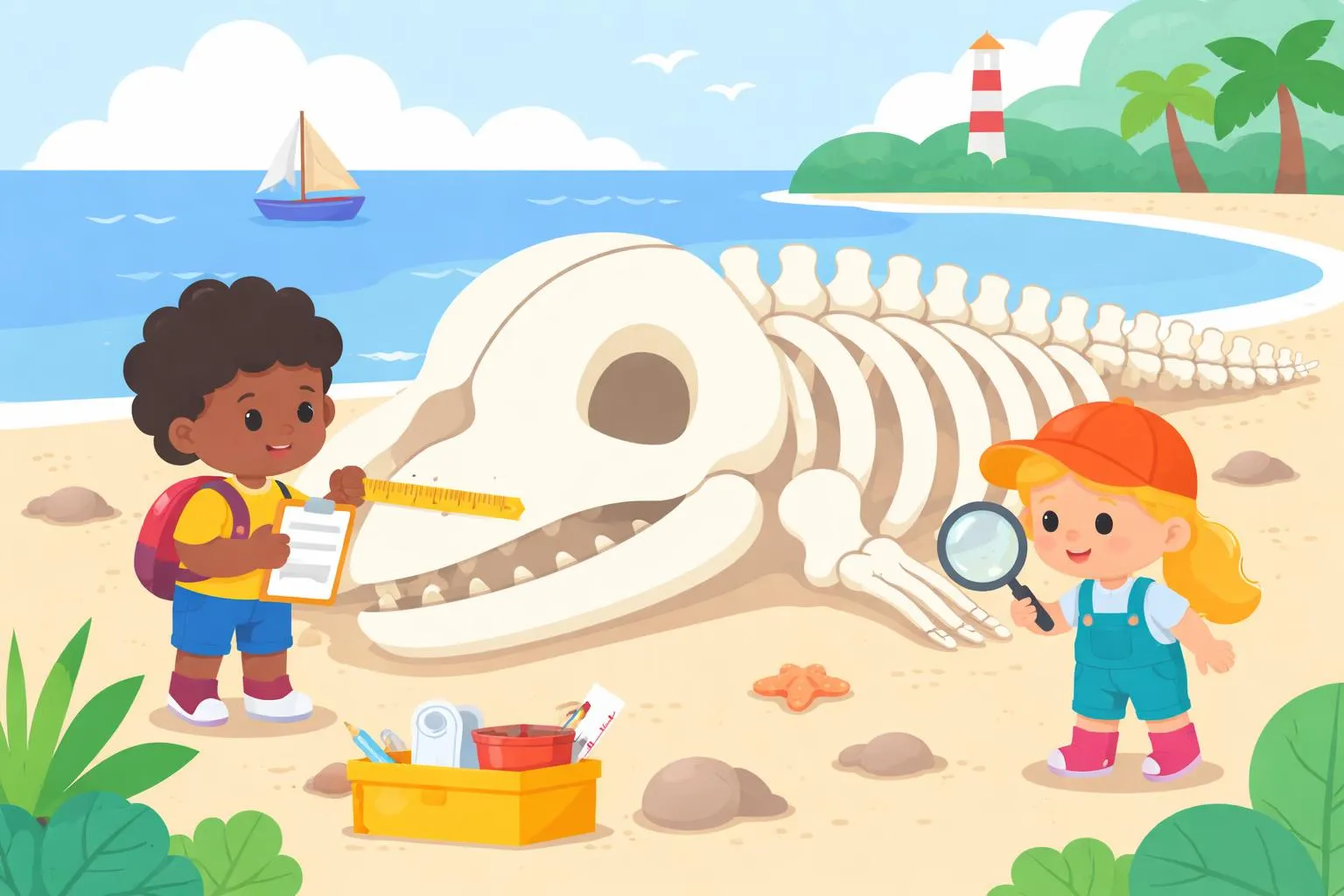
In length, the Sperm Whale’s skeleton at Tranque measured seventy-two feet: so that when fully invested and extended in life, he must have been ninety feet long; for in the whale, the skeleton loses about one fifth in length compared with the living body. Of this seventy-two feet, his skull and jaw comprised some twenty feet, leaving some fifty feet of plain backbone. Attached to this back-bone, for something less than a third of its length, was the mighty circular basket of ribs which once enclosed his vitals.
To me this vast ivory-ribbed chest, with the long, unrelieved spine, extending far away from it in a straight line, not a little resembled the hull of a great ship new-laid upon the stocks, when only some twenty of her naked bow-ribs are inserted, and the keel is otherwise, for the time, but a long, disconnected timber.
The ribs were ten on a side. The first, to begin from the neck, was nearly six feet long; the second, third, and fourth were each successively longer, till you came to the climax of the fifth, or one of the middle ribs, which measured eight feet and some inches. From that part, the remaining ribs diminished, till the tenth and last only spanned five feet and some inches. In general thickness, they all bore a seemly correspondence to their length. The middle ribs were the most arched. In some of the Arsacides they are used for beams whereon to lay footpath bridges over small streams.
In considering these ribs, I could not but be struck anew with the circumstance, so variously repeated in this book, that the skeleton of the whale is by no means the mould of his invested form. The largest of the Tranque ribs, one of the middle ones, occupied that part of the fish which, in life, is greatest in depth. Now, the greatest depth of the invested body of this particular whale must have been at least sixteen feet; whereas, the corresponding rib measured but little more than eight feet. So that this rib only conveyed half of the true notion of the living magnitude of that part. Besides, for some way, where I now saw but a naked spine, all that had been once wrapped round with tons of added bulk in flesh, muscle, blood, and bowels. Still more, for the ample fins, I here saw but a few disordered joints; and in place of the weighty and majestic, but boneless flukes, an utter blank!
How vain and foolish, then, thought I, for timid untravelled man to try to comprehend aright this wondrous whale, by merely pouring over his dead attenuated skeleton, stretched in this peaceful wood. No. Only in the heart of quickest perils; only when within the eddyings of his angry flukes; only on the profound unbounded sea, can the fully invested whale be truly and livingly found out.
But the spine. For that, the best way we can consider it is, with a crane, to pile its bones high up on end. No speedy enterprise. But now it’s done, it looks much like Pompey’s Pillar.
There are forty and odd vertebrae in all, which in the skeleton are not locked together. They mostly lie like the great knobbed blocks on a Gothic spire, forming solid courses of heavy masonry. The largest, a middle one, is in width something less than three feet, and in depth more than four. The smallest, where the spine tapers away into the tail, is only two inches in width, and looks something like a white billiard-ball. I was told that there were still smaller ones, but they had been lost by some little cannibal urchins, the priest’s children, who had stolen them to play marbles with. Thus we see how that the spine of even the hugest of living things tapers off at last into simple child’s play.
Expanded Article: Understanding the Majestic Sperm Whale Skeleton
Introduction and Summary
This fascinating passage offers a detailed look at the skeleton of a giant Sperm Whale, one of the largest creatures on Earth. The author begins by emphasizing the immense size and weight of this leviathan, comparing it to the combined population of a village to help readers grasp its enormity. The description then moves on to the whale’s skeleton, focusing on its skull, backbone, ribs, and other bones, illustrating how the skeleton alone cannot fully represent the whale’s living form. The author reflects on the challenge of truly understanding such a magnificent creature by only observing its bones, suggesting that the whale’s true essence can only be appreciated in its natural ocean environment.
Explanation and Interpretation
The passage is rich in scientific observation and poetic reflection. It reveals the complexity of the whale’s anatomy, highlighting that the skeleton is just a framework, while the living whale is much larger due to muscles, flesh, and organs. The author uses vivid comparisons, such as likening the whale’s rib cage to a ship’s hull, to help readers visualize the structure. The mention of the whale’s spine tapering down to tiny vertebrae, which children once used as marbles, adds a touch of humor and humanity to the narrative.
The underlying message is about the limitations of human understanding when faced with nature’s grandeur. The whale symbolizes the vastness and mystery of the natural world, reminding us that some wonders can only be fully appreciated in their living context, not just through scientific dissection or museum displays.
Background and Author Introduction
This passage is from a classic natural history or whaling narrative, likely written in the 19th century when exploration and scientific study of whales were popular. The author appears to be someone deeply knowledgeable about marine biology and whaling, possibly a naturalist or a whaler with a literary flair. Such works aimed to educate the public about the natural world while also inspiring awe and respect for these majestic creatures.
Reflections and Insights
Reading this story encourages us to appreciate the complexity and scale of marine life. It also teaches humility—recognizing that human knowledge is limited and that some aspects of nature remain beyond our full comprehension. The whale’s skeleton is a metaphor for how we often see only the surface or the framework of things, missing the full living reality.
Educational Value for Children and Students
From this story, children and students can learn:
- Biological concepts: Understanding anatomy, the difference between skeleton and living form, and how animals are structured.
- Measurement and scale: Grasping large numbers and sizes by comparing them to familiar objects or populations.
- Scientific observation: How to describe and analyze natural phenomena carefully and thoughtfully.
- Critical thinking: Recognizing the limits of observation and the importance of context.
- Vocabulary: Words like "leviathan," "skeleton," "vertebrae," and "circumference" enrich their language skills.
In life and learning, these lessons encourage curiosity about nature, respect for living creatures, and the development of careful observation skills. They also inspire imagination and wonder, which are crucial for scientific inquiry and creativity.
Practical Applications and Learning Challenges
- Science classes can use this passage to introduce marine biology and anatomy.
- Math lessons can explore measurements and proportions mentioned in the text.
- Language arts can focus on descriptive writing and vocabulary building.
- Critical thinking exercises can challenge students to consider how context affects understanding.
One challenge might be helping students visualize such large dimensions and relate abstract numbers to real-world concepts. Teachers can use models, videos, or interactive tools to aid comprehension.
Reading Comprehension Exercises
1. What is the estimated weight of the largest Sperm Whale mentioned in the passage?
A) 60 tons
B) 70 tons
C) 90 tons
D) 110 tons
2. Why does the author say the whale’s skeleton does not fully represent its living form?
A) Because the skeleton is incomplete.
B) Because the living whale has much more bulk from flesh and organs.
C) Because the bones are too small.
D) Because the whale changes size frequently.
3. How does the author describe the whale’s rib cage?
A) Like a small basket.
B) Like the hull of a great ship.
C) Like a giant cage made of metal.
D) Like a bird’s nest.
4. What does the author suggest is the best way to truly understand the whale?
A) By studying its skeleton in a museum.
B) By reading books about whales.
C) By seeing it alive in the ocean.
D) By drawing pictures of it.
5. What humorous detail does the author include about the vertebrae?
A) They were used as building blocks.
B) They were stolen by children to play marbles.
C) They were lost at sea.
D) They were sold as souvenirs.
Answers:
- C) 90 tons
- B) Because the living whale has much more bulk from flesh and organs.
- B) Like the hull of a great ship.
- C) By seeing it alive in the ocean.
- B) They were stolen by children to play marbles.
This passage invites readers to marvel at the grandeur of the natural world while learning important scientific and literary lessons. It is a valuable resource for education, encouraging a blend of factual knowledge and imaginative appreciation.