
Original Story:
Seat thyself sultanically among the moons of Saturn, and take high abstracted man alone; and he seems a wonder, a grandeur, and a woe. But from the same point, take mankind in mass, and for the most part, they seem a mob of unnecessary duplicates, both contemporary and hereditary. But most humble though he was, and far from furnishing an example of the high, humane abstraction; the Pequod’s carpenter was no duplicate; hence, he now comes in person on this stage.
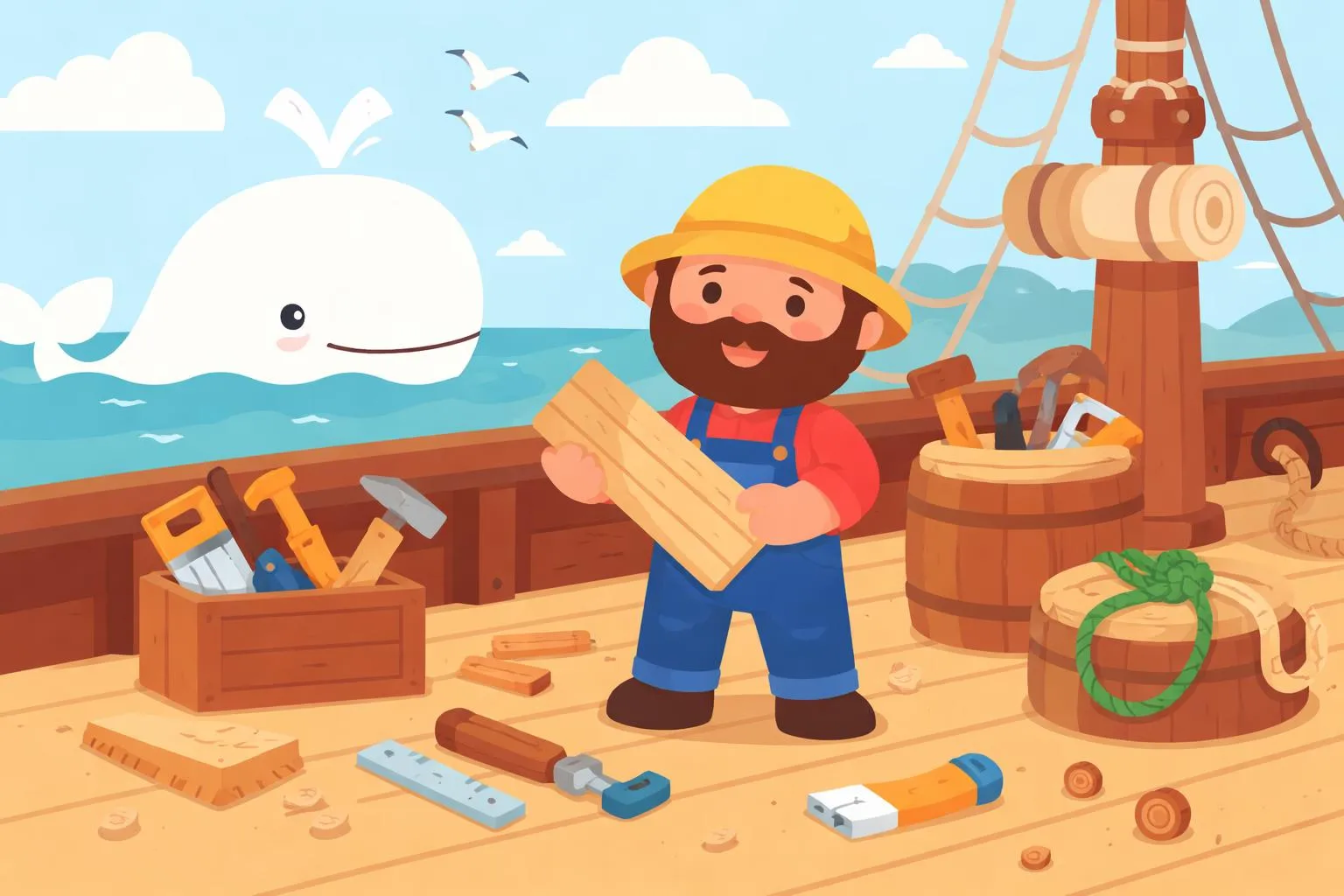
Like all sea-going ship carpenters, and more especially those belonging to whaling vessels, he was, to a certain off-hand, practical extent, alike experienced in numerous trades and callings collateral to his own; the carpenter’s pursuit being the ancient and outbranching trunk of all those numerous handicrafts which more or less have to do with wood as an auxiliary material. But, besides the application to him of the generic remark above, this carpenter of the Pequod was singularly efficient in those thousand nameless mechanical emergencies continually recurring in a large ship, upon a three or four years’ voyage, in uncivilized and far-distant seas. For not to speak of his readiness in ordinary duties:- repairing stove boats, sprung spars, reforming the shape of clumsy-bladed oars, inserting bull’s eyes in the deck, or new tree-nails in the side planks, and other miscellaneous matters more directly pertaining to his special business; he was moreover unhesitatingly expert in all manner of conflicting aptitudes, both useful and capricious.
The one grand stage where he enacted all his various parts so manifold, was his vice-bench; a long rude ponderous table furnished with several vices, of different sizes, and both of iron and of wood. At all times except when whales were alongside, this bench was securely lashed athwartships against the rear of the Try-works.
A belaying pin is found too large to be easily inserted into its hole: the carpenter claps it into one of his ever ready vices, and straightway files it smaller. A lost landbird of strange plumage strays on board, and is made a captive: out of clean shaved rods of right-whale bone, and cross-beams of sperm whale ivory, the carpenter makes a pagoda-looking cage for it. An oarsmen sprains his wrist: the carpenter concocts a soothing lotion. Stubb longed for vermillion stars to be painted upon the blade of his every oar; screwing each oar in his big vice of wood, the carpenter symmetrically supplies the constellation. A sailor takes a fancy to wear shark-bone ear-rings: the carpenter drills his ears. Another has the toothache: the carpenter out pincers, and clapping one hand upon his bench bids him be seated there; but the poor fellow unmanageably winces under the unconcluded operation; whirling round the handle of his wooden vice, the carpenter signs him to clap his jaw in that, if he would have him draw the tooth.
Thus, this carpenter was prepared at all points, and alike indifferent and without respect in all. Teeth he accounted bits of ivory; heads he deemed but top-blocks; men themselves he lightly held for capstans. But while now upon so wide a field thus variously accomplished and with such liveliness of expertness in him, too; all this would seem to argue some uncommon vivacity of intelligence. But not precisely so. For nothing was this man more remarkable, than for a certain impersonal stolidity as it were; impersonal, I say; for it so shaded off into the surrounding infinite of things, that it seemed one with the general stolidity discernible in the whole visible world; which while pauselessly active in uncounted modes, still eternally holds its peace, and ignores you, though you dig foundations for cathedrals. Yet was this half-horrible stolidity in him, involving, too, as it appeared, an all-ramifying heartlessness;- yet was it oddly dashed at times, with an old, crutch-like, antediluvian, wheezing humorousness, not unstreaked now and then with a certain grizzled wittiness; such as might have served to pass the time during the midnight watch on the bearded forecastle of Noah’s ark. Was it that this old carpenter had been a life-long wanderer, whose much rolling, to and fro, not only had gathered no moss; but what is more, had rubbed off whatever small outward clingings might have originally pertained to him? He was a stript abstract; an unfractioned integral; uncompromised as a new-born babe; living without premeditated reference to this world or the next. You might almost say, that this strange uncompromisedness in him involved a sort of unintelligence; for in his numerous trades, he did not seem to work so much by reason or by instinct, or simply because he had been tutored to it, or by any intermixture of all these, even or uneven; but merely by kind of deaf and dumb, spontaneous literal process. He was a pure manipulater; his brain, if he had ever had one, must have early oozed along into the muscles of his fingers. He was like one of those unreasoning but still highly useful, multum in parvo, Sheffield contrivances, assuming the exterior- though a little swelled- of a common pocket knife; but containing, not only blades of various sizes, but also screw-drivers, cork-screws, tweezers, awls, pens, rulers, nail-filers, countersinkers. So, if his superiors wanted to use the carpenter for a screw-driver, all they had to do was to open that part of him, and the screw was fast: or if for tweezers, take him up by the legs, and there they were.
Yet, as previously hinted, this omnitooled, open-and-shut carpenter, was, after all, no mere machine of an automaton. If he did not have a common soul in him, he had a subtle something that somehow anomalously did its duty. What that was, whether essence of quicksilver, or a few drops of hartshorn, there is no telling. But there it was; and there it had abided for now some sixty years or more. And this it was, this same unaccountable, cunning life-principle in him; this it was, that kept him a great part of the time soliloquizing; but only like an unreasoning wheel, which also hummingly soliloquizes; or rather, his body was a sentry-box and this soliloquizer on guard there, and talking all the time to keep himself awake.
Expansion and Analysis
Summary and Interpretation
This passage introduces the carpenter of the Pequod, a whaling ship, portraying him as a unique individual amidst the vastness of humanity. While mankind in general may seem like a mass of duplicates, this carpenter stands out as an original, skilled, and versatile craftsman. His expertise extends beyond his primary role, encompassing many trades related to woodworking and mechanical repairs essential for the survival of a ship on a long voyage.
The carpenter is described as a man of extraordinary practical skills who can fix almost anything on board—from repairing broken parts of the ship to creating intricate cages from whale bones. His workshop is a sturdy vice-bench where he performs all sorts of tasks, demonstrating his resourcefulness and adaptability. Despite his wide range of skills, the carpenter is portrayed as somewhat impersonal and stoic, almost machine-like in his efficiency, yet occasionally showing a dry, ancient humor.
The narrative suggests that the carpenter’s life has stripped him of attachments and emotions, making him an abstract figure who operates almost instinctively, without deep reflection or emotional involvement. His mind seems to have merged with his hands, making him a living tool, yet there remains an inexplicable life force within him that keeps him going, soliloquizing quietly to himself as a way of staying alert.
Background and Author Introduction
This excerpt is from Moby-Dick, written by Herman Melville, an American author of the 19th century. Melville’s work often explores complex themes such as the nature of humanity, fate, and the struggle against the unknown. Moby-Dick is considered a classic of American literature and is renowned for its detailed descriptions of whaling life and its philosophical depth.
The Pequod’s carpenter represents a symbolic figure in the novel—an embodiment of human skill, endurance, and the tension between mechanical efficiency and the mysterious essence of life. Melville’s writing style combines rich imagery with deep philosophical reflection, making his stories both engaging and thought-provoking.
Educational Value and Lessons for Children and Students
From this story, children and students can learn several important lessons:
- Versatility and Skill Development: The carpenter’s ability to perform many different tasks shows the value of learning diverse skills and being adaptable in various situations.
- Resourcefulness: His creative solutions to problems on the ship teach the importance of thinking practically and using available resources wisely.
- Stoicism and Resilience: The carpenter’s calm, impersonal attitude highlights the strength of maintaining composure and focus, even in difficult or uncertain circumstances.
- Humor and Humanity: Despite his stoic nature, the carpenter’s occasional humor reminds us of the importance of light-heartedness and wit in life.
Practical Applications and Insights
In daily life and learning environments, the carpenter’s example encourages:
- Problem-solving skills: Like the carpenter fixing broken tools, students can learn to approach challenges methodically and creatively.
- Hands-on learning: Engaging in crafts or practical tasks can build confidence and technical abilities.
- Emotional balance: Developing a calm, steady mindset helps in managing stress and staying productive.
- Appreciating craftsmanship: Understanding the value of skilled work fosters respect for trades and manual professions.
Reading Comprehension Exercises
Questions:
- What makes the Pequod’s carpenter different from the general mass of mankind?
- List three tasks the carpenter performs on the ship.
- How does the carpenter’s attitude towards people and things appear?
- What does the carpenter’s vice-bench symbolize in the story?
- Why does the author describe the carpenter as both a machine and a living person?
- What lessons can we learn from the carpenter’s behavior and skills?
Answers:
- He is unique and not a mere duplicate; he is highly skilled and versatile.
- Repairing stove boats, making cages from whale bones, and drilling ears for earrings.
- He is impersonal, stoic, and indifferent, treating things and people almost like tools.
- It symbolizes his workshop and the place where his many skills come together.
- Because he works instinctively and efficiently like a machine, yet he has a subtle life force and personality.
- To be versatile, resourceful, calm under pressure, and to value practical skills and humor.
This story not only enriches our imagination about life at sea but also inspires us to cultivate skills, resilience, and a balanced outlook in our own lives.