
Original Story:
According to usage they were pumping the ship next morning; and lo! no inconsiderable oil came up with the water; the casks below must have sprung a bad leak. Much concern was shown; and Starbuck went down into the cabin to report this unfavorable affair.
In Sperm-whalemen with any considerable quantity of oil on board, it is a regular semiweekly duty to conduct a hose into the hold, and drench the casks with sea-water; which afterwards, at varying intervals, is removed by the ship’s pumps. Hereby the casks are sought to be kept damply tight; while by the changed character of the withdrawn water, the mariners readily detect any serious leakage in the precious cargo.
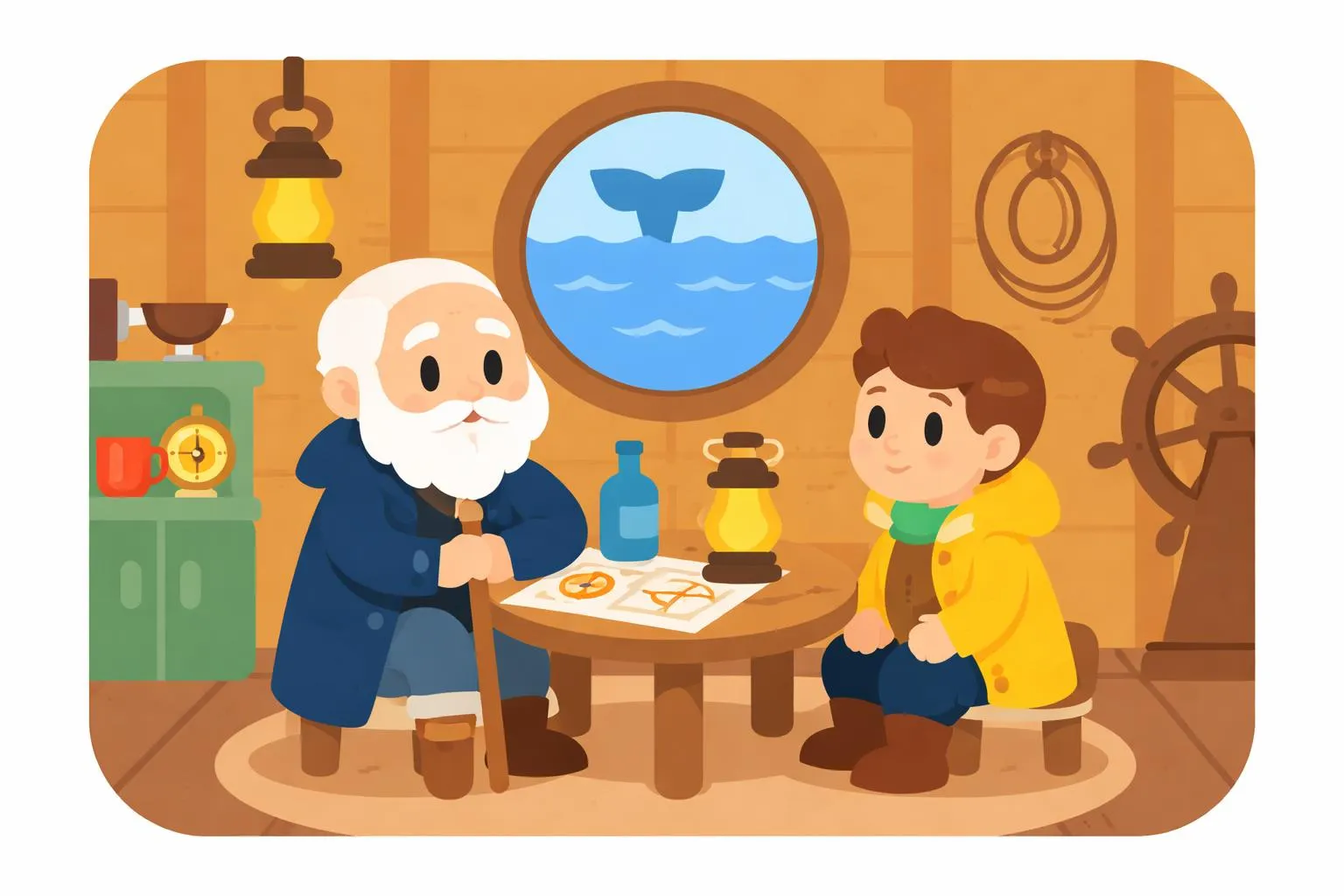
Now, from the South and West the Pequod was drawing nigh to Formosa and the Bashee Isles, between which lies one of the tropical outlets from the China waters into the Pacific. And so Starbuck found Ahab with a general chart of the oriental archipelagoes spread before him; and another separate one representing the long eastern coasts of the Japanese islands- Niphon, Matsmai, and Sikoke. With his snow-white new ivory leg braced against the screwed leg of his table, and with a long pruning-hook of a jack-knife in his hand, the wondrous old man, with his back to the gangway door, was wrinkling his brow, and tracing his old courses again.
“Who’s there?” hearing the footstep at the door, but not turning round to it. “On deck! Begone!”
“Captain Ahab mistakes; it is I. The oil in the hold is leaking, sir. We must up Burtons and break out.”
“Up Burtons and break out? Now that we are nearing Japan; heave-to here for a week to tinker a parcel of old hoops?”
“Either do that, sir, or waste in one day more oil than we may make good in a year. What we come twenty thousand miles to get is worth saving, sir.”
“So it is, so it is; if we get it.”
“I was speaking of the oil in the hold, sir.”
“And I was not speaking or thinking of that at all. Begone! Let it leak! I’m all aleak myself. Aye! leaks in leaks! not only full of leaky casks, but those leaky casks are in a leaky ship; and that’s a far worse plight than the Pequod’s, man. Yet I don’t stop to plug my leak; for who can find it in the deep-loaded hull; or how hope to plug it, even if found, in this life’s howling ale? Starbuck! I’ll not have the Burtons hoisted.”
“What will the owners say, sir?”
“Let the owners stand on Nantucket beach and outyell the Typhoons. What cares Ahab? Owners, owners? Thou art always prating to me, Starbuck, about those miserly owners, as if the owners were my conscience. But look ye, the only real owner of anything is its commander; and hark ye, my conscience is in this ship’s keel.- On deck!”
“Captain Ahab,” said the reddening mate, moving further into the cabin, with a daring so strangely respectful and cautious that it almost seemed not only every way seeking to avoid the slightest outward manifestation of itself, but within also seemed more than half distrustful of itself; “A better man than I might well pass over in thee what he would quickly enough resent in a younger man; aye, and in a happier, Captain Ahab.”
“Devils! Dost thou then so much as dare to critically think of me?- On deck!”
“Nay, sir, not yet; I do entreat. And I do dare, sir- to be forbearing! Shall we not understand each other better than hitherto, Captain Ahab?”
Ahab seized a loaded musket from the rack (forming part of most South-Sea-men’s cabin furniture), and pointing it towards Starbuck, exclaimed: “There is one God that is Lord over the earth, and one Captain that is lord over the Pequod.- On deck!”
For an instant in the flashing eyes of the mate, and his fiery cheeks, you would have almost thought that he had really received the blaze of the levelled tube. But, mastering his emotion, he half calmly rose, and as he quitted the cabin, paused for an instant and said: “Thou hast outraged, not insulted me, sir; but for that I ask thee not to beware of Starbuck; thou wouldst but laugh; but let Ahab beware of Ahab; beware of thyself, old man.”
“He waxes brave, but nevertheless obeys; most careful bravery that!” murmured Ahab, as Starbuck disappeared. “What’s that he said- Ahab beware of Ahab- there’s something there!” Then unconsciously using the musket for a staff, with an iron brow he paced to and fro in the little cabin; but presently the thick plaits of his forehead relaxed, and returning the gun to the rack, he went to the deck.
“Thou art but too good a fellow, Starbuck,” he said lowly to the mate; then raising his voice to the crew: “Furl the t’gallant-sails, and close-reef the top-sails, fore and aft; back the main-yard; up Burtons, and break out in the main-hold.”
It were perhaps vain to surmise exactly why it was, that as respecting Starbuck, Ahab thus acted. It may have been a flash of honesty in him; or mere prudential policy which, under the circumstance, imperiously forbade the slightest symptom of open disaffection, however transient, in the important chief officer of his ship. However it was, his orders were executed; and the Burtons were hoisted.
Story Explanation and Analysis
This passage is a dramatic excerpt from Herman Melville's classic novel Moby-Dick, focusing on a tense moment aboard the whaling ship Pequod. The story revolves around Captain Ahab, the obsessed leader of the ship, and Starbuck, his cautious and conscientious first mate.
Summary of the Passage
The crew discovers that the precious whale oil stored in the ship's hold is leaking due to damaged casks. Starbuck urges Captain Ahab to stop the ship and repair the damage to prevent further loss. However, Ahab refuses, revealing his stubborn and reckless nature. He dismisses the concerns about the leaking oil and even about the ship’s condition itself, expressing a fatalistic attitude toward the dangers they face. The conflict between Ahab and Starbuck highlights the tension between duty and obsession, pragmatism and recklessness.
Themes and Literary Devices
- Obsession and Authority: Ahab’s refusal to address the leaking oil symbolizes his obsessive focus on his personal quest, disregarding practical concerns. His assertion that the captain is the "only real owner" emphasizes the absolute authority he wields.
- Conflict: The dialogue between Ahab and Starbuck reveals a clash between reason and passion. Starbuck represents caution and responsibility, while Ahab embodies stubbornness and defiance.
- Symbolism: The leaking oil and the "leaky ship" metaphorically represent the vulnerabilities and dangers lurking beneath the surface of the Pequod’s voyage, as well as Ahab’s own flawed leadership.
- Tone and Mood: The tone is tense and foreboding, with Ahab’s volatile behavior creating an atmosphere of impending crisis.
Background and Author Introduction
Herman Melville (1819–1891) was an American novelist, short story writer, and poet, best known for Moby-Dick (1851). The novel is considered one of the greatest works of American literature. Melville drew upon his own experiences as a sailor to create a vivid and symbolic narrative about man’s struggle against nature, fate, and himself.
The Pequod’s voyage is a metaphor for life’s journey, filled with challenges and moral dilemmas. Melville’s complex characters and rich symbolism invite readers to reflect on themes such as obsession, leadership, and the human condition.
Educational Insights and Learning Points
What Children and Students Can Learn:
- Critical Thinking: The story encourages readers to analyze characters’ motivations and consequences of their actions.
- Moral Lessons: It highlights the importance of responsibility and listening to reason, as Starbuck tries to warn Ahab.
- Vocabulary Building: Words like leak, casks, heave-to, Burtons, and archipelagoes introduce nautical and historical terms.
- Understanding Conflict: The passage is a good example of interpersonal conflict and leadership challenges.
Practical Applications in Life and Learning:
- Decision-Making: Students can learn about the importance of weighing risks and benefits before making decisions.
- Leadership Qualities: The story shows how leadership can be both a responsibility and a burden, and how stubbornness can lead to disaster.
- Problem-Solving: The leaking oil problem can be used to discuss practical problem-solving and maintenance in real-life situations.
Reading Comprehension Exercises
Questions:
- What problem did the crew discover in the ship’s hold?
- Why does Starbuck want to stop the ship and fix the problem?
- How does Captain Ahab respond to the news about the leaking oil?
- What does Ahab mean when he says, “the only real owner of anything is its commander”?
- How does the conflict between Ahab and Starbuck reflect their different personalities?
- What does the leaking oil symbolize in this passage?
- Why might Ahab refuse to repair the leaks despite the risks?
- How does Starbuck show both respect and caution in his conversation with Ahab?
- What mood is created by the interaction between Ahab and Starbuck?
- What lesson can readers learn from this passage about leadership?
Answers:
- The crew discovered that the whale oil was leaking from damaged casks in the ship’s hold.
- Starbuck wants to stop the ship to repair the leaks to prevent wasting valuable oil.
- Ahab refuses to stop the ship or repair the leaks, showing stubbornness and fatalism.
- Ahab means that the captain has ultimate authority and responsibility over the ship and its cargo.
- Ahab is obsessive and reckless, while Starbuck is cautious and responsible, leading to conflict.
- The leaking oil symbolizes vulnerability, danger, and the consequences of neglect.
- Ahab refuses because he is focused on his personal mission and does not want to delay the voyage.
- Starbuck speaks carefully and respectfully, trying to persuade Ahab without provoking anger.
- The mood is tense, foreboding, and filled with conflict.
- Readers learn that good leadership requires responsibility, listening to advice, and balancing passion with reason.
This passage offers rich material for exploring complex characters, moral dilemmas, and the consequences of leadership decisions. It encourages young readers to think deeply about human nature and the importance of responsibility in any journey.