
Original Story:
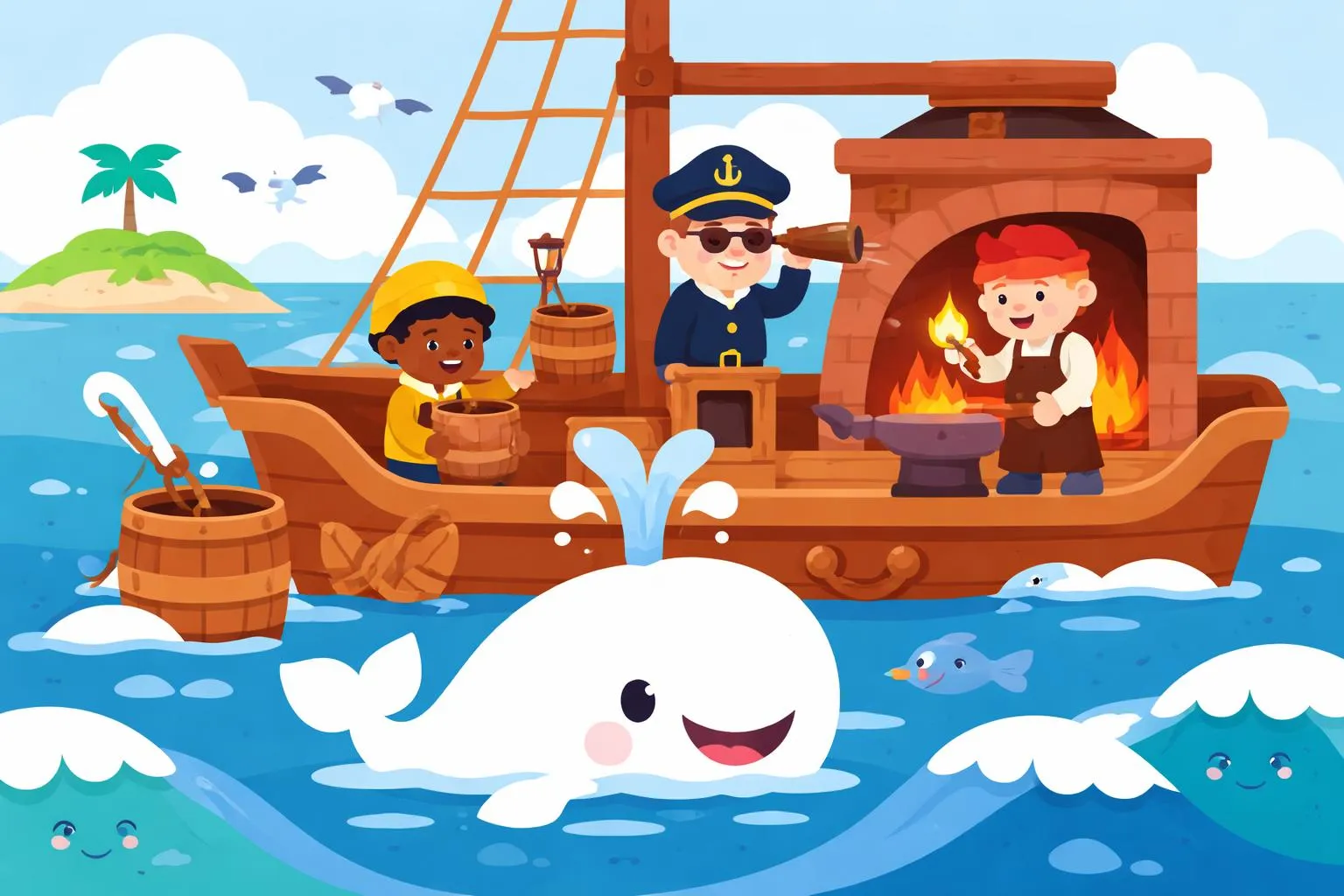
With matted beard, and swathed in a bristling shark-skin apron, about mid-day, Perth was standing between his forge and anvil, the latter placed upon an iron-wood log, with one hand holding a pike-head in the coals, and with the other at his forge’s lungs, when Captain Ahab came along, carrying in his hand a small rusty-looking leathern bag. While yet a little distance from the forge, moody Ahab paused; till at last, Perth, withdrawing his iron from the fire, began hammering it upon the anvil- the red mass sending off the sparks in thick hovering flights, some of which flew close to Ahab.
“Are these thy Mother Carey’s chickens, Perth? they are always flying in thy wake; birds of good omen, too, but not to all;- look here, they burn; but thou- thou liv’st among them without a scorch.”
“Because I am scorched all over, Captain Ahab,” answered Perth, resting for a moment on his hammer; “I am past scorching-, not easily can’st thou scorch a scar.”
“Well, well; no more. Thy shrunk voice sounds too calmly, sanely woeful to me. In no Paradise myself, I am impatient of all misery in others that is not mad. Thou should’st go mad, blacksmith; say, why dost thou not go mad? How can’st thou endure without being mad? Do the heavens yet hate thee, that thou can’st not go mad?- What wert thou making there?”
“Welding an old pike-head, sir; there were seams and dents in it.”
“And can’st thou make it all smooth again, blacksmith, after such hard usage as it had?”
“I think so, sir.”
“And I suppose thou can’st smoothe almost any seams and dents; never mind how hard the metal, blacksmith?”
“Aye, sir, I think I can; all seams and dents but one.”
“Look ye here then,” cried Ahab, passionately advancing, and leaning with both hands on Perth’s shoulders; “look ye here- here- can ye smoothe out a seam like this, blacksmith,” sweeping one hand across his ribbed brow; “if thou could’st, blacksmith, glad enough would I lay my head upon thy anvil, and feel thy heaviest hammer between my eyes. Answer! Can’st thou smoothe this seam?”
“Oh! that is the one, sir! Said I not all seams and dents but one?”
“Aye, blacksmith, it is the one; aye, man, it is unsmoothable; for though thou only see’st it here in my flesh, it has worked down into the bone of my skull- that is all wrinkles! But, away with child’s play; no more gaffs and pikes to-day. Look ye here!” jingling the leathern bag, as if it were full of gold coins. “I, too, want a harpoon made; one that a thousand yoke of fiends could not part, Perth; something that will stick in a whale like his own fin-bone. There’s the stuff,” flinging the pouch upon the anvil. “Look ye, blacksmith, these are the gathered nail-stubbs of the steel shoes of racing horses.”
“Horse-shoe stubbs, sir? Why, Captain Ahab, thou hast here, then, the best and stubbornest stuff we blacksmiths ever work.”
“I know it, old man; these stubbs will weld together like glue from the melted bones of murderers. Quick! forge me the harpoon. And forge me first, twelve rods for its shank; then wind, and twist, and hammer these twelve together like the yarns and strands of a tow-line. Quick! I’ll blow the fire.”
When at last the twelve rods were made, Ahab tried them, one by one, by spiralling them, with his own hand, round a long, heavy iron bolt. “A flaw!” rejecting the last one. “Work that over again, Perth.”
This done, Perth was about to begin welding the twelve into one, when Ahab stayed his hand, and said he would weld his own iron. As, then, regular, gasping hems, he hammered on the anvil, Perth passing to him the glowing rods, after the other, and the hard pressed forge shooting up its intense straight flame, the Parsee passed silently, and bowing over his head towards the fire, seemed invoking some curse or some blessing on the toil. But, as Ahab looked up, he slid aside.
“What’s that bunch of lucifers dodging about there for?” muttered Stubb, looking on from the forecastle. “That Parsee smells fire like a fusee; and smells of it himself, like a hot musket’s powder-pan.”
At last the shank, in one complete rod, received its final heat; and as Perth, to temper it, plunged it all hissing into the cask of water near by, the scalding steam shot up into Ahab’s bent face.
“Would’st thou brand me, Perth?” wincing for a moment with the pain; “have I been but forging my own branding-iron, then?”
“Pray God, not that; yet I fear something, Captain Ahab. Is not this harpoon for the White Whale?”
“For the white fiend! But now for the barbs; thou must make them thyself, man. Here are my razors- the best of steel; here, and make the barbs sharp as the needle-sleet of the Icy Sea.”
For a moment, the old blacksmith eyed the razors as though he would fain not use them.
“Take them, man, I have no need for them; for I now neither shave, sup, nor pray till- but here- to work!”
Fashioned at last into an arrowy shape, and welded by Perth to the shank, the steel soon pointed the end of the iron; and as the blacksmith was about giving the barbs their final heat, prior to tempering them, he cried to Ahab to place the water-cask near.
“No, no- no water for that; I want it of the true death-temper. Ahoy, there! Tashtego, Queequeg, Daggoo! What say ye, pagans! Will ye give me as much blood as will cover this barb?” holding it high up. A cluster of dark nods replied, Yes. Three punctures were made in the heathen flesh, and the White Whale’s barbs were then tempered.
“Ego non baptizo te in nomine patris, sed in nomine diaboli!” deliriously howled Ahab, as the malignant iron scorchingly devoured the baptismal blood.
Now, mustering the spare poles from below, and selecting one of hickory, with the bark still investing it, Ahab fitted the end to the socket of the iron. A coil of new tow-line was then unwound, and some fathoms of it taken to the windlass, and stretched to a great tension. Pressing his foot upon it, till the rope hummed like a harp-string, then eagerly bending over it, and seeing no strandings, Ahab exclaimed, “Good! and now for the seizings.”
At one extremity the rope was unstranded, and the separate spread yarns were all braided and woven round the socket of the harpoon; the pole was then driven hard up into the socket; from the lower end the rope was traced halfway along the pole’s length, and firmly secured so, with inter-twistings of twine. This done, pole, iron, and rope- like the Three Fates- remained inseparable, and Ahab moodily stalked away with the weapon; the sound of his ivory leg, and the sound of the hickory pole, both hollowly ringing along every plank. But ere he entered his cabin, light, unnatural, half-bantering, yet most piteous sound was heard. Oh! Pip, thy wretched laugh, thy idle but unresting eye; all thy strange mummeries not unmeaningly blended with the black tragedy of the melancholy ship, and mocked it!
Story Summary and Analysis
This excerpt vividly depicts a tense and symbolic scene between Perth, the blacksmith, and Captain Ahab, the obsessed whaler from Herman Melville’s Moby-Dick. Perth is at his forge, repairing an old pike-head, when Ahab arrives with a special request: to forge a harpoon unlike any other, one strong enough to kill the legendary White Whale. The dialogue between the two men reveals deep themes of pain, madness, and obsession.
Ahab’s scarred forehead, described as an “unsmoothable seam,” symbolizes his inner torment and relentless quest for vengeance. The forging of the harpoon, made from the toughest materials—horse-shoe nail stubs—and tempered with blood, represents the deadly tool of his obsession. The ritualistic preparation and the invocation of dark curses emphasize the almost supernatural intensity of Ahab’s mission.
The scene also introduces other characters briefly, such as Tashtego, Queequeg, and Daggoo, who are native harpooners, highlighting the multicultural crew aboard the Pequod. The eerie laughter of Pip at the end adds a haunting, tragic note, reflecting the madness and darkness enveloping the ship.
Background and Author Introduction
This passage is from Herman Melville’s classic novel Moby-Dick, first published in 1851. Melville was an American novelist, short story writer, and poet, whose work initially received mixed reviews but later became a cornerstone of American literature. Moby-Dick is considered one of the greatest novels ever written, exploring themes such as obsession, revenge, humanity’s relationship with nature, and fate.
Melville drew inspiration from his own experiences at sea and from whaling voyages. The character of Captain Ahab is a complex figure embodying the destructive power of obsession. The novel’s rich symbolism, philosophical depth, and vivid descriptions make it a challenging but rewarding read.
Educational Insights and Learning Points
What Children and Students Can Learn:
- Themes of Obsession and Consequences: The story shows how Ahab’s obsession with the White Whale consumes him, teaching readers about the dangers of letting a single goal dominate one’s life.
- Symbolism: Students can explore symbols like Ahab’s scar, the harpoon, and the forge to understand how objects represent deeper meanings.
- Character Study: The contrast between Perth’s calm endurance and Ahab’s fiery passion offers lessons in different ways people cope with suffering.
- Cultural Diversity: The mention of Tashtego, Queequeg, and Daggoo introduces multiculturalism and teamwork.
- Craftsmanship and Patience: Perth’s detailed forging process highlights the value of skill, patience, and dedication.
Practical Applications:
- In Life: Understanding obsession helps students recognize when passion becomes harmful.
- In Study: Analyzing symbolism improves critical thinking and interpretation skills.
- In Art and Writing: The vivid imagery and dialogue can inspire creative writing and storytelling techniques.
- In History and Culture: Learning about whaling and 19th-century maritime life enriches historical knowledge.
Reading Comprehension Questions
- Who is Perth and what is he doing at the beginning of the story?
- What is the significance of the “unsmoothable seam” on Ahab’s forehead?
- Why does Ahab want a special harpoon forged?
- What materials does Ahab provide for making the harpoon, and why are they important?
- How does the story depict Ahab’s mental state?
- What role do Tashtego, Queequeg, and Daggoo play in the story?
- What is the symbolic meaning of tempering the harpoon barbs with blood?
- How does the scene end and what mood does Pip’s laughter create?
Answers
- Perth is the blacksmith, standing at his forge repairing an old pike-head.
- The “unsmoothable seam” symbolizes Ahab’s deep emotional and physical scars caused by his obsession and past trauma.
- Ahab wants a harpoon strong enough to kill the White Whale, symbolizing his quest for revenge.
- He provides horse-shoe nail stubs, which are extremely tough and durable, symbolizing strength and resilience.
- Ahab is depicted as moody, obsessive, and almost mad, consumed by his mission.
- They are native harpooners and crew members who support Ahab’s quest.
- Tempering the barbs with blood symbolizes a dark ritual, binding the weapon with sacrifice and fate.
- The scene ends with Pip’s eerie laughter, creating a mood of madness and tragedy.
This story segment offers rich material for students to explore literary devices, character analysis, and thematic depth, while also providing historical and cultural context related to 19th-century whaling. It encourages reflection on human nature, obsession, and the consequences of single-minded pursuits.