
Original Story:
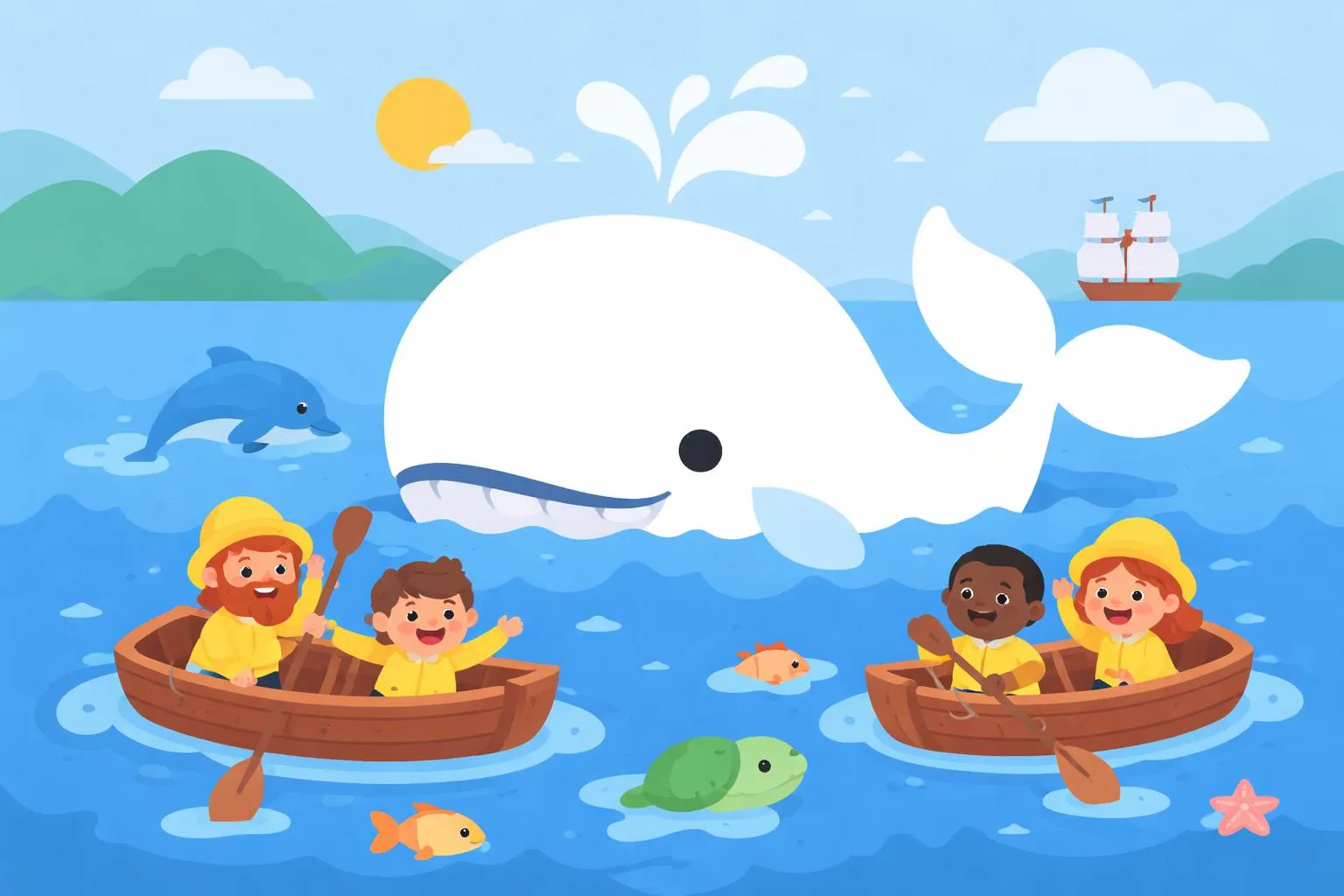
Not seldom in this life, when, on the right side, fortune’s favorites sail close by us, we, though all adroop before, catch somewhat of the rushing breeze, and joyfully feel our bagging sails fill out. So seemed it with the Pequod. For next day after encountering the gay Bachelor, whales were seen and four were slain; and one of them by Ahab.
It was far down the afternoon; and when all the spearings of the crimson fight were done; and floating in the lovely sunset sea and sky, sun and whale both stilly died together; then, such a sweetness and such plaintiveness, such inwreathing orisons curled up in that rosy air, that it almost seemed as if far over from the deep green convent valleys of the Manilla isles, the Spanish land-breeze, wantonly turned sailor, had gone to sea, freighted with these vesper hymns.
Soothed again, but only soothed to deeper gloom, Ahab, who had sterned off from the whale, sat intently watching his final wanings from the now tranquil boat. For that strange spectacle observable in all sperm whales dying- the turning sunwards of the head, and so expiring- that strange spectacle, beheld of such a placid evening, somehow to Ahab conveyed a wondrousness unknown before.
“He turns and turns him to it,- how slowly, but how steadfastly, his homage-rendering and invoking brow, with his last dying motions. He too worships fire; most faithful, broad, baronial vassal of the sun!- Oh that these too-favoring eyes should see these too-favoring sights. Look! here, far water-locked; beyond all hum of human weal or woe; in these most candid and impartial seas; where to traditions no rocks furnish tablets; where for long Chinese ages, the billows have still rolled on speechless and unspoken to, as stars that shine upon the Niger’s unknown source; here, too, life dies sunwards full of faith, but see! no sooner dead, than death whirls round the corpse, and it heads some other way.
“Oh, thou dark Hindoo half of nature, who of drowned bones hast builded thy separate throne somewhere in the heart of these unverdured seas; thou art an infidel, thou queen, and too truly speakest to me in the wide-slaughtering Typhoon, and the hushed burial of its after calm. Nor has this thy whale sunwards turned his dying head, and then gone round again, without a lesson to me.
“Oh, trebly hooped and welded hip of power! Oh, high aspiring, rainbowed jet!- that one strivest, this one jettest all in vain! In vain, oh whale, dost thou seek intercedings with yon all-quickening sun, that only calls forth life, but gives it not again. Yet dost thou darker half, rock me with a prouder, if a darker faith. All thy unnamable imminglings float beneath me here; I am buoyed by breaths of once living things, exhaled as air, but water now.
“Then hail, for ever hail, O sea, in whose eternal tossings the wild fowl finds his only rest. Born of earth, yet suckled by the sea; though hill and valley mothered me, ye billows are my foster-brothers!”
Story Summary and Interpretation
This passage is a poetic and reflective excerpt from Herman Melville’s Moby-Dick, focusing on Captain Ahab’s encounter with whales after a successful hunt. The Pequod, Ahab’s ship, benefits from a favorable wind and the sighting of whales, leading to the killing of four whales, one of which Ahab himself kills. The scene transitions into a serene yet somber moment as the sun sets and a whale dies, turning its head slowly toward the sun — a natural, almost ritualistic act that captivates Ahab.
The passage is rich in symbolism. The whale’s turning toward the sun as it dies represents a kind of worship or homage to life-giving fire, the sun, which paradoxically gives life but cannot restore it once lost. Ahab’s reflection on this phenomenon reveals his complex relationship with nature and fate — he sees both faith and futility in the whale’s final act. The sea is portrayed as a powerful, eternal force, a cradle of life and death, and Ahab feels a deep connection to it, despite his darker thoughts.
Background and Author Introduction
Herman Melville (1819–1891) was an American novelist, short story writer, and poet, best known for Moby-Dick, which was published in 1851. The novel is considered one of the greatest works of American literature and explores themes such as obsession, revenge, the struggle between man and nature, and the limits of knowledge.
Melville drew on his own experiences as a sailor to create vivid and realistic depictions of life at sea. Moby-Dick was not widely appreciated during Melville’s lifetime but has since become a classic, studied for its complex narrative style and profound philosophical insights.
Reflection and Learning Points
From this story, children and students can learn several important lessons:
- Respect for Nature: The whale’s death and Ahab’s reflections teach us to respect the natural world and its cycles of life and death.
- Observation and Reflection: Ahab’s detailed observation of the whale’s behavior encourages careful attention to detail and thoughtful reflection.
- Complex Emotions: The passage shows how feelings can be mixed — joy from success, sorrow from death, and awe at nature’s mysteries.
- Symbolism and Metaphor: The story is a good example of how writers use symbols (like the sun and the whale) to convey deeper meanings.
Practical Applications
- In science classes, students can explore marine biology and the behavior of whales.
- In literature lessons, this passage can be used to study symbolism, imagery, and narrative voice.
- In life skills, the story encourages resilience and finding meaning even in difficult or dark moments.
- Students can practice critical thinking by discussing Ahab’s conflicting emotions and what they reveal about human nature.
Reading Comprehension Questions
- What event happens the day after the Pequod encounters the gay Bachelor?
- How does the whale behave as it dies, and why is this significant to Ahab?
- What does Ahab mean when he says the whale “worships fire”?
- How does the sea symbolize life and death in this passage?
- What emotions does Ahab experience while watching the dying whale?
- What lessons can be learned from the whale’s final act?
Answers
- The Pequod sees whales and kills four of them, one of which is killed by Ahab.
- The whale slowly turns its head toward the sun as it dies, which Ahab finds wondrous and symbolic of homage or worship.
- Ahab means that the whale is paying respect to the sun, which represents fire and life-giving energy, even in death.
- The sea is eternal and impartial, a place where life and death continuously occur, symbolizing the cycle of nature.
- Ahab feels a mix of awe, sorrow, and deeper gloom as he watches the whale’s final moments.
- The whale’s final act teaches about faith, the inevitability of death, and the mystery of life’s connection to nature.
This passage from Moby-Dick offers a rich literary experience, blending vivid imagery with deep philosophical reflection. It invites readers, especially young learners, to explore themes of nature, life, death, and human emotion, encouraging both intellectual and emotional growth.