
Original Story:
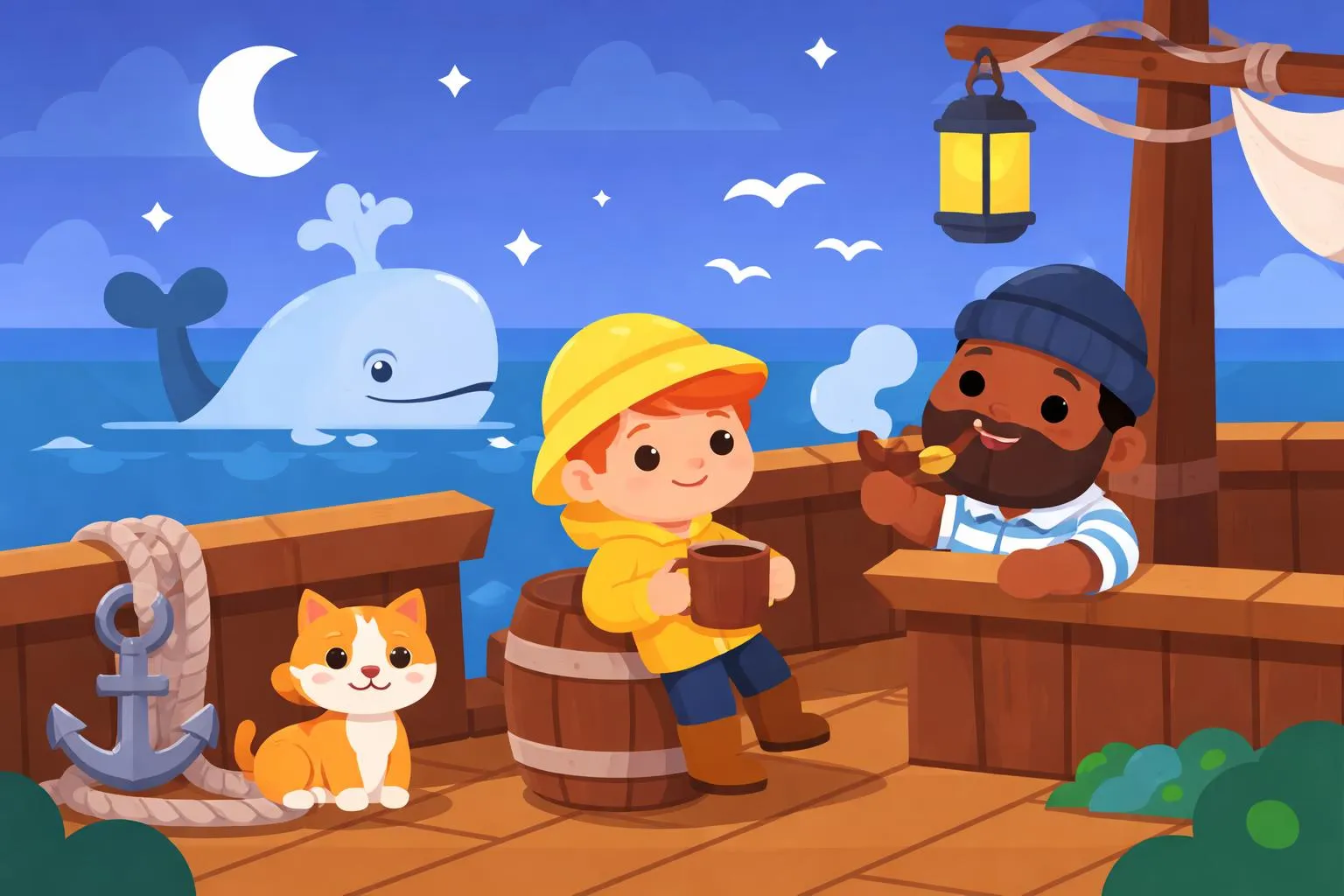
Stubb and Flask mounted on them, and passing additional lashings over the anchors there hanging.
No, Stubb; you may pound that knot there as much as you please, but you will never pound into me what you were just now saying. And how long ago is it since you said the very contrary? Didn’t you once say that whatever ship Ahab sails in, that ship should pay something extra on its insurance policy, just as though it were loaded with powder barrels aft and boxes of lucifers forward? Stop, now; didn’t you say so?”
“Well, suppose I did? What then! I’ve part changed my flesh since that time, why not my mind? Besides, supposing we are loaded with powder barrels aft and lucifers forward; how the devil could the lucifers get afire in this drenching spray here? Why, my little man, you have pretty red hair, but you couldn’t get afire now. Shake yourself; you’re Aquarius, or the water-bearer, Flask; might fill pitchers at your coat collar. Don’t you see, then, that for these extra risks the Marine Insurance companies have extra guarantees? Here are hydrants, Flask. But hark, again, and I’ll answer ye the other thing. First take your leg of from the crown of the anchor here, though, so I can pass the rope; now listen. What’s the mighty difference between holding a mast’s lightning-rod in the storm, and standing close by a mast that hasn’t got any lightning-rod at all in a storm? Don’t you see, you timber-head, that no harm can come to the holder of the rod, unless the mast is first struck? What are you talking about, then? Not one ship in a hundred carries rods, and Ahab,- aye, man, and all of us,- were in no more danger then, in my poor opinion, than all the crews in ten thousand ships now sailing the seas. Why, you King-Post, you, I suppose you would have every man in the world go about with a small lightning-rod running up the corner of his hat, like a militia officer’s skewered feather, and trailing behind like his sash. Why don’t ye be sensible, Flask? it’s easy to be sensible; why don’t ye, then? any man with half an eye can be sensible.”
“I don’t know that, Stubb. You sometimes find it rather hard.”
“Yes, when a fellow’s soaked through, it’s hard to be sensible, that’s a fact. And I am about drenched with this spray. Never mind; catch the turn there, and pass it. Seems to me we are lashing down these anchors now as if they were never going to be used again. Tying these two anchors here, Flask, seems like tying a man’s hands behind him. And what big generous hands they are, to be sure. These are your iron fists, hey? What a hold they have, too! I wonder, Flask, whether the world is anchored anywhere; if she is, she swings with an uncommon long cable, though. There, hammer that knot down, and we’ve done. So; next to touching land, lighting on deck is the most satisfactory. I say, just wring out my jacket skirts, will ye? Thank ye. They laugh at long-togs so, Flask; but seems to me, a long-tailed coat ought always to be worn in all storms afloat. The tails tapering down that way, serve to carry off the water, d’ye see. Same with cocked hats; the cocks form gable-end eave-troughs, Flask. No more monkey-jackets and tarpaulins for me; I must mount a swallow-tail, and drive down a beaver; so. Halloa! whew! there goes my tarpaulin overboard; Lord, Lord, that the winds that come from heaven should be so unmannerly! This is a nasty night, lad.
Story Explanation and Appreciation
This passage is a vivid dialogue between two sailors, Stubb and Flask, who are preparing their ship for a stormy night at sea. The conversation highlights their practical and humorous attitudes toward danger and superstition. Stubb challenges Flask’s earlier fears about the ship’s safety and insurance risks, using witty reasoning and nautical metaphors to reassure him. The imagery of anchors, lightning rods, and storm gear illustrates the sailors’ intimate knowledge of their environment and their reliance on experience over fear.
The story captures the tension between caution and courage, a common theme in maritime tales. Stubb’s confident, sometimes sarcastic tone contrasts with Flask’s more anxious nature, creating a dynamic that brings the scene to life. The passage also reflects the harsh realities of life at sea, where sailors must constantly prepare for unpredictable weather and trust their skills and equipment.
Background and Author Introduction
This excerpt is from Herman Melville’s Moby-Dick, a classic American novel first published in 1851. Melville was a sailor and novelist whose works often explore themes of adventure, human struggle, and the natural world. Moby-Dick tells the story of Captain Ahab’s obsessive quest to hunt the great white whale, symbolizing the conflict between man and nature.
Melville’s writing is known for its rich symbolism, detailed descriptions, and philosophical depth. The novel combines thrilling sea adventure with profound reflections on fate, obsession, and the human condition. Though it was not widely appreciated during Melville’s lifetime, Moby-Dick is now regarded as one of the greatest works of American literature.
Lessons and Knowledge for Children and Students
From this passage and the larger story, children and students can learn several important lessons:
- Courage and Preparedness: The sailors’ readiness for the storm teaches the value of preparation and facing fears with practical actions.
- Critical Thinking: Stubb’s reasoning about lightning rods and insurance encourages questioning assumptions and thinking logically.
- Teamwork and Communication: The dialogue shows how sailors must work together and communicate clearly to manage challenges.
- Respect for Nature: The story highlights the power of the sea and weather, fostering respect and awareness of natural forces.
Practical Applications
- In School: Students can use this story to practice reading comprehension, critical thinking, and discussion skills.
- In Life: The themes of courage and preparation apply to everyday challenges, such as studying for exams or handling difficult situations.
- In Science: The references to lightning rods and weather can lead to lessons about electricity, storms, and marine safety.
Reading Comprehension Questions
- Who are the two main characters in this passage?
- What is Stubb’s attitude toward the dangers of the ship?
- Why does Stubb mention lightning rods?
- What does the conversation reveal about the sailors’ experience with storms?
- How does the passage describe the function of the sailors’ coats and hats during a storm?
Answers
- The two main characters are Stubb and Flask.
- Stubb is confident and dismissive of unnecessary fears, relying on experience and logic.
- Stubb mentions lightning rods to explain that holding one during a storm is safe only if the mast is struck, and most ships don’t have them, yet they are still safe.
- The conversation shows that the sailors are familiar with storms and know how to prepare and protect themselves.
- The coats have long tails that help carry off water, and the cocked hats form shapes that channel water away, helping the sailors stay dry.
This passage from Moby-Dick offers rich material for learning about literature, critical thinking, and life skills, making it a valuable resource for children and students alike.