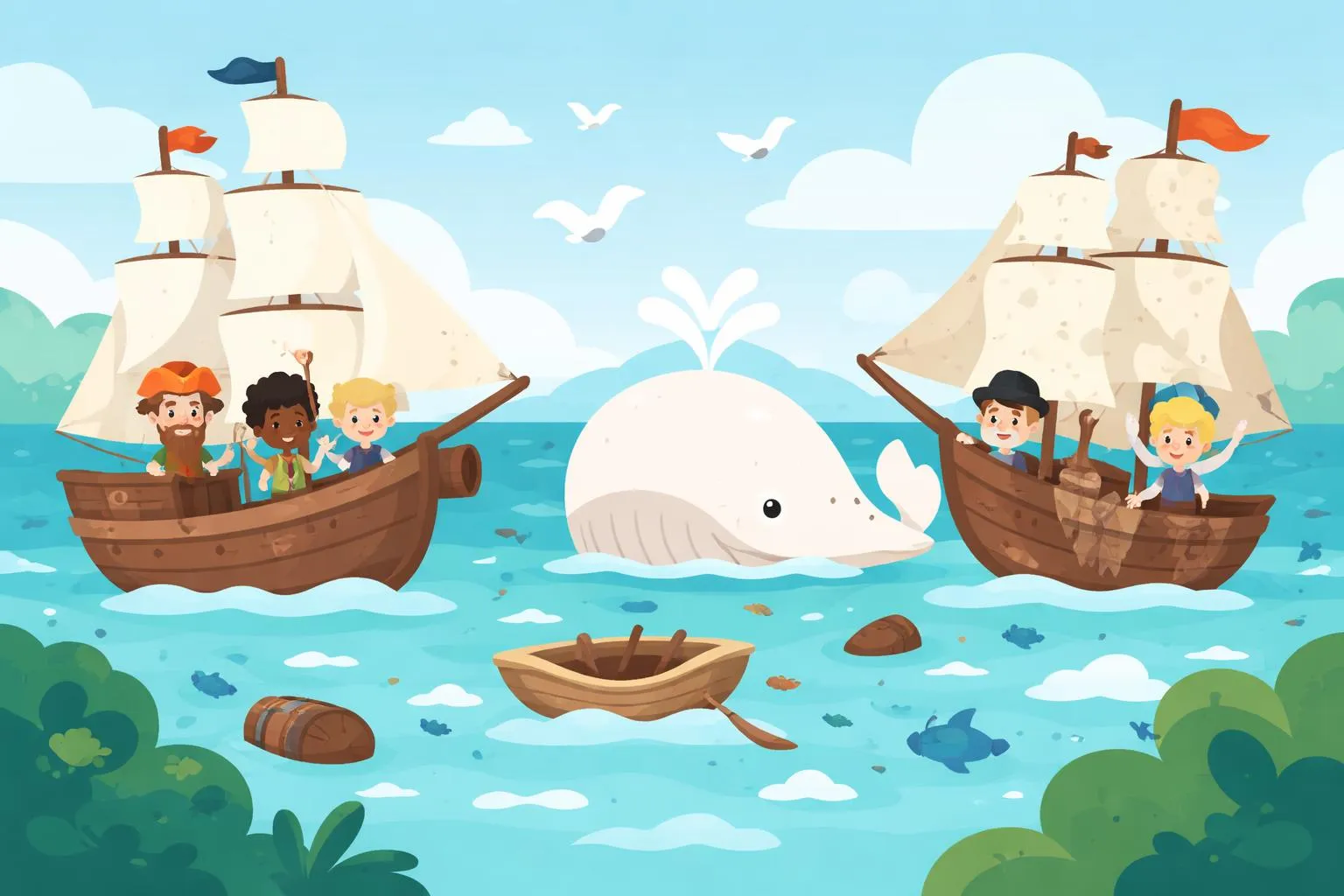

Original Story:
The intense Pequod sailed on; the rolling waves and days went by; the life-buoy-coffin still lightly swung; and another ship, most miserably misnamed the Delight, was descried. As she drew nigh, all eyes were fixed upon her broad beams, called shears, which, in some whaling-ships, cross the quarter-deck at the height of eight or nine feet; serving to carry the spare, unrigged, or disabled boats.
Upon the stranger’s shears were beheld the shattered, white ribs, and some few splintered planks, of what had once been a whale-boat; but you now saw through this wreck, as plainly as you see through the peeled, half-unhinged, and bleaching skeleton of a horse.
“Hast seen the White Whale?”
“Look!” replied the hollow-cheeked captain from his taffrail; and with his trumpet he pointed to the wreck.
“Hast killed him?”
“The harpoon is not yet forged that ever will do that,” answered the other, sadly glancing upon a rounded hammock on the deck, whose gathered sides some noiseless sailors were busy in sewing together.
“Not forged!” and snatching Perth’s levelled iron from the crotch, Ahab held it out, exclaiming- “Look ye, Nantucketer; here in this hand I hold his death! Tempered in blood, and tempered by lightning are these barbs; and I swear to temper them triply in that hot place behind the fin, where the White Whale most feels his accursed life!”
“Then God keep thee, old man- see’st thou that”- pointing to the hammock- “I bury but one of five stout men, who were alive only yesterday; but were dead ere night. Only that one I bury; the rest were buried before they died; you sail upon their tomb.” Then turning to his crew- “Are ye ready there? place the plank then on the rail, and lift the body; so, then- Oh! God”- advancing towards the hammock with uplifted hands- “may the resurrection and the life-”
“Brace forward! Up helm!” cried Ahab like lightning to his men.
But the suddenly started Pequod was not quick enough to escape the sound of the splash that the corpse soon made as it struck the sea; not so quick, indeed, but that some of the flying bubbles might have sprinkled her hull with their ghostly baptism.
As Ahab now glided from the dejected Delight, the strange life-buoy hanging at the Pequod’s stern came into conspicuous relief.
“Ha! yonder! look yonder, men!” cried a foreboding voice in her wake. “In vain, oh, ye strangers, ye fly our sad burial; ye but turn us your taffrail to show us your coffin!”
Story Explanation and Analysis
This passage is from Herman Melville’s classic novel Moby-Dick, a tale of obsession, revenge, and the relentless pursuit of the great white whale. The Pequod, a whaling ship, sails on through rough seas, encountering another ship ironically named the Delight. The Delight is in a state of ruin, carrying the wreckage of a whale-boat and the bodies of men lost to the dangerous hunt for the White Whale.
The dialogue between the captains reveals the grim reality of whaling: the White Whale is nearly invincible, and many men have died trying to kill it. Captain Ahab, the Pequod’s obsessed leader, holds a harpoon he believes is forged to kill the whale, tempered in blood and lightning, symbolizing his fiery determination and almost supernatural resolve. The scene is filled with tension and foreboding, as Ahab prepares to continue his deadly quest despite the tragic losses.
The imagery of the life-buoy-coffin swinging lightly, the shattered whale-boat, and the burial at sea all emphasize the perilous nature of whaling and the thin line between life and death on the ocean. The story explores themes of fate, obsession, man versus nature, and the consequences of revenge.
Background and Author Introduction
Moby-Dick was written by Herman Melville and first published in 1851. Melville was an American novelist, short story writer, and poet, whose experiences as a sailor deeply influenced his writing. The novel is considered one of the greatest works of American literature and a masterpiece of narrative complexity and symbolism.
Melville drew inspiration from real-life whaling voyages and the mysterious white whale known as Mocha Dick. The book reflects 19th-century whaling culture and raises profound philosophical questions about human nature, destiny, and the struggle against uncontrollable forces.
Lessons and Learning Points for Children and Students
What Can Be Learned?
- Courage and Determination: Captain Ahab’s relentless pursuit of the White Whale teaches about strong will and determination, but also warns about the dangers of obsession.
- Respect for Nature: The story highlights the power of nature and the risks humans take when trying to dominate it.
- Consequences of Revenge: Ahab’s quest shows how revenge can lead to destruction and loss.
- Teamwork and Leadership: The interactions among crew members demonstrate the importance of leadership and cooperation in difficult situations.
Practical Applications
- In School: Students can relate the story to lessons on perseverance and goal-setting, understanding both positive and negative outcomes.
- In Life: The story encourages respect for nature and awareness of the consequences of our actions.
- In Reading Skills: The complex language and symbolism help develop critical thinking and interpretation skills.
Reading Comprehension Questions
- What is the name of the ship that the Pequod encounters, and why is its name ironic?
- What does Captain Ahab hold in his hand, and why is it important?
- What do the shattered whale-boat and the hammock on the deck symbolize?
- How does the story portray the dangers of hunting the White Whale?
- What lesson can be learned from Captain Ahab’s obsession?
Answers
- The ship is called the Delight, which is ironic because it is in a miserable state and carries death rather than delight.
- Ahab holds a harpoon tempered in blood and lightning, symbolizing his determination to kill the White Whale.
- The shattered whale-boat and the hammock symbolize the destruction and death caused by the whale hunt.
- The story shows that hunting the White Whale is extremely dangerous, leading to the death of many men and the destruction of ships.
- The lesson is that obsession and revenge can be destructive and lead to tragic consequences.
This passage from Moby-Dick offers rich material for students to explore themes of human nature, courage, and the consequences of obsession, while also improving their reading comprehension and critical thinking skills.