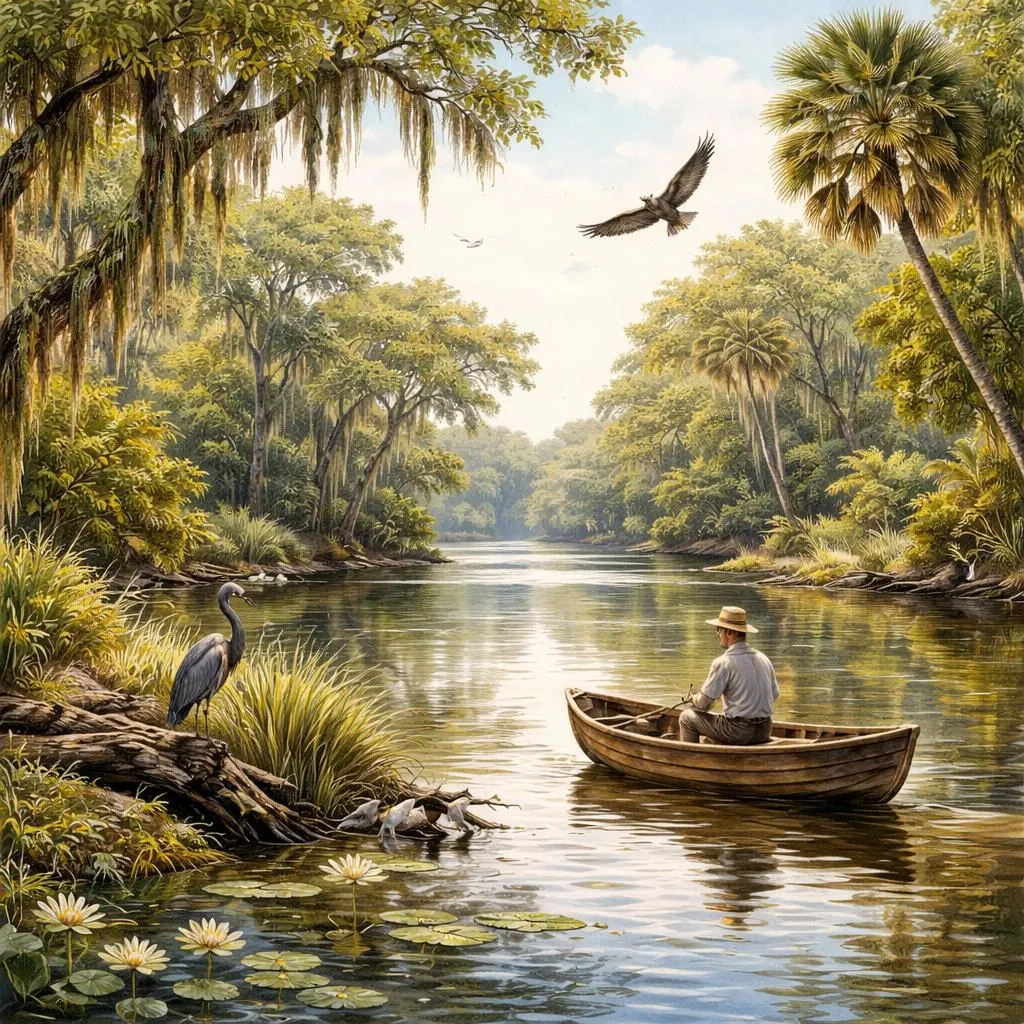

Wherever a person who loves to walk lives, they eventually find a favorite path—a special road they enjoy returning to again and again. This was true for me when I stayed in New Smyrna for three weeks. I had come there to enjoy the river, and my very first choice was the road that runs south along the riverbank. At that time, I thought it was the most beautiful road I had ever found in Florida, and I have not seen anything since that changed my mind.
This road is full of gentle curves, winding along the edge of a forested area called a hammock, with the river on one side and thick woods on the other. Beautiful roads are rarely straight or too wide, and this one follows that rule perfectly. When I first saw it in the afternoon, the sun was low, casting a soft, magical light over the river and the opposite shore—a light so beautiful it is hard to describe or imagine, a light that seems almost like a dream.
In flat places like Florida, stretches of water are especially welcome because they give the eye a sense of distance, softening the view and making the colors richer and more beautiful. As I walked along the river road, I loved looking across the water to a long wooded island and beyond it to the sandy hills that mark the edge of the peninsula. The white tops of the hills stood out sharply against the horizon, with tall palmetto trees here and there on the ridges facing the sea. But it was not the details that mattered most; it was the overall beauty of the blue water, the pale green woods, the deeper green pines, the changing colors of the sky, and the sunlight flooding the whole scene. Often, the road was shaded by palmetto and live-oak trees, and I would stop to gaze at the view or sit quietly on the old prow of a broken rowboat lying on the sand.
The river was shallow, with sandbars and oyster beds visible at low tide. Even when the water looked deep, a great blue heron, known locally as "the major," was often wading in the middle of the river. This large bird is common in Florida but is very cautious and hard to approach. It has long legs, wings, and a bill, and it waits patiently for the right moment to catch its food. The major is not a bird you would imagine as a pet, like a chickadee or a bluebird, but it is a pleasant sight to see regularly. I often saw several herons along the river, each seeming to be thinking about what to do next, standing still with great patience.
The major heron is very careful. If it wanted to cross a shallow area, it would first look all around for danger before flying over. It acts as if it is always on alert, like early settlers who had to watch for attacks. This cautiousness means the bird is always ready and never bored, because there is always something to be careful about. One day, I saw a heron standing proudly on the sandy beach, dressed in beautiful breeding feathers, seeming to enjoy being admired.
Alongside the major heron, two smaller relatives—the little blue heron and the Louisiana heron—were often seen feeding in the same shallow waters. The little blue heron sometimes appears white, and I was hoping to spot the little white egret, a rare bird that has been hunted almost to extinction for its feathers. The Louisiana heron was my favorite because of its delicate and light appearance, almost like a butterfly when it flew. Another bird, the green heron, was surprisingly tame, letting me walk very close without flying away.
The most magnificent bird I saw was the great white egret, a large, snowy-white bird with long feathers flowing behind it. I saw it only once, standing on an island in perfect light, looking truly magnificent. Birds like the egret are at great risk because of their size and color, but thankfully, laws have been passed to protect them.
Besides herons, I saw a few cormorants, sandpipers, plovers, gulls, and terns. Fish-hawks and bald eagles were common, often soaring overhead or perched on dead trees. Sometimes, I heard their cries and watched their dramatic chases in the sky.
The forest beside the road was quiet and had very few birds, which was surprising. I found only a few species there, including an oven-bird and some warblers and thrushes. The lack of birds and flowers made the place peaceful, a good retreat for someone who wanted to enjoy the beauty of the world without distractions.
The road itself was paved with oyster shells, which is a special feature in southern Florida. This made walking easier and was a sign of the natural history of the area, where Native Americans once lived and left behind large piles of shells. The road wound through the woods, with few houses scattered along it, and I often stopped to rest on a small hill that gave a wonderful view of the river, the village, and the distant sand hills.
Orange trees grew nearby, heavy with fruit and blossoms, filling the air with their sweet scent. Wild oranges were plentiful but not much eaten by locals. I enjoyed their sour, refreshing taste, especially during the cold season when cultivated oranges were dry.
I also noticed fig trees and red cedars growing together, a surprising combination for someone used to northern forests. The red cedars of Florida were different from those I knew, with a more sprawling shape.
The village along the river road was quiet, with a few people fishing or camping. One memorable scene was a group gathered around a campfire on a cold night, a sight that felt deeply connected to our human past and love of fire.
On another cold morning, I saw a man warming his hands over a fire in the street, a simple but touching moment that showed how people adapt to their environment.
The main street of the village was the same as the river road but more developed, with hotels and shops. There, I saw live-oaks full of birds, including the bright red summer tanager and many warblers and other small birds. Across the river, red-winged blackbirds sang a slightly different song, suggesting they might be a unique local variety.
Clapper rails lived in the tall grass near the water, making sharp calls and fishing for crabs. One day, a fierce storm flooded their island, but the birds survived and were soon heard again.
Nearby, a crow roost was noisy every evening, with hundreds of birds flying in to settle for the night. I once saw a lone bird soaring above the flock, perhaps acting as a lookout.
This river road and its surroundings left a deep impression on me, a place of natural beauty and quiet moments, where the light on the river seemed almost magical.
Background and Author Introduction
This passage is a reflective and descriptive piece, likely written by a naturalist or traveler deeply connected to the landscapes and wildlife of Florida. The author shares personal observations and poetic impressions of the natural environment, blending scientific knowledge with a love for beauty and a respect for the creatures that inhabit the area. Such writings often come from the late 19th or early 20th century, when exploration and appreciation of American natural landscapes were popular.
Detailed Interpretation and Significance
The story is more than just a travelogue; it is a meditation on the relationship between humans and nature. The author invites readers to slow down and appreciate the subtle beauty of a place—the curves of a road, the light on the water, the patient stance of a heron. This attention to detail encourages mindfulness and respect for the environment.
The herons symbolize patience, caution, and grace, qualities that the author admires and suggests are valuable in life. The description of the oyster-shell road connects the present to history, reminding us of the people who lived there before and the natural cycles that continue.
The passage also touches on themes of conservation and the impact of humans on wildlife, noting the dangers faced by birds hunted for their feathers and the importance of protective laws.
Lessons and Insights for Students
-
Appreciation of Nature: Students can learn to observe and appreciate the natural world around them, noticing details that often go unseen. This fosters curiosity, respect, and a sense of wonder.
-
Patience and Caution: The behavior of the herons teaches the value of patience and careful observation before acting—important skills in learning and social situations.
-
Connection to History: Understanding the land’s history, such as the oyster shells left by Native Americans, helps students see how past and present are linked.
-
Conservation Awareness: The story highlights the need to protect wildlife and natural habitats, encouraging responsible behavior toward the environment.
-
Mindfulness and Reflection: The author’s reflective mood shows how spending time in nature can calm the mind and inspire creativity, a valuable practice for mental health.
Applying These Lessons in Life
-
In School: Students can practice patience when learning difficult subjects, observing carefully before jumping to conclusions. They can also engage in nature studies or outdoor activities to connect with the environment.
-
In Social Settings: Like the cautious heron, students can learn to be aware of their surroundings and thoughtful in their interactions, avoiding rushed judgments.
-
In Daily Life: Taking time to notice small beauties—like a sunset or a bird’s song—can improve mood and encourage gratitude.
-
In Environmental Stewardship: Students can participate in conservation projects, learn about local wildlife, and advocate for protecting natural areas.
Cultivating Positive Qualities from the Story
- Patience: Practice waiting calmly and observing before acting.
- Respect: Show kindness to animals and people, valuing their space and needs.
- Curiosity: Ask questions and seek to learn more about the world.
- Mindfulness: Spend quiet moments appreciating nature and reflecting on experiences.
- Responsibility: Understand the impact of actions on the environment and others.
By embracing these qualities, young readers can grow into thoughtful, caring individuals who contribute positively to their communities and the natural world.
This passage, rich in imagery and thoughtful reflections, offers students a window into the beauty of the natural world and the importance of living with awareness and respect. It encourages a lifelong journey of learning, appreciation, and stewardship.