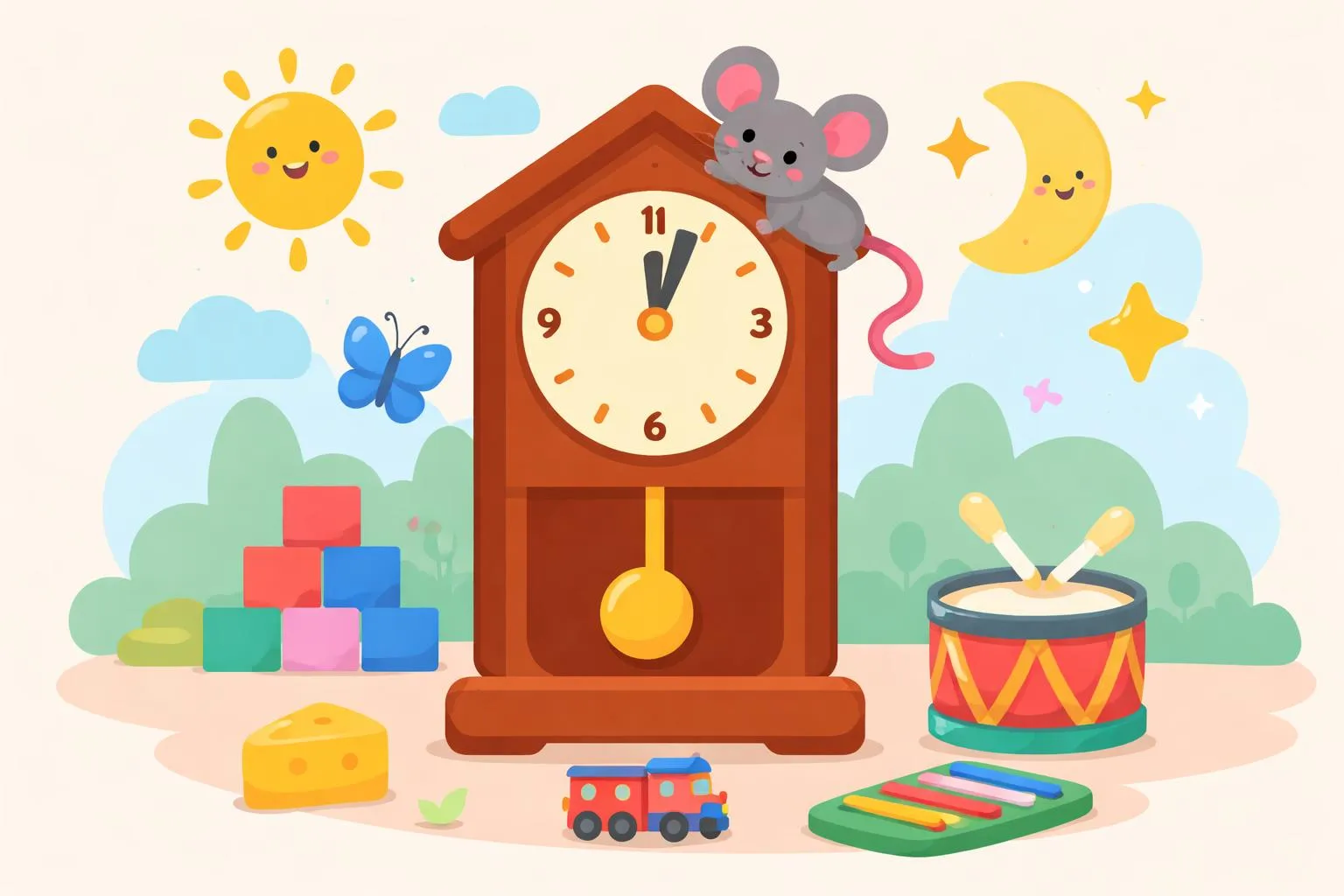

Original Story:
Hickory, dickory, dock,
The mouse ran up the clock.
The clock struck one,
And down he run,
Hickory, dickory, dock.
Expansion and Analysis
Summary and Interpretation
The nursery rhyme "Hickory, Dickory, Dock" is a short and simple poem that tells the story of a mouse running up a clock. When the clock strikes one, the mouse quickly runs back down. This rhyme is rhythmic and playful, making it easy for children to remember and recite.
The story illustrates a cause-and-effect relationship: the mouse climbs the clock, the clock strikes, and then the mouse responds by running down. This simple narrative helps children understand sequences and time concepts in a fun way.
Background and Author Information
"Hickory, Dickory, Dock" is a traditional English nursery rhyme, and like many nursery rhymes, its exact origins are unclear. It was first recorded in the 18th century and has since become a staple in early childhood education. The rhyme is often used to introduce young children to the concept of telling time and to develop their listening and memory skills.
The author of this rhyme is unknown, as it has been passed down orally through generations. Its enduring popularity is a testament to its simplicity and educational value.
Reflection and Personal Thoughts
This rhyme is charming in its simplicity and rhythmic quality. It captures a small, relatable moment—a mouse interacting with a clock—in a way that sparks imagination and curiosity in children. The repetitive sounds and rhythm make it engaging and enjoyable, which is essential for early learning.
Educational Value and Learning Points
Children and students can learn several important lessons from this nursery rhyme:
- Time Concepts: The rhyme introduces the idea of a clock striking a particular hour, helping children become familiar with telling time.
- Cause and Effect: It demonstrates how one event (the clock striking) can cause another event (the mouse running down).
- Rhythm and Language Skills: The rhyme's rhythmic pattern helps develop phonemic awareness, which is crucial for reading skills.
- Memory and Recitation: Its repetitive structure aids in memorization and oral language development.
Practical Applications in Life and Learning
- Learning to Tell Time: Teachers and parents can use this rhyme to teach children how to read clocks and understand hours.
- Sequencing Skills: The rhyme helps children understand sequences of events, which is important in storytelling and daily routines.
- Language Development: Reciting nursery rhymes enhances vocabulary, pronunciation, and listening skills.
- Engagement in Learning: The fun and musical nature of the rhyme encourages children to participate actively in learning activities.
Key Challenges and Focus Areas
- Understanding Time: Young children might find it challenging to grasp the concept of the clock striking one and what it means.
- Pronunciation of Rhythmic Words: Some children may need practice to pronounce the repetitive sounds clearly.
- Connecting Story to Real Life: Helping children relate the rhyme to actual clocks and daily timekeeping is important for meaningful learning.
Reading Comprehension Practice
Questions:
- Who ran up the clock in the rhyme?
- What happened when the clock struck one?
- What is the main action of the mouse in the story?
- Why do you think the mouse ran down after the clock struck one?
- What can children learn from this rhyme?
Answers:
- The mouse ran up the clock.
- The clock struck one.
- The mouse ran up the clock and then ran down.
- The mouse ran down because the clock struck one, possibly startled by the sound.
- Children can learn about telling time, cause and effect, rhythm, and memory skills.
This classic nursery rhyme continues to be a valuable educational tool, combining fun with foundational learning for young children.