
Original Story:
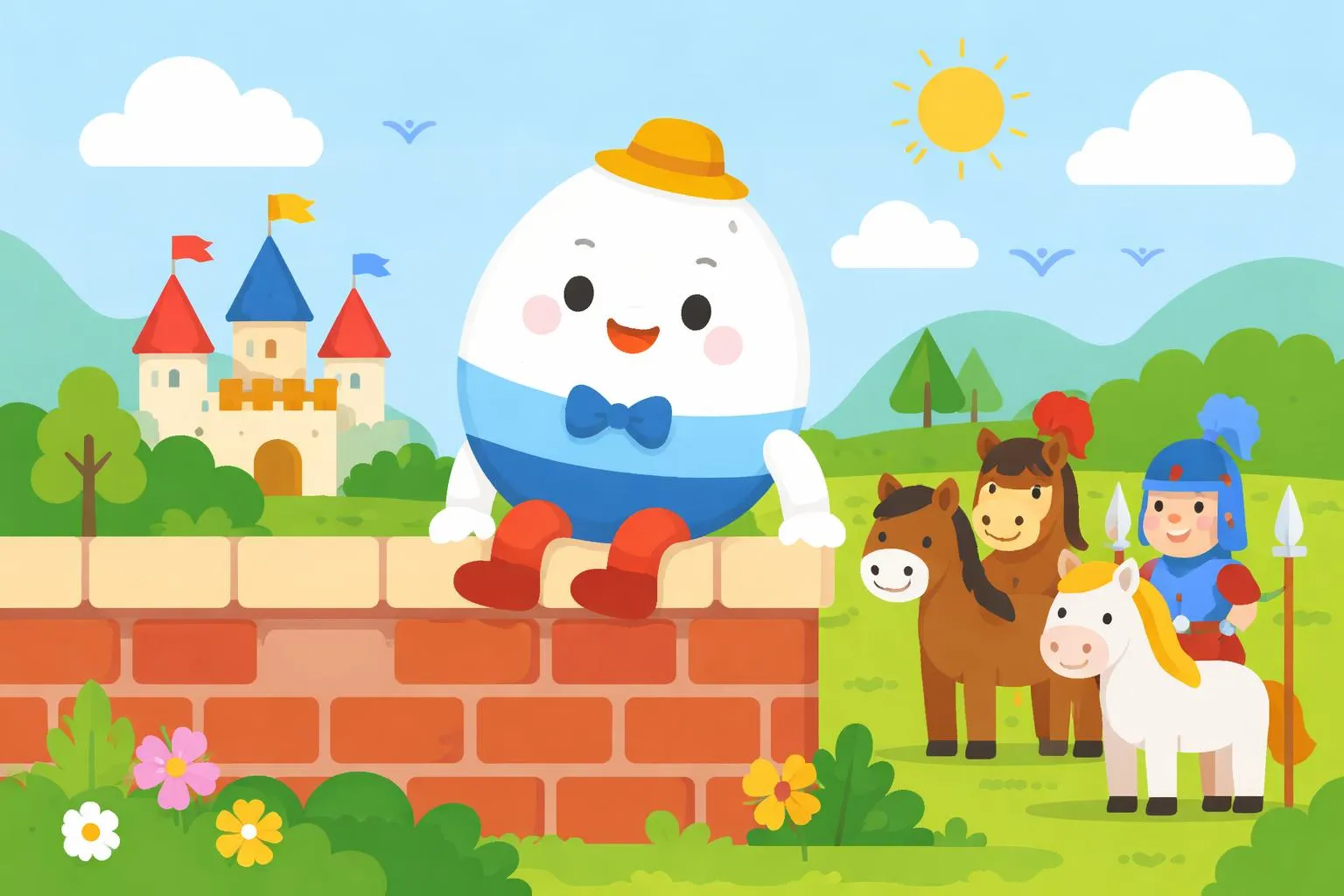
Humpty Dumpty sat on a wall,
Humpty Dumpty had a great fall;
All the King’s horses, and all the King’s men
Couldn’t put Humpty together again.
Introduction and Explanation
The nursery rhyme Humpty Dumpty is a short, simple poem that tells the story of a character named Humpty Dumpty who sat on a wall, fell down, and could not be put back together despite the efforts of the King’s horses and men. At its core, this rhyme is about a great fall and the irreversible consequences that follow.
This story is often interpreted as a metaphor for fragility and the idea that some accidents or mistakes cannot be undone. It teaches children about caution and the importance of being careful in their actions.
Background and Author
The origins of Humpty Dumpty are somewhat unclear. The rhyme first appeared in print in the late 18th century, but it likely existed in oral tradition before that. The character Humpty Dumpty is commonly depicted as an egg, although the original rhyme does not specify this. This image was popularized later, especially through Lewis Carroll’s Through the Looking-Glass (1871), where Humpty Dumpty is portrayed as an egg-shaped figure.
The rhyme’s author is unknown, as is common with many traditional nursery rhymes. It has been passed down through generations and remains a classic example of English folklore.
Interpretation and Appreciation
Humpty Dumpty is more than just a simple children’s rhyme. It reflects themes of vulnerability and the consequences of risky behavior. The fact that even the King’s horses and men cannot fix Humpty Dumpty highlights the finality of certain events. This can be a gentle way to introduce children to the concept of cause and effect.
The rhyme’s rhythm and rhyme scheme make it easy to memorize, which is why it has remained popular for so many years. Its brevity and repetition help young learners develop language skills and phonemic awareness.
Lessons and Learning Points
From Humpty Dumpty, children and students can learn several important lessons:
- Cause and Effect: Understanding that actions have consequences, sometimes irreversible.
- Safety Awareness: Encouraging careful behavior to avoid accidents.
- Problem-Solving: Recognizing that not all problems have easy solutions.
- Memory and Language Skills: The rhyme’s simple structure helps with memorization and pronunciation.
Practical Applications
In everyday life, this rhyme can be used to teach children about safety, such as being careful when climbing or playing near heights. In school, teachers can use it to introduce literary devices like rhyme, rhythm, and repetition. It also serves as a starting point for discussions about resilience and dealing with setbacks.
Reading Comprehension Questions
- Who is the main character in the rhyme?
- What happened to Humpty Dumpty?
- Who tried to help Humpty Dumpty after the fall?
- What does the story teach us about consequences?
- Why do you think the King’s horses and men could not fix Humpty Dumpty?
Answers
- The main character is Humpty Dumpty.
- Humpty Dumpty had a great fall from the wall.
- The King’s horses and the King’s men tried to help.
- The story teaches that some consequences cannot be reversed.
- Because the fall caused damage that was too severe to repair.
By exploring Humpty Dumpty, children not only enjoy a classic nursery rhyme but also gain valuable insights into language, safety, and the nature of consequences in life.