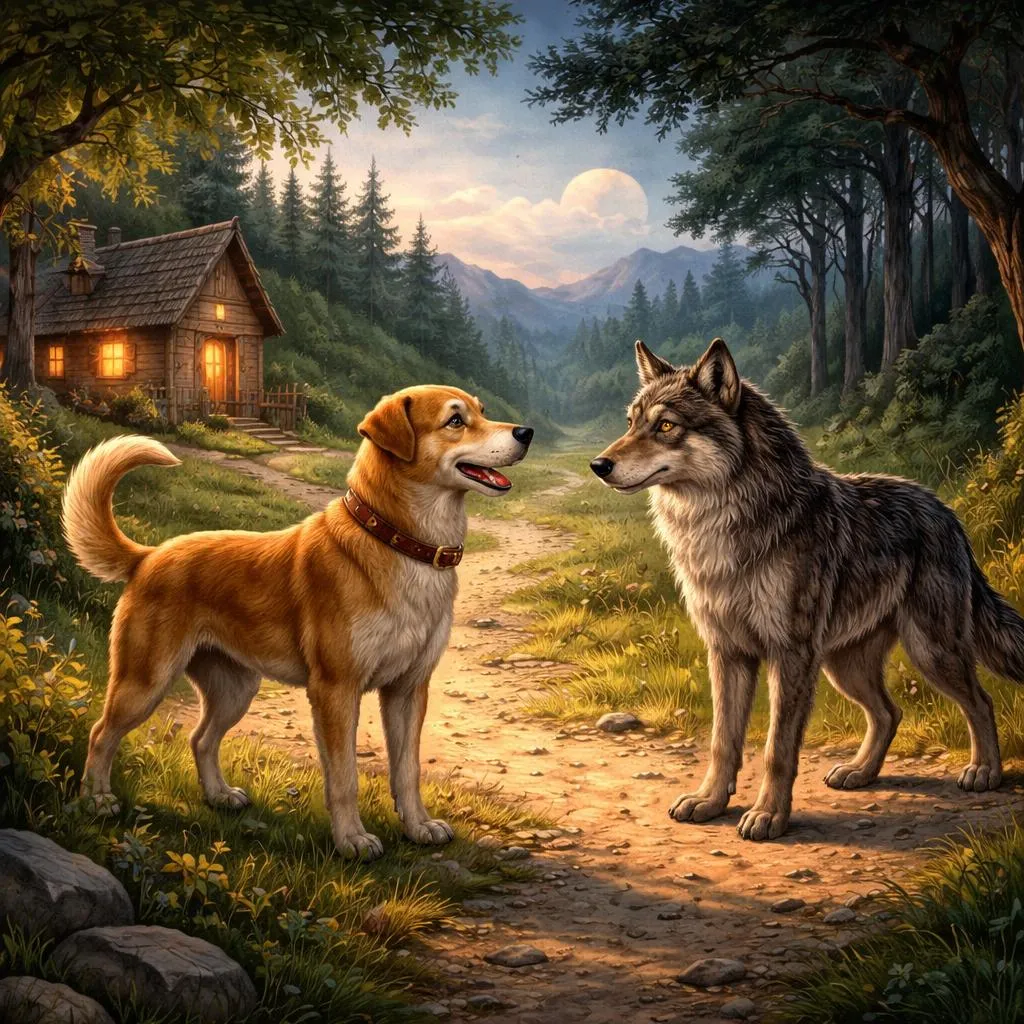

A gaunt Wolf was almost dead with hunger when he happened to meet a House-dog who was passing by. “Ah, Cousin,” said the Dog. “I knew how it would be; your irregular life will soon be the ruin of you. Why do you not work steadily as I do, and get your food regularly given to you?”
“I would have no objection,” said the Wolf, “if I could only get a place.”
“I will easily arrange that for you,” said the Dog; “come with me to my master and you shall share my work.” So the Wolf and the Dog went towards the town together. On the way there the Wolf noticed that the hair on a certain part of the Dog’s neck was very much worn away, so he asked him how that had come about.
“Oh, it is nothing,” said the Dog. “That is only the place where the collar is put on at night to keep me chained up; it chafes a bit, but one soon gets used to it.” “Is that all?” said the Wolf. “Then good-bye to you, Master Dog.”
Better starve free than be a fat slave.
Background and Author Introduction
This story is one of Aesop’s Fables, a collection of short tales attributed to Aesop, a storyteller believed to have lived in ancient Greece around 600 BCE. These fables use animals as characters to convey moral lessons and practical wisdom. The fable of "The Wolf and the Dog" is a classic example that explores themes of freedom, security, and the costs of comfort.
Aesop’s fables have been passed down through centuries and remain popular worldwide because they teach important life lessons in a simple and memorable way. The use of animals allows readers, especially young students, to engage with the story without the complexity of human social contexts, making the morals clear and accessible.
Detailed Interpretation and Meaning
In this fable, the gaunt Wolf symbolizes independence and freedom, though it comes with hardship and hunger. The House-dog represents security and comfort, but at the cost of personal freedom and autonomy. The Dog’s life is easier because it has a master who feeds it regularly, but it must wear a collar and be chained, symbolizing loss of freedom.
The Wolf initially envies the Dog’s steady supply of food and offers to join the Dog’s life. However, upon discovering the collar’s mark on the Dog’s neck, the Wolf realizes that the Dog’s comfort comes with a price: submission and loss of freedom. The Wolf chooses to remain free, even if that means suffering hunger.
The moral “Better starve free than be a fat slave” teaches that personal freedom and dignity are more valuable than comfort gained through submission or loss of independence.
Lessons and Insights for Students
-
Value of Freedom: The story encourages students to appreciate freedom and autonomy. It highlights that comfort and security are important, but not at the expense of one’s personal liberty or values.
-
Critical Thinking: Students learn to look beyond surface appearances. The Dog’s life seems better at first glance, but deeper observation reveals hidden costs.
-
Making Choices: The fable teaches that every choice has trade-offs. It’s important to consider what we might be sacrificing for comfort or security.
-
Self-Respect and Integrity: The Wolf’s decision to remain free reflects courage and self-respect. Students can learn to stand by their principles even when faced with difficulties.
Applications in Life, Learning, and Social Situations
-
In Personal Life: Students can reflect on situations where they might feel pressured to conform or give up their values for convenience. The story encourages them to prioritize their integrity.
-
In Learning: The fable reminds students that hard work and independence are valuable, even if the path is challenging. It discourages taking shortcuts that compromise one’s character.
-
In Social Interactions: The story can help students understand peer pressure and the importance of making choices that align with their true selves rather than simply following the crowd for comfort or acceptance.
Cultivating Positive Traits from the Story
-
Courage to Choose Freedom: Encourage students to be brave in making decisions that protect their freedom and dignity.
-
Awareness and Observation: Teach students to look beyond appearances and question situations critically.
-
Respect for Hard Work: Emphasize the value of steady effort and perseverance, even if the rewards are not immediate.
-
Self-Reflection: Encourage students to think about what freedom means to them and how they can maintain it in their daily lives.
Conclusion
“The Wolf and the Dog” is more than just a simple fable; it is a profound lesson on the balance between freedom and security. For students and young readers, it offers valuable insights into making thoughtful choices, understanding the consequences of those choices, and valuing personal integrity above all. By reflecting on this story, students can develop a stronger sense of self, learn to appreciate the importance of freedom, and cultivate the courage to live authentically in their studies, friendships, and future endeavors.