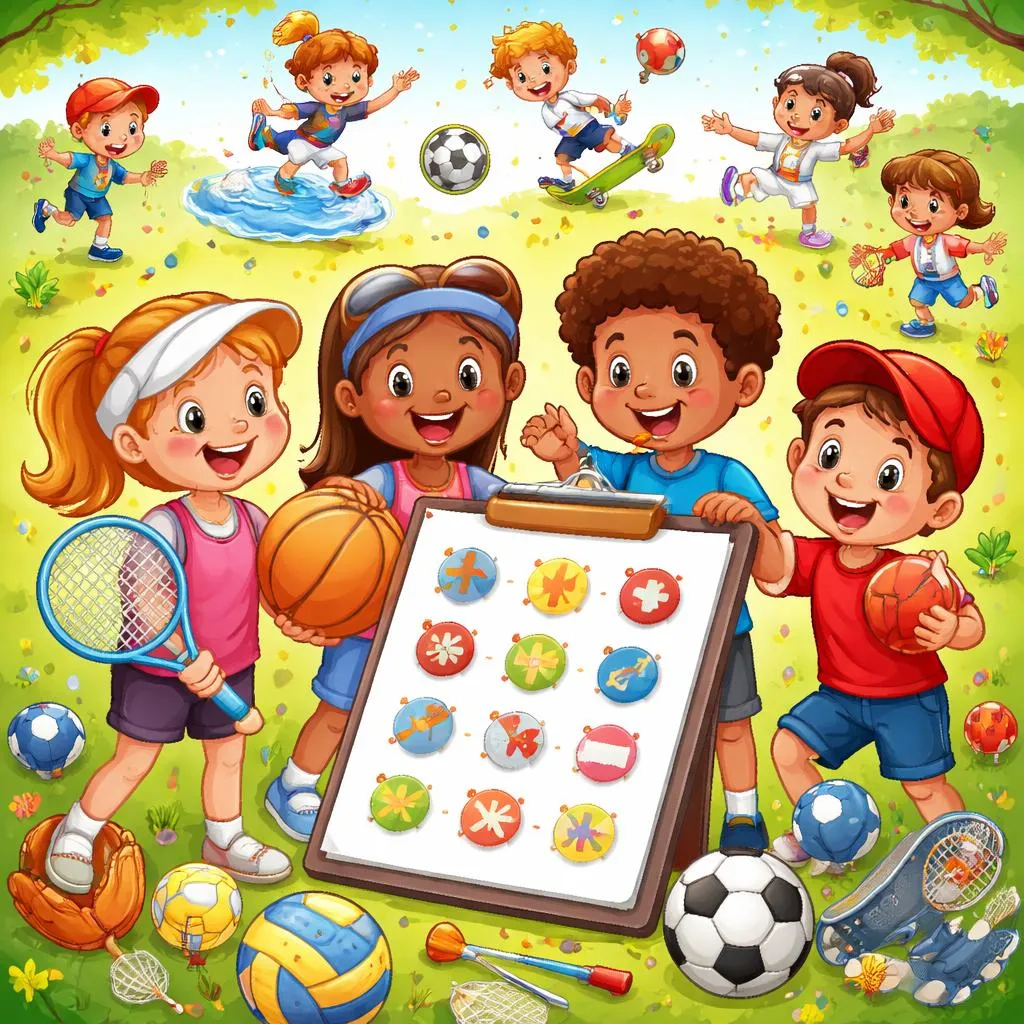

What is this topic about?
Let's talk about action, teamwork, and fun around the world. Creating a list of different sports is an exciting way to explore new vocabulary. It connects language learning to a subject full of energy, passion, and global culture. Sports are a universal language, and knowing their names in English opens doors to conversations, games, and understanding international events.
When we build a list of different sports, we do more than write words. We learn about categories. We discover what people do in teams and what they do alone. We see sports played on land, in water, and on snow. This topic helps young learners connect English words to vivid pictures of movement and competition. It makes vocabulary feel active and alive.
Meaning and explanation
Why is a list of different sports a valuable learning tool? Sports vocabulary is highly functional. It appears in news, on television, in video games, and on playgrounds worldwide. Learning these words allows children to participate in broader conversations. They can talk about their favorite activities, understand simple sports reports, and share interests with friends from other countries.
A well-organized list teaches more than nouns. It introduces the concept of categorization. We can group sports by the number of players, by the playing environment, or by the equipment used. This builds critical thinking skills alongside language skills. Understanding that soccer is a team sport played on a field, while swimming is an individual sport in a pool, helps structure knowledge in a meaningful way.
Categories or lists
A great way to manage a long list of different sports is to sort them into clear categories. This makes the information easier to remember and use. Let's explore some common groupings.
First, we can list sports by Team vs. Individual. Team Sports include soccer, basketball, baseball, volleyball, and hockey. Individual Sports include swimming, gymnastics, tennis (singles), golf, and track and field events like running or jumping.
We can also categorize by Where they are played. Land Sports: soccer, basketball, tennis, running. Water Sports: swimming, diving, surfing, rowing. Winter Sports: skiing, snowboarding, ice skating, hockey. Another fun category is Sports with Balls: soccer, basketball, tennis, baseball, volleyball. Grouping sports this way turns a simple list into an organized knowledge system.
Daily life examples
We see and use a list of different sports in many everyday situations. The most exciting example is during big international events like the Summer or Winter Olympic Games. We hear commentators say the names of sports like judo, archery, cycling, and figure skating. Children can watch and learn the words in action.
In school, during physical education class, the teacher might ask, "Who wants to play basketball today?" or "Let's practice running." At the playground, children choose between kicking a soccer ball or shooting hoops. Even video games and cartoons feature sports, using their English names. Pointing out these connections shows that the vocabulary is useful and relevant right now.
Printable flashcards
Printable flashcards are a dynamic way to master a list of different sports. Create cards with a vivid action image on one side—a player kicking a soccer ball, someone swimming, a gymnast on a balance beam. On the reverse side, clearly print the sport's name: SOCCER, SWIMMING, GYMNASTICS.
For more advanced learners, include a simple fact: "Soccer: A team sport with 11 players. You use your feet." Use these cards for sorting games (put all team sports together, all water sports together). Play memory match with two sets of cards. Use them as prompts for charades or quick drawing games. This visual and interactive approach builds strong word-picture association.
Learning activities and games
Let's get active with the vocabulary! Here are engaging ways to use a list of different sports.
A fantastic whole-class activity is "Sports Charades." Write names of sports from your list on small cards. A learner picks a card and acts out playing that sport without speaking. The class must guess the sport in English. This game connects physical movement to vocabulary recall in a hilarious and memorable way.
Another creative activity is "Design Your Own Sport." After reviewing many sports, challenge learners to invent a new one. They must give it an English name, decide if it's a team or individual sport, describe the equipment needed, and draw the playing field. They then present their sport to the class. This activity uses the learned vocabulary as a springboard for creativity, storytelling, and presentation skills.
For a listening and sorting game, create a "Sports Stadium" sorting center. Label three boxes or areas on the floor: "Team Sports," "Individual Sports," and "Water Sports." Have a large collection of picture cards or small toy equipment (a tiny basketball, a plastic tennis racket). Call out a sport's name. Learners find the corresponding card or object and run to place it in the correct "stadium." This combines physical activity with vocabulary categorization.
To integrate simple writing, try "My Sports Journal." Provide a template with prompts: "My favorite sport is ______." "I play it with ______." "You need a ______." Learners complete the sentences and draw a picture. This personalizes the vocabulary and practices basic sentence structure using the list of different sports as a reference.
A fun phonics link is "Beginning Sound Sports." Focus on the initial sounds of sports names. Gather pictures of sports starting with different letters: Basketball, Soccer, Tennis, Golf, Swimming. Ask learners to sort them by their first sound. This builds phonemic awareness using engaging, familiar content.
The power of learning through a list of different sports lies in its inherent appeal and global relevance. It provides a high-interest context for acquiring practical nouns, action verbs (run, jump, throw, kick, swim), and descriptive language. By moving beyond rote memorization into categorization, games, and creation, we help children own the language. They don't just know words; they understand concepts and can communicate about a world full of action and passion. This knowledge builds confidence to watch, play, and discuss sports anywhere, turning them into global citizens on and off the field.