
Meaning
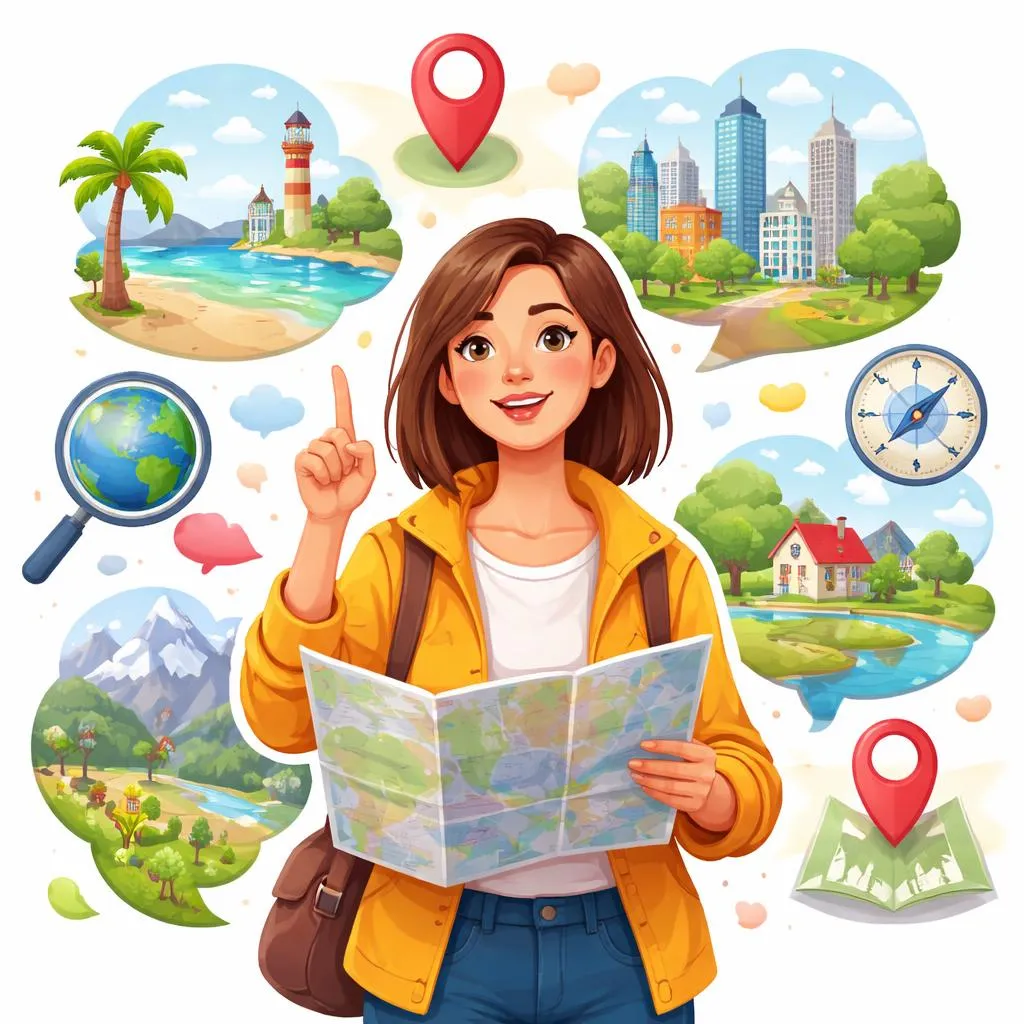
Let's explore a very useful word today: "place." When we look for an example of a place, we are looking for a word that names a specific location or type of location. A "place" is a spot, an area, or a building where something is located or where an event happens. It answers the questions "Where?" or "In what location?"
Understanding what makes a good example of a place helps us build clear sentences. We learn to tell stories, give directions, and share our experiences. Words like park, school, home, supermarket, and beach are all perfect examples. They are nouns that tell us where.
Conjugation
The word "place" itself is a noun, so it does not conjugate like a verb. We do not say "I place, you place" when talking about a location. Instead, we use different forms to show one or many. The singular form is place. The plural form is places.
We use these forms with other words that do conjugate, like the verb "to be." For example: "The park is a fun place." (singular) "Parks are fun places." (plural). So, when giving an example of a place, we choose the singular or plural form based on what we are describing.
Present tense
We often describe places in the simple present tense. This tense is used for facts, general truths, and routines. When we give an example of a place, we use the present tense to state what that place is or what happens there.
For example: "A library is a quiet place." "We go to the supermarket every week." "Children play at the playground." These sentences use the present tense to tell us about the nature or common use of a place right now.
Past tense
We use the simple past tense to talk about a place we visited or an event that happened at a place in the past. This helps us tell stories about our experiences.
For example: "Yesterday, I went to the zoo." "We had a picnic at the park last weekend." "My school was very busy during the festival." When sharing an example of a place from a memory, we use past tense verbs to describe our actions there.
Future tense
We use the future tense to talk about places we plan to go or events that will happen at a place. This is useful for making plans and sharing dreams.
For example: "Tomorrow, we will visit the museum." "Next summer, I am going to go to the beach." "They are going to build a new playground here." When thinking ahead about an example of a place, we use "will" or "going to" with our verbs.
Questions
We can ask many questions about a place. To ask for an example of a place, we say: "What is an example of a place you like?" To ask about location, we use "Where?": "Where is the library?" To ask about activities, we use "What...do?": "What do you do at the park?"
Other common questions include: "When do you go to the market?" "Who is at the cinema with you?" Practicing these questions helps learners use place vocabulary in full conversations.
Other uses
The word "place" can also be used as a verb. As a verb, it means to put something in a specific spot. For example: "Please place the book on the table." This is different from its use as a noun, but it's good to know.
In grammar, we also use special words called prepositions to show the relationship between a place and other things. Words like in, on, at, next to, behind are crucial. For example: "The cat is on the chair." "We play in the garden." Mastering prepositions is key to accurately describing an example of a place.
Learning tips
A great way to learn about places is to connect them to your own life. Make a list: "Places in My Town." Draw a simple map of your neighborhood and label the places. Practice saying: "This is my house. Next to my house is a park."
Use flashcards with pictures of different places. On one side, have a picture of a bank. On the other side, write: "A bank is a place where people keep money." This adds a simple definition. Role-play is also powerful. Pretend to be at a restaurant or a shop and use English to "order food" or "buy things."
Educational games
Play "I Spy a Place." Say, "I spy with my little eye... a place where we buy food." The others guess: "Supermarket!" You can also play "Place Charades." Write names of places on cards. A player acts out an activity done at that place (like swinging for a playground) while others guess.
Another fun game is "Where Am I?" Give clues about a place: "I am thinking of a place. It has many books. It is quiet. People read there." The first to guess "Library!" wins. These games make learning the vocabulary for an example of a place active and engaging.
What is the rhyme?
Many children's songs and rhymes are about places. A classic one is "The Wheels on the Bus." This song takes us on a journey through a town on a bus. It mentions different parts of the bus (a moving place) and what happens there.
Another is "Down by the Bay," which describes a silly, imaginative place near the water. Singing about places helps children remember the words and associate them with fun, melody, and rhythm.
Vocabulary learning
Songs and stories about places introduce wonderful vocabulary. From "The Wheels on the Bus," we learn nouns like bus, town, door, wipers, horn. We learn action verbs like go, open, swish, beep.
We also learn prepositions like on, round, up, down. This vocabulary helps children describe not just static places, but also the movement and activity within them. It builds a dynamic understanding of locations.
Phonics points
These songs offer great phonics practice. "The Wheels on the Bus" has strong rhyming words: town/down, swish/swash. It uses alliteration: "The wipers on the bus go swish, swish, swish." The repetitive sounds make it easy to join in and practice pronunciation.
Clapping along to the rhythm helps children feel the syllables in words like wheel (1), win-dow (2), e-ver-y-where (4). This builds phonological awareness in a joyful, musical context.
Grammar patterns
Songs like "The Wheels on the Bus" model the present simple tense for repeated actions: "The wheels go round and round." They use the structure [The] + [noun] + [on the bus] + [verb].... This reinforces how to describe parts of a place.
They also use the present continuous tense in some versions: "The people on the bus are going up and down." This shows ongoing action within a specific location. Children absorb these patterns naturally through repetition.
Printable materials
Create a "My Town" map worksheet. Provide a simple street grid with blank buildings. Children can draw or paste pictures (from a provided sheet) of places like a school, fire station, and grocery store. They label each building. This connects writing, art, and vocabulary.
Another idea is a "Place Sorting" mat. Print a sheet with two columns: "Indoor Places" and "Outdoor Places." Provide cut-out pictures of a library, a beach, a cinema, a forest, etc. Children glue each picture in the correct column, practicing categorization.
Educational games (for songs/stories)
For "The Wheels on the Bus," have a "Bus Role-Play." Arrange chairs in rows like a bus. Assign roles: driver, passengers. Sing the song and act out each verse—making round wheel motions, pretending to open and shut the door, swishing arms for wipers. This brings the song and its vocabulary to life.
Play "Finish the Rhyme" for "Down by the Bay." Sing the song but pause before the rhyming word: "Did you ever see a bear, combing his ______?" Children shout out the rhyming word ("hair!"). This focuses on phonemic awareness and prediction.
Mastering how to give and describe an example of a place is a foundational language skill. It empowers learners to navigate their world, share stories, and understand their community. By using songs, games, maps, and daily conversation, we move this vocabulary from a simple list to a useful tool for connection and expression. The world is full of interesting places waiting to be discovered and described in English.