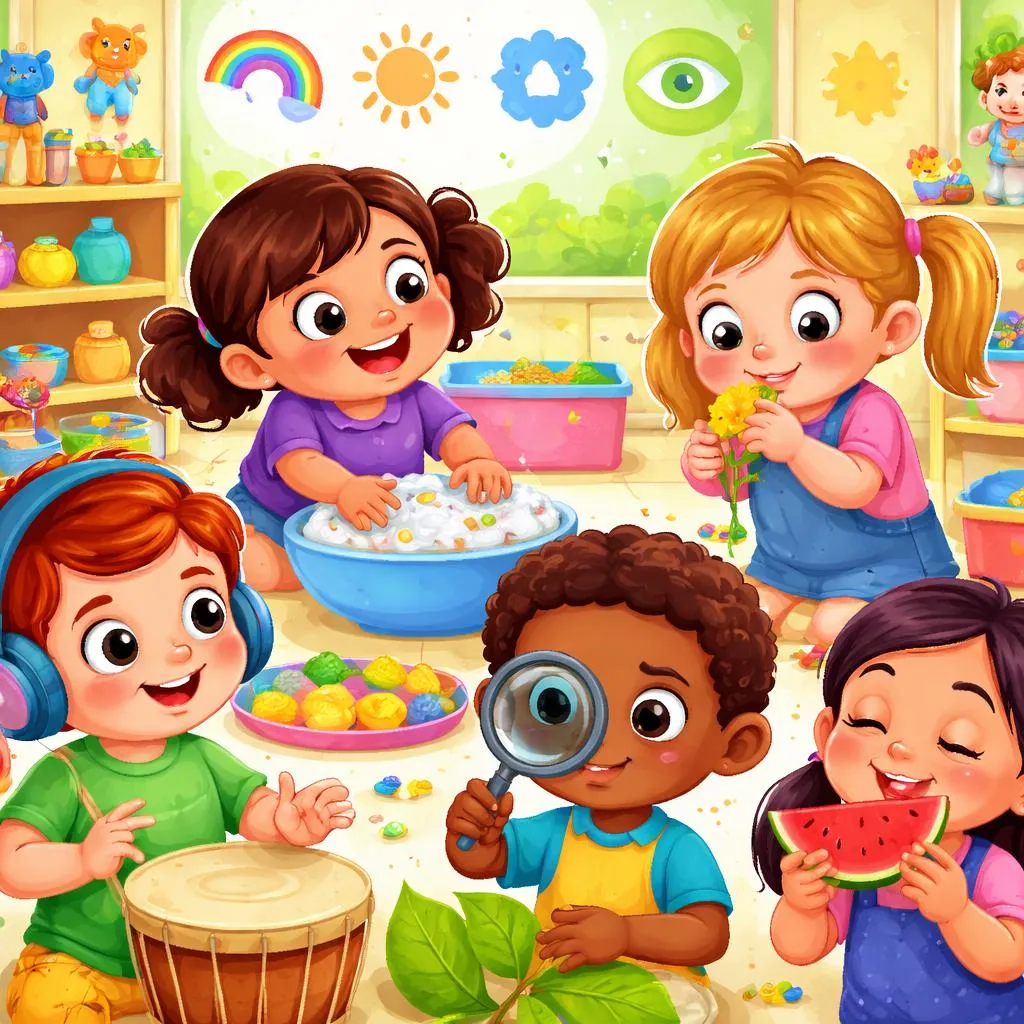

Teaching preschool is about channeling energy into discovery. Young children learn best not by listening, but by doing. This is why we need meaningful, hands-on experiences. The best place to start is with the body itself. Planning activities about five senses for preschool allows us to turn everyday moments into powerful lessons. It helps children understand how they interact with their environment. Let's explore how we can build a rich sensory curriculum together.
What Are the Five Senses in Preschool? In a preschool setting, we introduce the five senses as special tools. These tools help us learn about the world. We explain that our bodies are amazing. They have different parts that send messages to our brain.
We introduce each sense clearly and simply.
Our eyes are for sight. They help us see colors and shapes.
Our ears are for hearing. They help us hear music and voices.
Our hands (and skin) are for touch. They help us feel soft and hard things.
Our nose is for smell. It helps us smell flowers and food.
Our mouth is for taste. It helps us taste sweet and sour flavors.
This simple framework gives us a foundation. From here, we can build engaging activities about five senses for preschool that are both fun and educational.
Meaning and Explanation: Why Do We Explore the Senses? It is important for us, as guides, to understand the "why" behind these lessons. Exploring the senses is not just an activity. It is a cognitive development tool. When we engage the senses, we build neural pathways. We help children organize information.
For example, when a child feels a cold ice cube, the brain learns "cold." When they smell a lemon, the brain learns "sour." These experiences build a mental library. This library helps them make sense of future experiences. It also builds language skills. They learn the words to describe their world. This is the true value of designing thoughtful activities about five senses for preschool.
Categories or Lists: Types of Sensory Play We can group sensory activities into categories. This helps us plan a balanced curriculum. It ensures we touch on all senses, not just the most obvious ones.
Exploratory Play: This involves free discovery. Think of a sand table or a water play station. Children explore without a set goal. They feel the texture of the sand. They see how water moves.
Structured Discovery: Here, we guide the exploration with a question. "Can you find something smooth?" or "What does this smell like?" This focuses their attention. It builds observation skills.
Creative Expression: This combines senses with art. We can use scented paints. We can listen to music while drawing. We can create collages with different textures like fabric or leaves.
Cooking Activities: Food is a wonderful sensory medium. Preparing a simple snack involves sight, smell, touch, and taste. It is a perfect real-world application for our theme.
Daily Life Examples: Bringing the Senses into the Routine The best learning happens naturally throughout the day. We can seize these moments. We do not need special materials to explore the senses. We just need to draw attention to what is already there.
During morning snack, we can talk about the apple. We see its red skin. We hear the crunch when we bite it. We feel if it is cold. We taste its sweetness. At recess, we feel the wind on our skin. We hear the birds singing. We see the blue sky. By simply narrating these moments, we reinforce the concepts. We show that activities about five senses for preschool can happen anytime, anywhere.
Printable Flashcards: Visual Tools for the Classroom Flashcards are a useful resource for introduction and review. They provide a clear visual link between the sense and the body part. We can create simple, friendly cards.
One card might show a large ear. Another might show a nose. We can also make matching cards. One card shows a picture of a bell. The matching card shows an ear. This helps children connect the object to the sense used to perceive it. These cards are a great starting point for many activities about five senses for preschool. We can use them in circle time or place them in a learning center for independent exploration.
Learning Activities or Games: Hands-On Ideas for the Classroom Now, let's get to the heart of the matter. Here are detailed, teacher-guided activities designed for the preschool classroom.
Activity 1: The Sound Shakers This activity focuses on the sense of hearing. We need small, opaque containers. Think of film canisters or small plastic eggs. We fill pairs of containers with different items. Use rice, beans, bells, or sand. We seal them tightly.
During the activity, we demonstrate how to hold a shaker near the ear. We shake it gently. The children listen carefully. Their task is to find the shaker that makes the same sound. This sharpens auditory discrimination. It is a quiet, focused game that fits perfectly into a unit on activities about five senses for preschool.
Activity 2: Mystery Scent Jars This activity focuses on the sense of smell. We need small jars or containers with lids. We place a cotton ball inside each one. We soak each cotton ball with a different scent. Good choices are lemon extract, vanilla extract, peppermint, or orange oil. We poke small holes in the lid.
We guide the children to bring the jar to their nose. We ask them to take a gentle sniff. We ask them if the smell is familiar. Is it sweet? Is it strong? We can then reveal the source of the smell. This activity isolates the sense of smell in a safe and contained way.
Activity 3: Feely Board Exploration This activity focuses on the sense of touch. We create a "feely board" by gluing different materials onto a sturdy piece of cardboard. We can use a piece of faux fur, sandpaper, aluminum foil, bubble wrap, and a soft piece of fabric.
During circle time, we bring out the board. We guide the children to touch each section. We introduce descriptive words. We say, "This fur feels soft." We say, "This sandpaper feels rough." This builds vocabulary while providing a rich tactile experience. It is a simple but effective addition to our collection of activities about five senses for preschool.
Activity 4: Taste Test Party With proper permissions, a taste test is a highlight. We prepare small samples of food representing different tastes. We need something sweet, like a banana. We need something salty, like a cracker. We need something sour, like a yogurt drop. We can also introduce something slightly bitter, like dark chocolate.
We give each child a small plate. We guide them to try one food at a time. We ask them to describe the taste. We talk about how the tongue can taste many different things. This structured approach makes the experience both safe and educational.
Activity 5: Color Mixing Bags This activity focuses on the sense of sight. We take strong, sealable plastic bags. We place squirts of yellow and blue paint inside. We seal the bag shut, reinforcing the seal with tape. Children can then mush the paint around inside the bag. They watch as the two colors mix to create green.
This is a mess-free way to explore color. It teaches cause and effect. It shows that our eyes can see changes happen in real time. It is a calm, focused activity that is perfect for a quiet afternoon.
By implementing these strategies, we provide a well-rounded educational experience. We guide our youngest learners to become aware of their own bodies. We help them understand the incredible tools they use every day to learn about their world. Each activity builds a foundation for future scientific thinking and language development.