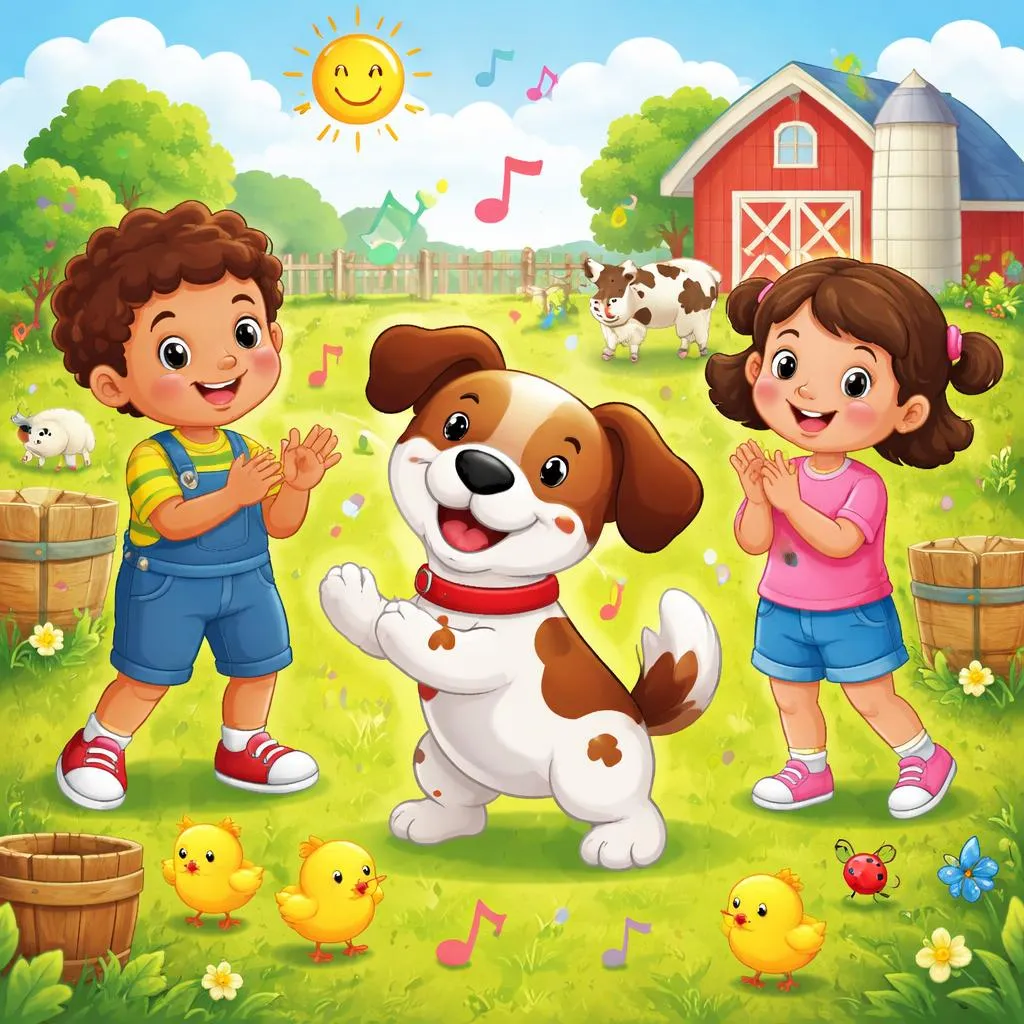

What is the rhyme?
Let’s meet a friendly farm dog today! The song about “Bingo” is a classic, cumulative folk song beloved around the world. It tells a simple, cheerful story about a farmer and his dog. The magic of this song isn’t in a complex plot, but in its brilliant, interactive structure. Each verse removes one letter from the dog’s name, replacing it with a hand clap.
This clever design makes the Bingo was his name o song lyrics a powerful tool for learning. They practice letter recognition, spelling, rhythm, and memory in a fun, participatory way. It’s a call-and-response adventure that builds anticipation and engagement with every verse. Everyone can join in, making it perfect for group learning and building confidence.
The lyrics of nursery rhymes
The Bingo was his name o song lyrics follow a very clear and predictable pattern. The song establishes the story in the first verse: “There was a farmer had a dog, and Bingo was his name-o. B-I-N-G-O, B-I-N-G-O, B-I-N-G-O, and Bingo was his name-o!”
Then, the pattern changes. In the next verse, we clap instead of saying the first letter: “(Clap)-I-N-G-O…” The verse after that uses two claps: “(Clap)-(Clap)-N-G-O…” This continues until the final verse, where all five letters are replaced by claps. The consistent rhythm and repetition of the core Bingo was his name o song lyrics make it incredibly easy and satisfying to follow.
Vocabulary learning
While the song focuses on spelling, the Bingo was his name o song lyrics introduce a set of useful, concrete vocabulary words. The core nouns are farmer, dog, name. We also learn the letters that make up the name B, I, N, G, O as distinct vocabulary items themselves.
The song is rich with common verbs in the simple past tense: was, had. The repetitive structure reinforces these high-frequency words. Additionally, the act of clapping becomes an associated action verb. This small set of words is practiced so frequently within the song that they become deeply familiar, providing a strong foundation for simple sentence building.
Phonics points
This song is a spelling and phonics powerhouse. The primary focus is on letter names and letter sequence. Singing “B-I-N-G-O” repeatedly reinforces the alphabetical names of these five letters, distinct from their sounds. This is a crucial pre-reading skill.
We can also focus on the initial letter sound /b/, as in Bingo and his name-o. The “-o” ending in “name-o” provides a consistent rhyming sound throughout the song. For very young learners, identifying the first sound in their own name (e.g., “M” for Mary) and comparing it to the /b/ in Bingo is a wonderful extension. The rhythmic clapping also helps segment the word into its five distinct parts.
Grammar patterns
The Bingo was his name o song lyrics beautifully illustrate a fundamental grammar structure: the simple past tense narrative. The entire song is a mini-story told in the past. It uses the common structure: “There was a… who had a… and… was his/her…”. This pattern, “There was a farmer had a dog,” is a classic folk song construction that exposes learners to narrative phrasing.
The song also reinforces possessive pronouns with “his name-o.” Furthermore, the consistent subject-verb-object order in the main lyric (“Bingo was his name”) provides a clear model for building simple, declarative English sentences. The grammar is absorbed naturally through the song’s repetitive and melodic frame.
Learning activities
The most obvious and engaging activity is to sing with actions! The prescribed clapping for each verse is the core activity. It develops auditory processing (listening for when to clap), motor skills, and rhythmic awareness. To increase the challenge, try stomping feet, tapping knees, or using rhythm sticks instead of clapping on the missing letters.
A fantastic follow-up activity is “Name Song Adaptation.” After mastering Bingo, apply the same tune and structure to other five-letter names. This could be a student’s name, like “S-A-R-A-H,” or another animal, like “K-I-T-T-Y.” This activity practices flexible thinking, spelling, and reinforces the song’s grammatical and rhythmic pattern with new vocabulary.
Printable materials
Printable resources can extend the learning from auditory to visual. A “Bingo Spelling Wheel” is a perfect tool. Create a circular dial with a window that shows one letter at a time. Around the wheel, write B-I-N-G-O in order. Learners can turn the wheel to “hide” letters, mimicking the song’s progression, and spell the name visually.
Another great printable is a “Clapping Chart.” This sheet has six columns, one for each verse. Each column shows the five letters of BINGO, but with progressively more letters replaced by a clap symbol (👏). Learners can point to the chart as they sing, connecting the visual representation of the missing letters to the auditory practice of clapping. This supports memory and sequencing.
Educational games
Turn the song into a lively game with “Musical Spelling Chairs.” Arrange five chairs in a row, each with a large letter card: B, I, N, G, O. Play the song. Six learners walk around the chairs. When the music stops (or when you pause the singing), everyone finds a chair. The learner without a chair must identify a letter (e.g., “What letter is on your chair?”) or say the sound it makes before joining back in.
For a fine motor and spelling game, create “Bingo Letter Build.” Use magnetic letters, letter tiles, or printed letter cards. Sing the song slowly. As each letter is sung, the learner finds that letter and places it in order to build the name “B-I-N-G-O.” For the clapping verses, they remove the corresponding letter. This directly connects the auditory song to tactile letter manipulation and word building.
The genius of the Bingo was his name o song lyrics lies in their perfect blend of simplicity, structure, and interaction. They transform the basic skill of spelling into a communal, physical, and musical event. This multi-sensory approach ensures that the language patterns—the letters, the grammar, the rhythm—are learned not just by ear, but by the whole body and mind. The joyful repetition builds a deep, intuitive understanding that makes language learning feel like a game everyone can win. So, gather round, start clapping, and let the spelling fun begin