
What is the rhyme?
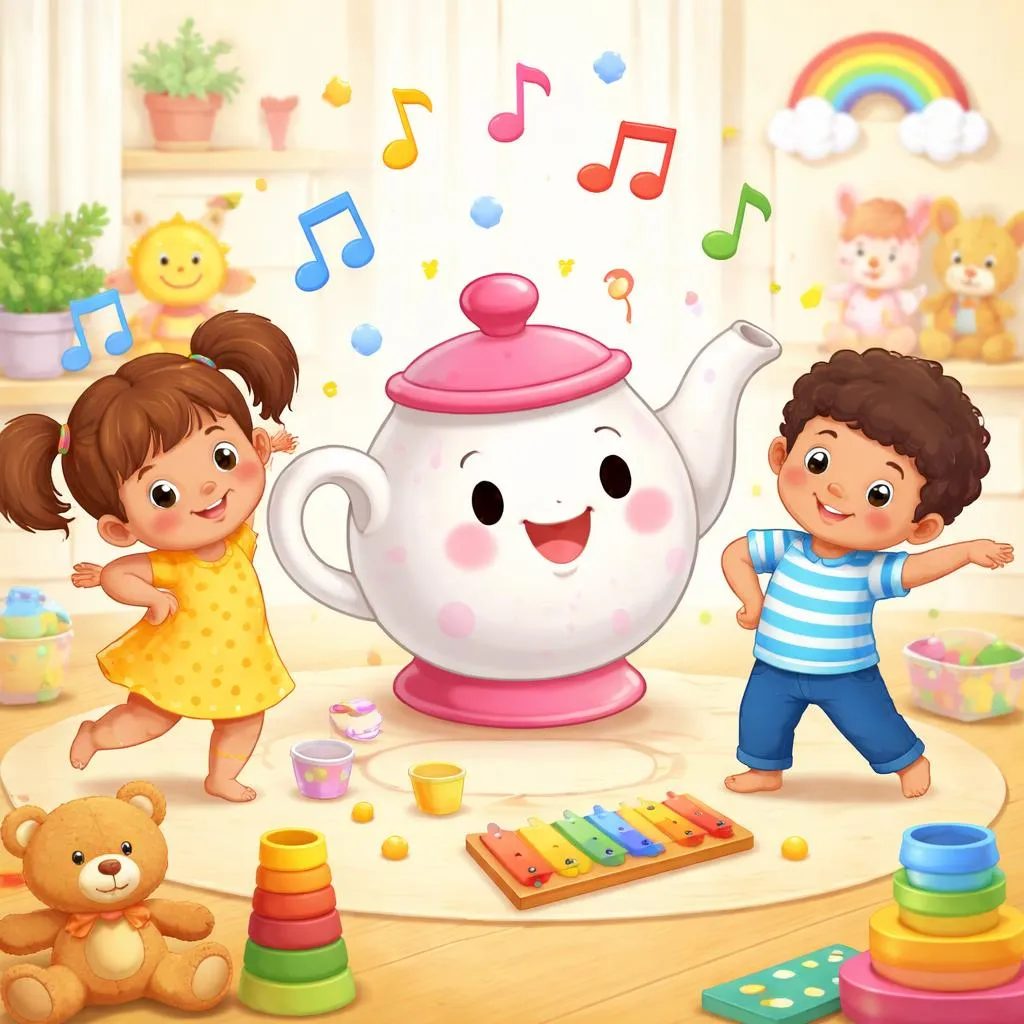
Let's warm up for some musical fun with a classic. The search for "teapot lyrics" almost certainly points to the beloved children's action song, "I'm a Little Teapot." This is not just a song; it's a whole-body experience. It combines simple, memorable lyrics with specific, charming movements that mimic the shape and function of a teapot.
This rhyme is a perfect example of learning through play. The teapot lyrics describe the teapot's physical form ("short and stout") and its action ("tip me over and pour me out"). Children get to act this out, turning abstract words into concrete physical shapes and motions. It's a foundational song for building coordination, rhythm, and vocabulary in a joyful, pressure-free way.
The lyrics of nursery rhymes
The classic teapot lyrics are short, sweet, and wonderfully descriptive. The most common version goes:
I'm a little teapot, short and stout. Here is my handle, here is my spout. When I get all steamed up, hear me shout: "Tip me over and pour me out!"
Often, a second verse adds more playful action: I'm a very special pot, it's true. Here's an example of what I can do. I can change my handle and my spout. (Switch arm positions) Tip me over and pour me out!
The lyrics are a masterclass in simplicity and repetition, making them incredibly easy for young learners to remember and perform with confidence.
Vocabulary learning
This short song packs in excellent vocabulary. It introduces descriptive adjectives for size and shape: little, short, stout. It names specific parts of an object: handle, spout. These are useful words that extend beyond the song to describe many everyday items.
The teapot lyrics are also rich with action verbs and phrases: get (steamed up), hear, shout, tip over, pour out. The phrase "steamed up" is a playful, child-friendly introduction to both a physical state (hot water making steam) and an idiom for feeling excited or angry. Learning these words in the context of a familiar, physical action deepens understanding.
Phonics points
The teapot lyrics provide great opportunities for focused phonics practice. The song heavily features the /ou/ diphthong sound, as heard in stout, spout, and out. Repeating this sound in a rhyming context helps children hear and reproduce it clearly.
We can also highlight alliteration and initial consonant sounds. The /t/ sound is prominent in teapot, tip, and true. The /h/ sound appears in handle and hear. Clapping the steady beat of the song helps segment the lyrics into measurable parts, reinforcing the rhythm of the language. The exclamation "pour me out!" perfectly emphasizes that final /t/ sound.
Grammar patterns
The song models several basic grammar structures. The primary sentence is a simple declaration using the verb "to be" for identity: "I am a little teapot." It then uses the demonstrative "here is" to point out features: "Here is my handle."
The lyric "When I get all steamed up, hear me shout" introduces a time clause ("When I get...") and an imperative verb ("hear me..."). The final line, "Tip me over and pour me out!" is a clear example of a command sentence (imperative mood). These patterns are absorbed naturally through the song's catchy and repetitive structure.
Learning activities
The best activity is, of course, to sing and perform the song with the actions. This kinesthetic connection is vital. Ensure everyone practices being a "short and stout" teapot, showing their "handle" (one hand on hip) and "spout" (other arm out straight), and the dramatic "tip over" to pour. This solidifies the meaning of the vocabulary.
A wonderful extension activity is a "Tea Party Vocabulary" session. After singing, set up a pretend tea party. Use real or toy cups, saucers, a teapot, and spoons. Practice using the words from the song in context: "This is the teapot's spout." "Can you pour the tea?" This connects the imaginative song to tangible objects and social play.
Printable materials
Create engaging printables to support the lesson. A "Label the Teapot" worksheet is perfect. Provide a large, friendly drawing of a teapot. Children can cut out labels that say "handle," "spout," "lid," and "body," and glue them to the correct parts. This reinforces the specific nouns from the teapot lyrics.
Another great printable is a "Sequence the Song" sheet. Have four boxes showing the key actions of the song: 1. Standing like a teapot. 2. Showing handle and spout. 3. Looking "steamed up." 4. Tipping over. Children can put them in order, draw them, or paste in provided pictures. This builds narrative sequencing skills.
Educational games
Turn the theme into playful games. Play "Musical Teapots." Similar to Musical Chairs, place paper "teapot mats" on the floor (one fewer than the number of children). Play the song or just sing it. When the music stops at the words "pour me out!", everyone must find a teapot mat to stand on. The child without a mat can perform the teapot pose for everyone.
For a listening and phonics game, try "Rhyming Pot." Gather a collection of small objects or picture cards. Some should rhyme with words from the song (e.g., a cut-out of a trout to rhyme with spout; a picture of a shout). Have a special box or "pot." Say a word from the song, like "spout." Children find an object that rhymes with it and put it in the "rhyming pot." This hones phonemic awareness.
Exploring the teapot lyrics through song, movement, and play demonstrates how language learning can be embodied and joyous. This simple song teaches more than words; it teaches rhythm, coordination, and the expressive connection between language and action. By extending the song with themed activities, we help children own the vocabulary, using it confidently in new contexts. The charm of "I'm a Little Teapot" endures because it turns every child into a storyteller with their body and voice, proving that some of the best learning happens when we're just being silly, stout, and ready to pour out our knowledge.