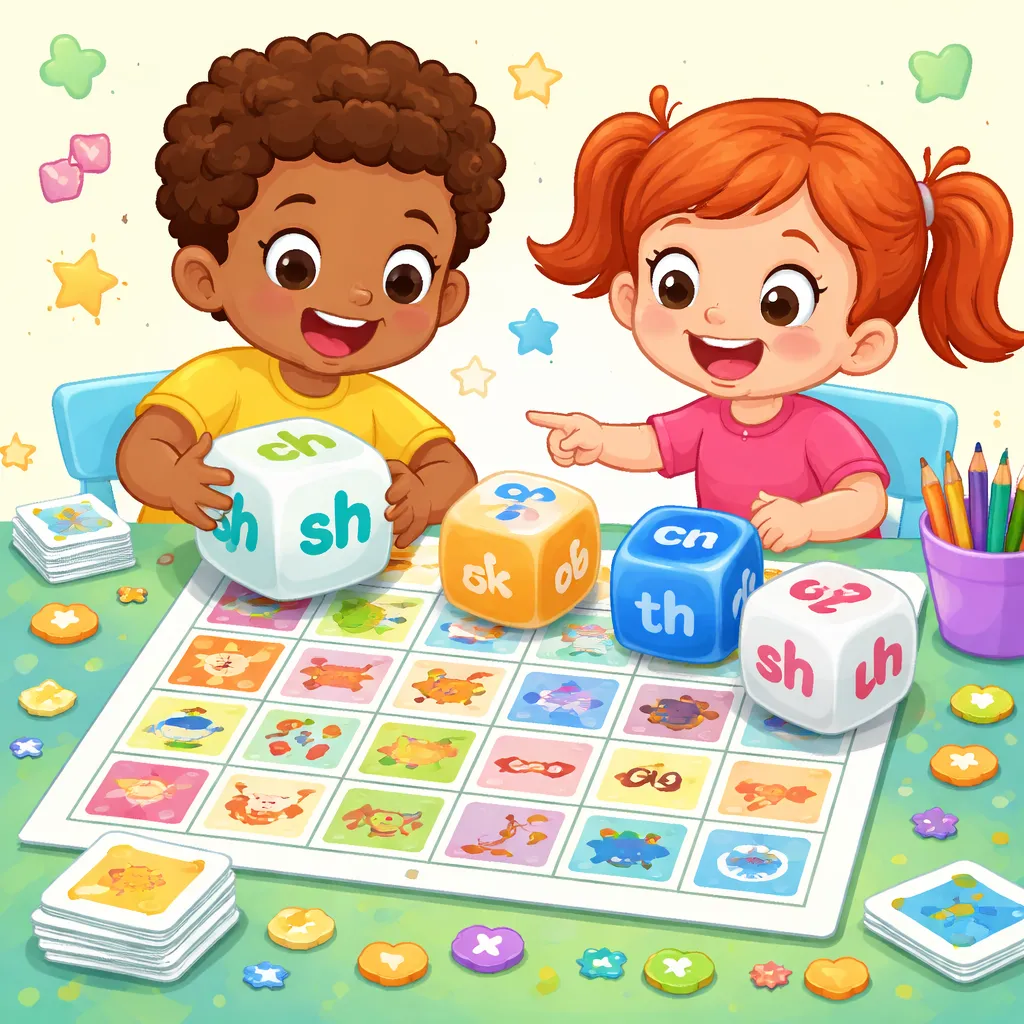

It’s a lively afternoon in the classroom! Your teacher pulls out colorful dice and paper sheets, saying: “Today we’ll play with phonics dice game template printable—let’s roll, read, and learn!” You grab a die, feeling its smooth sides. As you roll it, you see a letter: “A!” Your friend cheers, “Say the sound! /æ/!” Suddenly, phonics feels like a game, not work. What sounds will you master? How will these dice help you read words? Let’s roll into the fun world of phonics dice games!
Core Knowledge Explanation
First, let’s talk about phonics dice game template printable. They are printable sheets with dice outlines (or templates to make dice) that have letters or phonics sounds on each side. You cut, fold, and glue the templates to make dice, then use them to practice reading and spelling words—all while playing!
Phonics is the key to reading English. It teaches you how letters and letter combinations sound. When you know phonics, you can “decode” words: sound out each letter, then blend them together. For example, “c-a-t” becomes /k/-/æ/-/t/ → “cat”!
Let’s start with vowel sounds —the heart of phonics. Vowels are a, e, i, o, u. They have short and long sounds, but we’ll focus on short vowels first (the most common in CVC words: Consonant-Vowel-Consonant). Here’s a fun vowel (vowel sound rhyme) to remember them:
Short a: “A, a, /æ/, cat in a hat!”
Short e: “E, e, /e/, pen on the bed!”
Short i: “I, i, /ɪ/, pig in the wig!”
Short o: “O, o, /ɒ/, dog on the log!”
Short u: “U, u, /ʌ/, sun on the bun!”
Now, let’s learn a CVC word list (Consonant-Vowel-Consonant) with phonics, (phonetic symbols), and simple sentences. These words are perfect for phonics dice games:
Short a:
Cat /kæt/: “The cat sits on the mat.”
Hat /hæt/: “I wear a red hat.”
Bat /bæt/: “The bat flies at night.”
Rat /ræt/: “The rat runs fast.”
Pan /pæn/: “Mom cooks in a pan.”
Short e:
Pen /pen/: “I write with a pen.”
Hen /hen/: “The hen lays eggs.”
Ben /ben/: “Ben is my friend.”
Ten /ten/: “I have ten toys.”
Net /net/: “The fish is in the net.”
Short i:
Pig /pɪɡ/: “The pig is pink.”
Fig /fɪɡ/: “I eat a sweet fig.”
Big /bɪɡ/: “The elephant is big.”
Dig /dɪɡ/: “The dog likes to dig.”
Lip /lɪp/: “I bite my lip.”
Short o:
Dog /dɒɡ/: “The dog wags its tail.”
Log /lɒɡ/: “We sit on a log.”
Fog /fɒɡ/: “The fog is thick.”
Hog /hɒɡ/: “The hog eats corn.”
Box /bɒks/: “I put toys in a box.”
Short u:
Sun /sʌn/: “The sun is bright.”
Bun /bʌn/: “I eat a bread bun.”
Fun /fʌn/: “We have fun at the park.”
Run /rʌn/: “I run fast.”
Cup /kʌp/: “I drink from a cup.”
Next, let’s learn basic phonics rules that phonics dice game template printable help you practice:
- CVC Rule : In words with consonant-vowel-consonant, the vowel makes its short sound. For example, “cat” (c-a-t) → short a /æ/.
- Blending Rule : Say each sound slowly, then blend them together quickly. “c-a-t” → /k/.../æ/.../t/ → “cat”!
- Consonant Sound Rule : Most consonants make one sound (e.g., “b” → /b/, “c” → /k/, “d” → /d/). This makes them easy to learn.
Now, let’s correct common phonics mistakes kids often make:
Mistake 1: Confusing short a (/æ/) and short e (/e/). Example: Saying “pet” instead of “pat.” Fix: Use the rhyme—“A is /æ/ like cat, E is /e/ like pen!”
Mistake 2: Skipping consonant sounds. Example: Saying “at” instead of “cat.” Fix: Point to each letter as you sound it out—“c-a-t, not a-t!”
Mistake 3: Making long vowel sounds in CVC words. Example: Saying “kay-t” instead of “cat.” Fix: Remember the CVC rule—short vowels for consonant-vowel-consonant!
Mistake 4: Mixing up “b” and “d.” Example: Saying “doy” instead of “boy.” Fix: Use a trick—“b” looks like a bed, “d” looks like a dog!
Phonics dice game template printable are designed to practice these rules and fix mistakes. Each die has letters (consonants or vowels) that you roll to make CVC words. For example, one die has consonants (b, c, d, f, g, h) and another has vowels (a, e, i, o, u)—roll both to make words like “bad,” “bed,” “bid,” “bod,” “bud!”
Fun Interactive Learning
First, let’s learn how to use phonics dice game template printable. Follow these simple steps to make and play:
Step 1: Print the template. Ask an adult to help print the phonics dice game template printable. There are two types of dice: Consonant Dice (with letters b, c, d, f, g, h) and Vowel Dice (with a, e, i, o, u).
Step 2: Cut the template. Use scissors (adult help!) to cut along the black lines of the dice templates. Each die is a square with six faces.
Step 3: Fold and glue. Fold along the dotted lines to make a cube shape. Glue the tabs to hold the die together. Let it dry for a few minutes.
Step 4: Decorate (optional). Color the dice with markers or crayons. You can write the letter sounds next to each letter to help you remember—e.g., write /æ/ next to “a.”
Now, let’s play “Roll & Spell” Game —the most popular game with phonics dice game template printable:
Game Rules:
- Gather 2-4 players. Each player gets a piece of paper and a pencil.
- Place the Consonant Dice (2 dice) and Vowel Dice (1 die) in the middle of the table.
- Take turns rolling the dice. For example, if you roll “b” (consonant), “a” (vowel), and “t” (consonant), you have the letters to make “bat.”
- When you roll the letters, say each sound aloud: “b → /b/, a → /æ/, t → /t/.”
- Blend the sounds to make a word: “/b/-/æ/-/t/ → bat!”
- Write the word on your paper. If you spell it correctly, you get 1 point.
- The player with the most points after 10 rounds wins!
Variation: If you roll letters that don’t make a real word (e.g., “b-e-x”), say “No word!” and skip your turn. Or challenge yourself to make a silly word and say it aloud—“bex! /b/-/e/-/x/ → bex!”
Next, let’s play “Phonics Race”闯关练习 (Adventure Challenge) . This game helps you practice blending and speed:
Game Setup:
Make a “race track” on paper with 20 spaces. Label each space with a point value (1-3).
Use 3 phonics dice (2 consonant, 1 vowel) from your phonics dice game template printable.
Game Rules:
- Each player picks a game piece (button, toy car, or drawing). Place it at the start line.
- Take turns rolling the dice. Blend the letters to make a word.
- If you say the word correctly, move your game piece forward the number of points on the space.
- If you land on a “Bonus Space,” roll the dice again and make another word for extra points.
- The first player to reach the finish line wins a “Phonics Master” sticker!
Example Play:
Player 1 rolls “c,” “a,” “t” → “cat” → moves 2 spaces.
Player 2 rolls “d,” “o,” “g” → “dog” → moves 3 spaces.
Player 1 lands on Bonus Space, rolls “f,” “u,” “n” → “fun” → moves 1 extra space.
Let’s do “Word Building Challenge” to practice making multiple words with the same letters:
Game Rules:
- Roll 3 dice (2 consonant, 1 vowel) from your phonics dice game template printable. For example, roll “b,” “e,” “d.”
- See how many words you can make with these letters. You can rearrange the consonants, but the vowel stays in the middle (CVC rule!).
- For “b,” “e,” “d,” you can make “bed” and “deb” (a name—yes, it counts!).
- Write down all the words you make. Each real word gets 1 point.
- Play with a friend—who can make more words?
Another fun game: “Sentence Maker” . After rolling and spelling a word, use it in a sentence:
- Roll the dice to make a word (e.g., “sun”).
- Say a sentence using the word: “The sun shines bright in the sky.”
- If the sentence makes sense, you get 2 points instead of 1.
- For extra fun, act out the sentence—pretend to be the sun shining!
Let’s practice common mistake correction with a game called “Fix the Word”:
- One player says a word with a phonics mistake (e.g., “pet” instead of “pat”).
- The other player listens, finds the mistake, and fixes it: “That’s not pet—it’s pat! /p/-/æ/-/t/ → pat!”
- If they fix it correctly, they get a point.
- Switch roles—now you say a mistake, and your friend fixes it!
Expanded Learning
Let’s learn about phonics in English-speaking countries . Kids in the US, UK, and Australia use phonics to learn reading too! They play dice games, use flashcards, and read simple books—just like you.
In the UK, phonics is taught in primary schools starting at age 4. Teachers use games like “Roll a Word” to make learning fun. In the US, many schools use “phonics workbooks” with dice templates to practice CVC words. Now you’re learning like kids around the world!
Let’s sing a “Phonics Dice Song” to remember vowel sounds and CVC words. Tune: “Row, Row, Row Your Boat”
Roll the dice, say the sound,
/æ/ /e/ /ɪ/ /ɒ/ /ʌ/,
Make a word, blend it fast,
Reading’s fun for us!
Cat and bat, pen and hen,
Pig and big, dog and log,
Sun and fun, one by one,
Phonics rocks our world!
Let’s expand our CVC word list with more words for each vowel. These words are perfect for your phonics dice game template printable:
Short a: Bag /bæɡ/, Tap /tæp/, Map /mæp/, Cap /kæp/, Nap /næp/
Short e: Bet /bet/, Get /ɡet/, Let /let/, Met /met/, Set /set/
Short i: Bin /bɪn/, Gin /dʒɪn/, Kin /kɪn/, Pin /pɪn/, Tin /tɪn/
Short o: Bot /bɒt/, Cot /kɒt/, Dot /dɒt/, Hot /hɒt/, Pot /pɒt/
Short u: But /bʌt/, Cut /kʌt/, Hut /hʌt/, Nut /nʌt/, Put /pʊt/ (special sound, but still CVC!)
Let’s try phonics dice variations . You can make different dice with your phonics dice game template printable:
Blends Dice: Add consonant blends (sh, ch, th, bl, br) to make words like “shat” (not a real word—oops!), “chat,” “thud,” “blab,” “brat.”
Long Vowel Dice: Add silent “e” to make long vowels—e.g., “cake” (c-a-k-e), “bike” (b-i-k-e). Roll three consonants and a vowel, then add “e” to the end!
Let’s learn how to make your own dice templates . If you don’t have a printable, draw a cube on paper:
- Draw a square with six smaller squares (like a cross).
- Write phonics letters on each small square (e.g., consonants on one die, vowels on another).
- Cut it out, fold, and glue. Now you have a homemade phonics die!
Let’s connect phonics to reading. Pick a simple English book (or free PDF storybook) and look for CVC words. Every time you see a CVC word, sound it out: “Look! The cat is on the mat. Cat → /k/-/æ/-/t/, mat → /m/-/æ/-/t/!” This helps you use phonics in real reading.
What You Will Learn
From phonics dice game template printable, you will learn so many valuable skills! First, you’ll master short vowel sounds (a, e, i, o, u) and remember them with fun rhymes. You’ll know exactly how to say /æ/ for a, /e/ for e, and so on.
You’ll learn over 50 CVC words —words like cat, pen, pig, dog, and sun. You can sound them out, spell them, and use them in sentences. These words are the building blocks of English reading—once you know them, you can read simple books!
You’ll master phonics rules : how to blend sounds into words, the CVC short vowel rule, and how to avoid common mistakes. You’ll no longer mix up a and e, or skip consonant sounds.
You’ll develop reading and spelling skills . Phonics helps you “decode” new words—when you see a word like “hat,” you can sound it out without asking for help. You’ll also spell better, because you know how letters sound and how they fit together.
Your listening and speaking skills will improve. You’ll practice saying letter sounds and words correctly, which makes your English easier to understand. You’ll also listen for mistakes and fix them—great for communication!
You’ll learn to work with others . Games like Phonics Race and Sentence Maker are fun with friends or family. You’ll take turns, cheer each other on, and learn together—teamwork makes learning better!
You’ll develop a love for learning English . Phonics dice games are fun, so you’ll look forward to practicing. You’ll realize that English isn’t just work—it’s a game you can play and win!
Using What You Learned in Life
You can use your phonics skills every day with phonics dice game template printable! Play a quick game before breakfast—roll the dice, make 3 words, and say them aloud. It’s a fun way to start the day.
When you’re reading a book or watching a cartoon, look for CVC words. Point them out and sound them out: “Mom, look! ‘Dog’ is a CVC word—/d/-/ɒ/-/g/ → dog!” You’ll be surprised how many CVC words are in books and shows.
Have a “Phonics Playdate” with friends. Bring your phonics dice game template printable and play Roll & Spell or Phonics Race. You can even make new dice together with different letters.
Practice spelling with your family. Ask a parent to say a CVC word, and you spell it using the dice: “Spell ‘pen!’” You roll p, e, n → “p-e-n, pen!” Correct spelling gets you a high-five!
Use CVC words in your daily conversations. When you’re playing outside, say: “The sun is hot!” or “Let’s run to the park!” When you’re eating, say: “I eat a bun for snack.” Every sentence is practice!
Make a “Phonics Word Wall” at home. Write down all the CVC words you learn on sticky notes and stick them on the wall. Add new words every time you play the dice game. Soon, you’ll have a wall full of words you can read and spell!
Closing Encouragement
Wow! You’ve rolled, blended, spelled, and laughed your way through phonics with phonics dice game template printable. You can sound out CVC words, say vowel sounds correctly, and play fun games—you’re a phonics star!
Every time you rolled the dice, blended a word, or fixed a mistake, you got better at English. It’s okay if you took time to sound out a word or made a mistake—what matters is you kept trying and having fun.
Keep playing with your phonics dice. Make new words, play new games, and challenge yourself to use more words in sentences. The more you practice, the faster you’ll read, the better you’ll spell, and the more confident you’ll feel.
Remember, phonics is your superpower. It lets you read new words, spell correctly, and speak clearly. With this superpower, you can read books, write stories, and talk to people in English—anything is possible!
You’re a brave and curious learner. We’re so proud of how hard you’ve worked. Keep rolling the dice, keep learning, and keep loving English—your phonics journey is just beginning. Happy rolling and reading