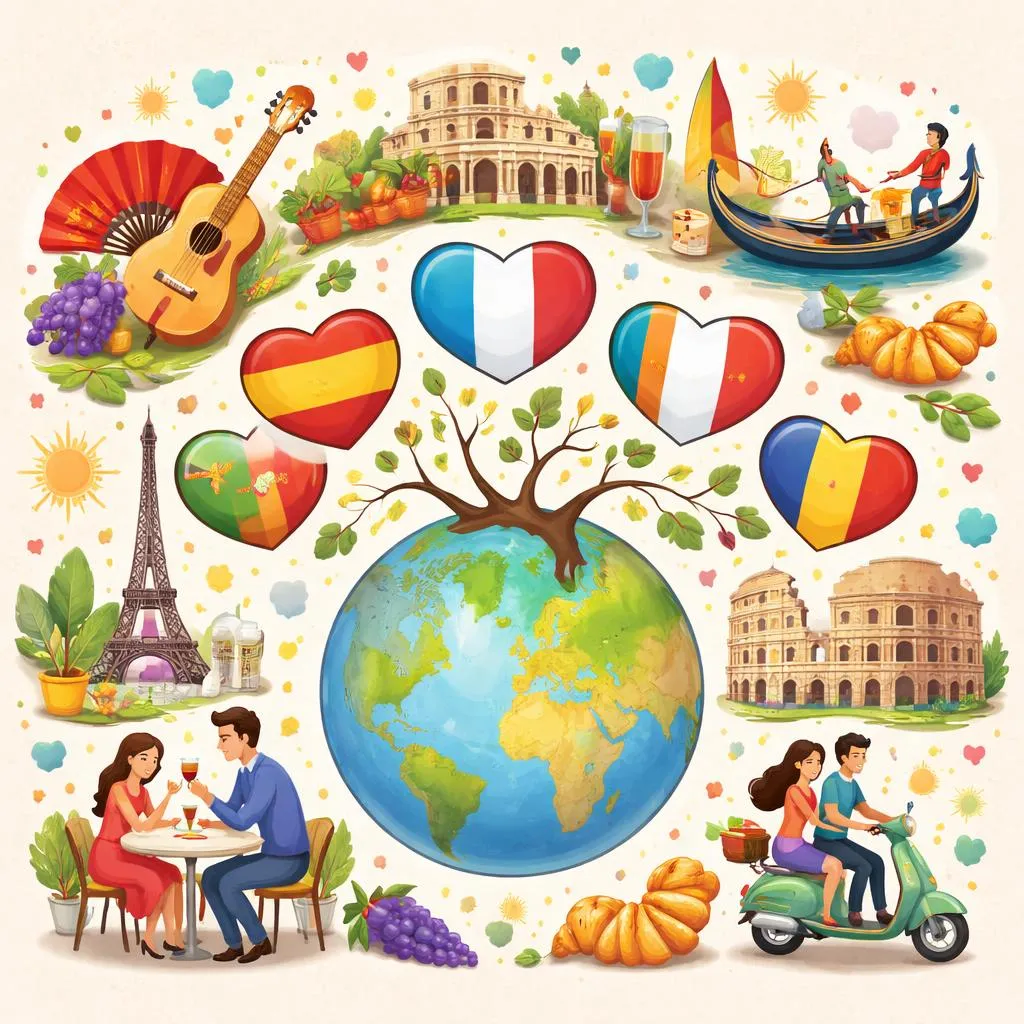

What Are Romance Languages? Romance languages are a group of languages that come from Latin, the language spoken by the ancient Romans. These languages developed over time as the Roman Empire expanded and then broke apart. Today, we have many different Romance languages, but they all share similarities because they evolved from Latin. Some of the most well-known Romance languages are:
Spanish
French
Italian
Portuguese
Romanian
Other less commonly spoken Romance languages include Catalan, Galician, and Occitan. These languages are spoken in different parts of the world, and each has its own unique sounds, words, and grammar rules, but they all share their roots in Latin.
Why Are They Called Romance Languages? The name "Romance languages" comes from the word "Roman" because these languages are all derived from Latin, the language of the Romans. Even though Latin is no longer spoken in everyday life, its influence continues in the Romance languages that came from it. When the Roman Empire expanded, Latin was spoken across large areas of Europe, North Africa, and parts of Asia. After the empire fell, people in different regions started to speak Latin in their own ways. Over many years, these regional forms of Latin became the Romance languages we know today.
What Do All Romance Languages Have in Common? Even though there are many different Romance languages, they share some important characteristics. Here are some things that all Romance languages have in common:
- Vocabulary Many words in Romance languages are very similar because they come from the same Latin roots. For example, in Spanish, "mesa" means "table", and in Italian, "tavolo" also means "table." These words come from the Latin word "mensa." This is just one example of how Romance languages share vocabulary. Here are some other examples:
Spanish: "familia", French: "famille", Italian: "famiglia" – All mean "family".
Spanish: "libro", French: "livre", Italian: "libro" – All mean "book".
- Grammar Romance languages have similar grammar structures because they all evolved from Latin. They all use gendered nouns (masculine and feminine) and conjugate verbs depending on the subject. For example, in many Romance languages, you have different forms for "I am" based on the language:
Spanish: "Yo soy"
French: "Je suis"
Italian: "Io sono"
Even though the words are different, they follow the same structure and meaning. 3. Verb Conjugation Another common feature of Romance languages is the way verbs change, or conjugate, based on the subject. For example, the verb "to speak" is conjugated differently in Spanish, French, and Italian:
Spanish: "hablar" – "Yo hablo" (I speak)
French: "parler" – "Je parle" (I speak)
Italian: "parlare" – "Io parlo" (I speak)
Even though the verbs are different, the way they change based on the subject is very similar in all Romance languages.
The Most Popular Romance Languages Now, let's take a closer look at some of the most spoken Romance languages.
- Spanish Spanish is the second most spoken language in the world, with over 460 million people speaking it. It is spoken in Spain, most of Latin America, and in some parts of the United States. Spanish has many similarities to other Romance languages, but it also has its own unique features, like the "voseo" in Argentina and other parts of Latin America, where people use "vos" instead of "tú" to say "you."
- French French is spoken by more than 275 million people worldwide, making it one of the most widely spoken languages. It is the official language of France, as well as many countries in Africa, Canada, and the Caribbean. French is known for its beautiful pronunciation and is often considered the language of love!
- Italian Italian is spoken by around 85 million people, mostly in Italy and Switzerland. It is known for its musical sound and is the language of art, opera, and fashion. Italian is very similar to Latin, and many English words related to music and art come from Italian.
- Portuguese Portuguese is spoken by around 220 million people, mainly in Portugal, Brazil, and parts of Africa. It is very similar to Spanish, so if you speak Spanish, learning Portuguese can be easier! Brazilian Portuguese, in particular, has its own distinctive pronunciation and vocabulary.
- Romanian Romanian is the least similar to the other Romance languages because it has influences from Slavic languages, Greek, Turkish, and Hungarian. However, it still has many similarities with Latin and other Romance languages. Romanian is spoken by around 24 million people, mostly in Romania and Moldova.
Fun Facts About Romance Languages Here are some fun facts about the Romance languages that you might not know!
The word "romance" comes from the Latin word "Romanicus", which means "in the Roman style." This is where we get the term "Romance languages."
The French language has a big influence on many other languages, including English. Many English words related to food, fashion, and culture come from French, such as "restaurant," "ballet," "croissant," and "menu."
In Spain, Catalan and Galician are also Romance languages. Catalan is spoken in parts of Spain, Andorra, and France, while Galician is spoken in the region of Galicia in Spain.
Italian is often called the "language of music." Many musical terms, like "allegro," "forte," and "piano," come from Italian.
Learning Romance Languages If you're interested in learning a Romance language, it's a great choice! Many of the words and grammar structures are similar across these languages, so once you learn one, it will be easier to pick up others. Tips for Learning Romance Languages:
Start with vocabulary: Learn the most common words that are shared across Romance languages.
Listen to music and watch movies: Watching movies or listening to music in a Romance language can help you get used to the sounds and rhythm.
Practice regularly: Learning a language takes time, so practicing every day is key.
Use language apps: There are many apps like , Babbel, and Rosetta Stone that can help you learn Romance languages in a fun and interactive way.
Find a language partner: Practicing with a native speaker or fellow learner is one of the best ways to improve.
Common Expressions in Romance Languages Here are some common expressions in different Romance languages that will help you get started:
Spanish: "Hola, ¿cómo estás?" – Hello, how are you?
French: "Bonjour, comment ça va?" – Hello, how are you?
Italian: "Ciao, come stai?" – Hello, how are you?
Portuguese: "Olá, como você está?" – Hello, how are you?
Romanian: "Bună ziua, ce mai faci?" – Hello, how are you?
Practice Using Romance Languages! If you want to practice speaking a Romance language, try these fun activities:
- Learn a song in a Romance language to help you with pronunciation.
- Write simple sentences in the Romance language you're learning. Start with basic phrases like "I am happy" or "I like pizza."
- Play language games: Try online games or apps that teach you vocabulary in the Romance language.