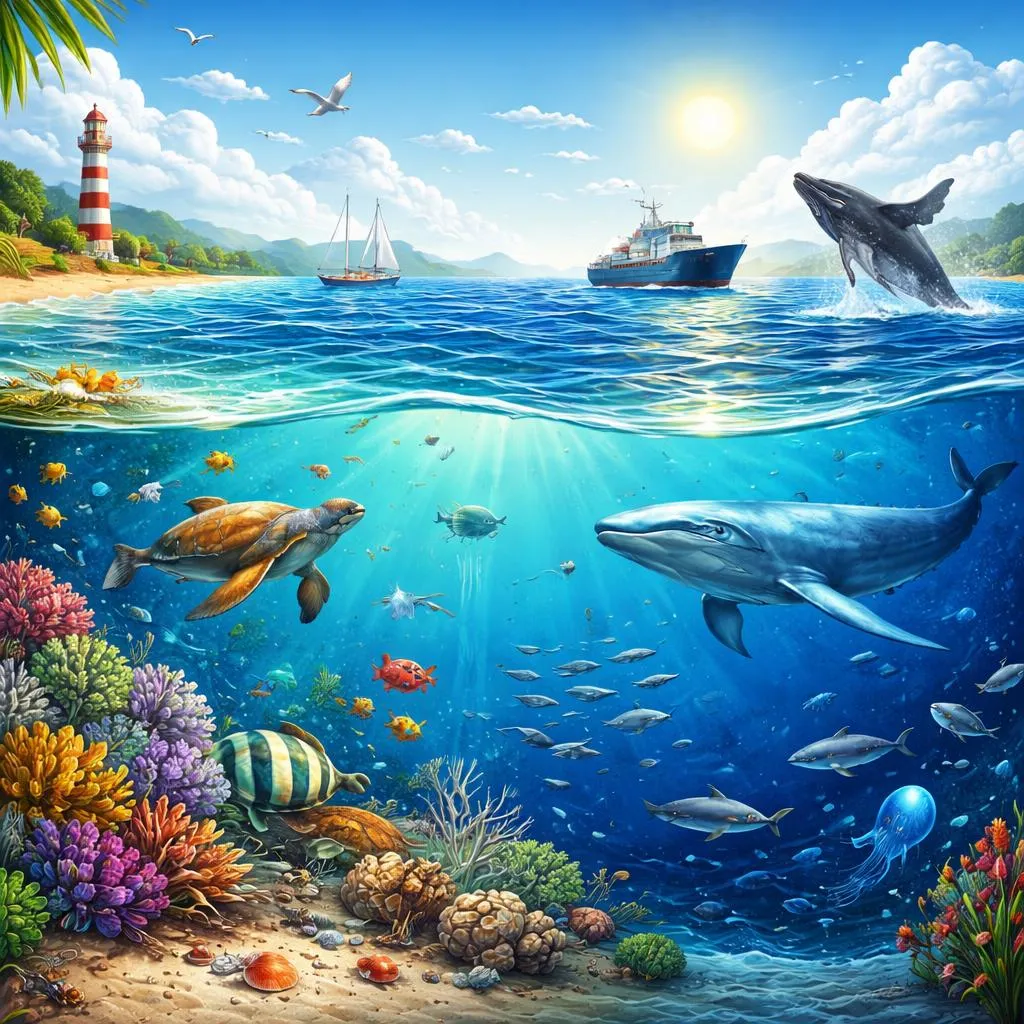

Hello, water explorer! We swim in the sea. Ships cross the ocean. Both are big and blue. But are they the same thing? They are two different sizes of salty water. One is like a big neighbor's pond. One is like a giant, mysterious deep. Let's discover their secret! Today, we explore the word pair "sea" and "ocean". Knowing the difference makes you a word expert. Let's begin.
First, let's be Language Listeners. Listen at home. Here are two sentences. "We swam in the calm sea on vacation." "The Pacific Ocean is the largest on Earth." Both talk about salty water. Calm water on vacation. The largest on Earth. Do they sound the same? One sounds smaller and closer. One sounds huge and global. Can you sense the difference? Great listening! Now, let's dive deeper.
Adventure! Into the World of Salty Water
Welcome to understanding big water. A "sea" and an "ocean" are both bodies of salt water. But their size and feeling are different. Think of a "sea" as a familiar neighbor's pond. It is often smaller. It is partly enclosed by land. It feels closer, sometimes calmer. Think of an "ocean" as a giant, mysterious deep. It is vast and open. It separates continents. It feels powerful and endless. Both are salty. But one is the "familiar pond". One is the "mysterious deep". Let's learn about each one.
A Familiar Pond vs. A Mysterious Deep Think about the word "sea". A "sea" is a large body of salt water. It is often smaller than an ocean. It is usually partly surrounded by land. The Mediterranean Sea is warm. Now, think about "ocean". An "ocean" is a vast body of salt water. It covers most of Earth's surface. Oceans are huge and deep. The Atlantic Ocean is deep. We sailed on the sea. Whales live in the ocean. "Sea" is the familiar pond. "Ocean" is the mysterious deep.
Smaller and Enclosed vs. Vast and Open Let's compare their size and shape. A "sea" is often smaller. It is often nearly enclosed by land. The North Sea is by Europe. An "ocean" is the largest division of water. It is open and separates continents. The Indian Ocean is warm. Some seas are almost like lakes. The ocean is very deep. One is often smaller and enclosed. One is vast and open.
Their Special Word Partners and Common Uses Words have best friends. "Sea" often partners with specific names and local travel. The Red Sea. At sea. Sea level. By the sea. "Ocean" often partners with the major global bodies and vastness. Pacific Ocean. Across the ocean. Ocean floor. Deep ocean. Note: "Sea" is used for specific, named bodies, often between lands. "Ocean" is used for the few vast global bodies. You visit the sea. You cross the ocean.
Let's visit a school scene. In geography, we learned the names of the five oceans. This is about the major global bodies of water. We studied creatures from the Coral Sea. The word "ocean" fits the lesson about the five major global water bodies. The word "sea" fits the lesson about a specific, named body of water. One is about the biggest divisions. One is about a specific sea.
Now, let's go to the playground. The wave pool felt like the sea. This compares the pool to the experience of a sea. Our pretend ship crossed the vast ocean. The word "sea" fits the local, wave-pool-like experience. The word "ocean" fits the idea of a vast, pretend voyage. One is a comparison to a local experience. One is for a vast, imaginary journey.
Our Little Discovery So, what did we find? A "sea" and an "ocean" are both salty water. But a "sea" is usually smaller. It is often partly enclosed by land. An "ocean" is a vast, open body of water. Oceans are the largest divisions on Earth. Some seas are parts of oceans. The Caribbean Sea is beautiful. The ocean covers most of Earth. "Sea" is the familiar pond. "Ocean" is the mysterious deep.
Challenge! Become a Word Champion
Ready for a nature test? Let's try your new skills!
"The Best Choice" Challenge Let's imagine a natural scene. The huge whale swam in the deep blue ocean. This describes the vast, open waters where large whales roam. We built a sandcastle by the gentle sea. The word "ocean" is the champion for the deep, vast home of the huge whale. The word "sea" is the best choice for the gentle waters by the shore where you build sandcastles. One is vast and deep. One is gentler and by the shore.
"My Sentence Show" Your turn to create! Here is your scene: A beach vacation. Can you make two sentences? Use "sea" in one. Use "ocean" in one. Try it! Here is an example: "The water in the sea was warm and clear." This describes the water at a specific, local beach. "We learned about the huge ocean currents." This talks about the large-scale movements in the vast global waters. Your sentences will show local water versus global water!
"Eagle Eyes" Search Look at this sentence. Can you find the word that could be better? Let's check a home context. "My grandpa sailed across the big sea to another continent." Hmm. Sailing to another continent usually means crossing a vast, open "ocean", not a "sea". Using "sea" here sounds a bit small for a trip between continents. A better sentence is: "My grandpa sailed across the big ocean to another continent." Using "ocean" correctly describes the vast water between continents. "Sea" is better for smaller, more enclosed waters. Did you spot it? Super thinking!
Harvest and Action! Turn Knowledge Into Your Superpower
Great exploring! We started thinking "sea" and "ocean" were just big salty water. Now we know they are different in size and feel. A "sea" is often a smaller body of salt water, partly enclosed by land. An "ocean" is a vast, major body of salt water that separates continents. You can now talk about water with perfect clarity.
What you can learn from this article: You can now see that a "sea" is often a large body of salt water that is partly surrounded by land. It can feel closer, like the Mediterranean Sea or the Caribbean Sea. You can now understand that an "ocean" is a much vaster body of salt water. There are only a few oceans on Earth, like the Pacific and Atlantic. They are the biggest divisions of water. You know that you might swim in the sea on holiday. A ship might cross the ocean. You learned to match the word to the idea: "sea" for the smaller, often enclosed salty water; "ocean" for the vast, open, and deep salty water.
Life practice application: Try your new skill today! Be a water detective. Look at a world map. Find the names of the big oceans. Then, look for smaller bodies of water named "sea", like the North Sea or the Red Sea. Remember, sea is the familiar neighbor's pond, ocean is the giant mysterious deep. Use "sea" when you talk about a specific, named body of water on a coast. Use "ocean" when you talk about the vast, open waters of the world. You will read maps and stories in a whole new way!