
What is the rhyme?
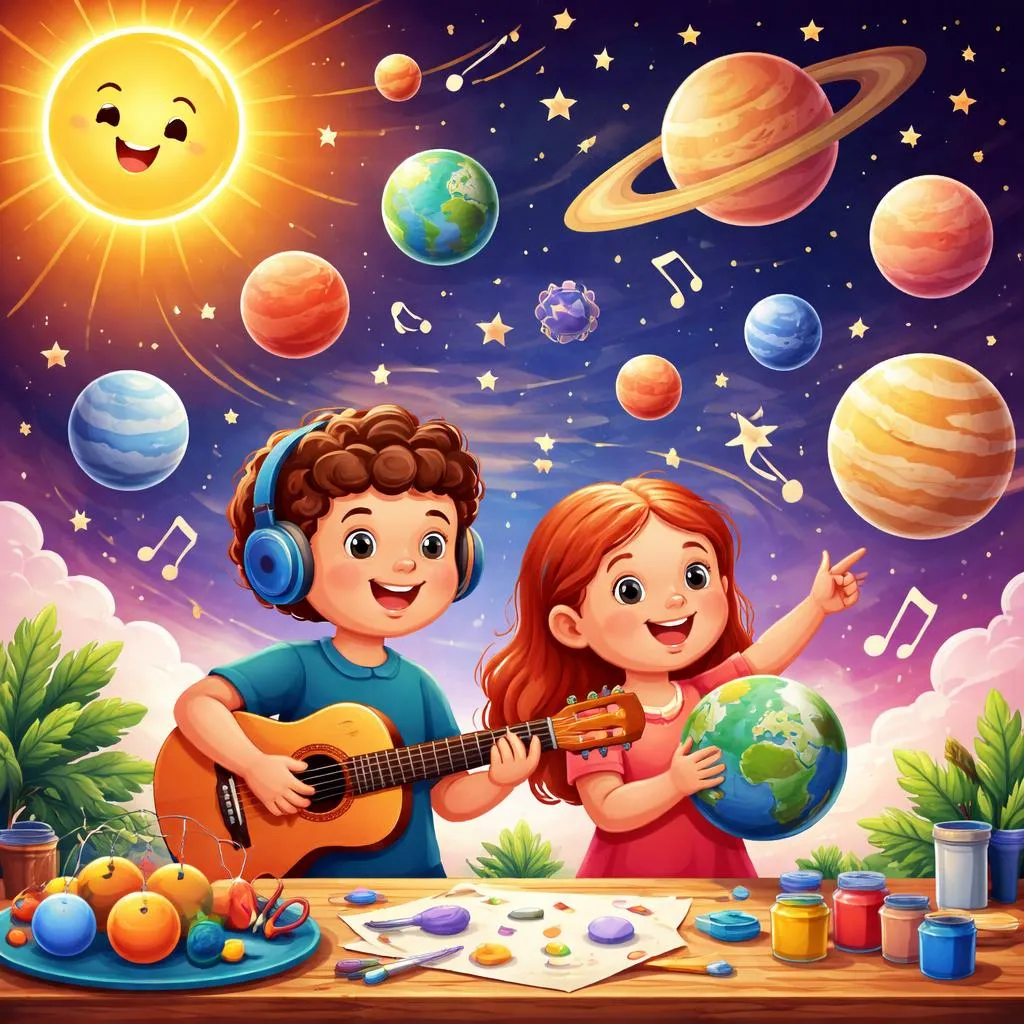
Let's take a musical trip through space today. A planet song is an educational nursery rhyme or chant designed to teach the order and key features of the planets in our solar system. It transforms a list of names—Mercury, Venus, Earth, Mars, Jupiter, Saturn, Uranus, Neptune—into a memorable, rhythmic sequence.
The power of a great planet song lies in its ability to make complex information simple and fun. By setting facts to music, it helps children remember the number of planets, their names, and their sequence from the Sun. This song is often a child's first exciting introduction to astronomy, building a foundation for scientific curiosity and vocabulary through melody.
The lyrics of nursery rhymes
Lyrics for a planet song typically follow a clear, repetitive structure. Many are based on familiar tunes like "Twinkle, Twinkle, Little Star" or "The Wheels on the Bus." A common version focuses on listing the planets in order:
Mercury, Venus, Earth, and Mars, These are the planets near our stars. Jupiter and Saturn, big and grand, Uranus and Neptune, out in the blue land. All orbit the Sun, a fiery ball, Eight planets in total, we know them all!
Some songs include a simple fact for each planet in successive verses, creating a cumulative learning effect. The repetitive chorus and rhyming ends (Mars/stars, grand/land, ball/all) are key to making the information stick.
Vocabulary learning
A well-crafted planet song introduces a universe of specific vocabulary. First, it teaches the proper nouns: the names of the eight planets and the Sun. Beyond names, it brings in essential nouns like orbit, star, system, space, world.
The song is also rich with descriptive adjectives that paint a picture: hot, cold, red, big, giant, blue, far, gaseous, rocky. Verbs like orbit, spin, glow, live (on) describe actions. This thematic grouping of words helps learners organize new information. Hearing "Jupiter is a giant planet" connects an adjective to a proper noun in a meaningful context.
Phonics points
Singing a planet song provides excellent practice with phonics. The planet names themselves are multi-syllabic words perfect for breaking down: Mer-cu-ry (3 syllables), Ve-nus (2), Ju-pi-ter (3), Sat-urn (2). Clapping along with the song helps children feel the rhythm of these longer words.
We can focus on initial sounds and vowel sounds. The /m/ in Mercury and Mars, the /v/ in Venus, the soft /j/ in Jupiter, and the /n/ in Neptune are distinct. The song also offers practice with the long U sound in Uranus and the /th/ digraph in Earth. The rhyming structure of the lyrics reinforces phonemic awareness in a joyful way.
Grammar patterns
This song naturally models important grammar. All planet names are proper nouns, providing a clear, repeated lesson in capitalization. The lyrics often use the simple present tense to state universal facts: "The planets orbit the Sun." "Mars is red."
We see the comparative form in phrases like "big and grand." The structure "These are the planets" reinforces the verb to be for identification. Prepositions of place are also practiced: planets are "near our stars" or "out in the blue land." This grammar is absorbed seamlessly through the song's structure.
Learning activities
Extend the song's magic with hands-on learning. After singing, create a "Human Solar System." Assign eight children to be planets. Give them signs or hats with planet names. Have them stand in the correct order, with one child as the Sun in the center. As you sing the song, each "planet" can take a step in a circle to simulate orbiting. This kinesthetic activity links physical movement to the lyrical sequence.
Another great activity is "Planet Song Karaoke." Display the lyrics on a screen or large poster. Sing the song through once, then have volunteers come up and point to each word or planet name as the class sings. This builds word recognition, fluency, and confidence in a supportive, group setting.
Printable materials
Printable resources can make the learning visual and lasting. Create a "Lyrics Fill-in-the-Blank" sheet. Provide the song lyrics with key vocabulary words missing (e.g., "______, Venus, Earth, and Mars."). Include a word bank at the bottom. Learners fill in the blanks, reinforcing spelling and recall of the planet names from the planet song.
A "Solar System Mobile" template is a wonderful art project. Provide printed circles of different sizes for the Sun and planets. Children can color them accurately (e.g., red Mars, blue Earth), cut them out, and attach them with string to a hanger in the correct order. Hanging the mobile creates a constant visual reminder of the song's lesson.
Educational games
Turn the theme into playful games. Play "Musical Planets." Place hula hoops or mats on the floor, each labeled with a planet's name. Play the planet song while children walk around. When the music stops, call out a planet feature: "Find the Red Planet!" or "Go to the largest planet!" Children must run to the correct mat (Mars or Jupiter). This tests listening comprehension and quick recall.
For a calmer table game, create "Planet Bingo." Make bingo cards with pictures or names of the planets instead of numbers. Call out clues instead of just the name: "This planet has rings." (Saturn) or "This is the planet we live on." (Earth). The first to get a line wins. This deepens understanding beyond simple name recognition.
The true value of a planet song is how it packages wonder and information into an accessible, joyful experience. It gives children a tool to hold the vast solar system in their minds through melody and rhythm. By pairing the song with creative activities and games, we move from passive listening to active exploration. This approach ensures that the planet song becomes more than a tune—it becomes a springboard for curiosity, vocabulary growth, and a lifelong interest in the stars. Every time they sing it, they are rehearsing not just words, but a story of our place in the cosmos.