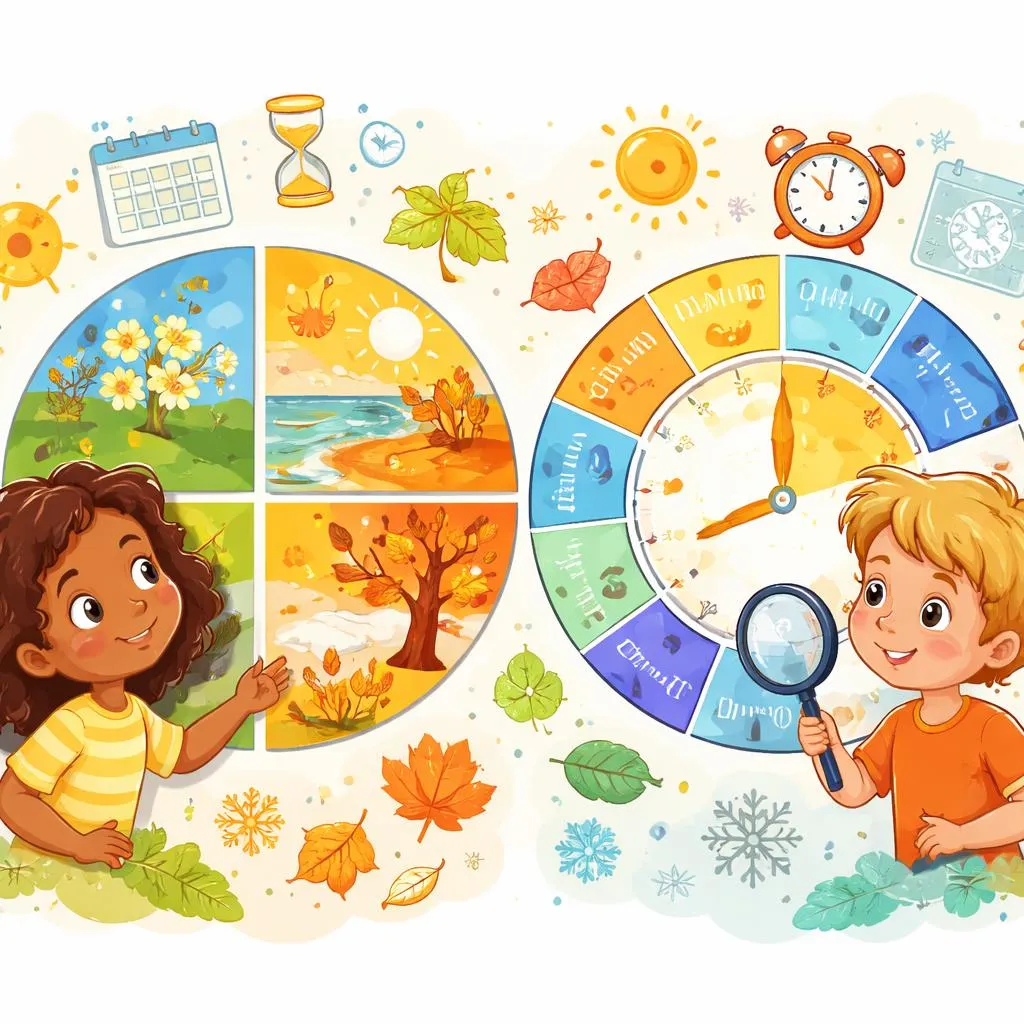

Hello, time adventurer! Fall is a beautiful season. Lunch is my favorite period at school. Both talk about a stretch of time. But are they the same stretch? They are two words for a block of time. One is like a familiar friend with a special outfit. One is like a flexible container you can fill. Let's discover their secret! Today, we explore the time-block word pair "season" and "period". Knowing the difference makes you a time word expert. Let's begin.
First, let's be Language Listeners. Listen at home. Here are two sentences. "My favorite season is summer." "We have a quiet period after dinner." Both talk about a part of time. Summer. After dinner. Do they sound the same? One sounds like a named, regular part of the year. One sounds like a general, flexible stretch. Can you sense the difference? Great listening! Now, let's dive deeper.
Adventure! Into the World of Time Blocks
Welcome to understanding stretches of time. A "season" and a "period" are both blocks of time. But their type and feel are different. Think of a "season" as a familiar friend with a special outfit. This friend always visits four times a year. Each friend has a name and a special look. Think of a "period" as a flexible container. You can put any amount of time inside it. Both hold time. But one is the "familiar friend". One is the "flexible container". Let's learn about each one.
A Familiar Friend vs. A Flexible Container Think about the word "season". A "season" is one of the four named parts of the year. It is regular. It has a fixed name and feel. Winter is a cold season. Now, think about "period". A "period" is any length or portion of time. It is more general. It can be long or short. A short period of rain. The holiday season is fun. A study period is quiet. "Season" is the familiar friend. "Period" is the flexible container.
Specific and Named vs. General and Flexible Let's compare their identity. A "season" is specific. It is always one of four. Spring, summer, fall, winter. A "period" is general. It can be any length. A long period. A ten-minute period. You look forward to a season. You wait for a period of time. One has a fixed name and feel. One is a general time block.
Their Special Word Partners and Common Uses Words have best friends. "Season" often partners with the four names and related activities. Football season. Holiday season. Growing season. "Period" often partners with descriptions of length or purpose. A short period. History period in school. Rest period. Note: A "season" is about nature and cycles. A "period" is about any duration. "Season" connects to weather and events. "Period" connects to schedules and durations.
Let's visit a school scene. The soccer season starts in September. This is a regular, named part of the year for sports. Third period is math class. The word "season" fits the regular, annual sports cycle. The word "period" fits the scheduled block in the school day. One is a yearly cycle. One is a daily schedule block.
Now, let's go to the playground. The water park is open in the summer season. This refers to the specific, named time of year. There was a long waiting period for the big slide. The word "season" fits the specific, named part of the year the park operates. The word "period" fits the general length of time spent waiting. One is a calendar event. One is a measured wait.
Our Little Discovery So, what did we find? A "season" and a "period" are both stretches of time. But a "season" is one of the four regular, named parts of the year. It is specific, like a friend. A "period" is any portion or length of time. It is flexible, like a container. "Summer" is a season. "Recess" is a period of play. "Season" is the familiar, named friend. "Period" is the flexible, general container for time.
Challenge! Become a Time-Word Champion
Ready for a nature test? Let's try your new skills!
"The Best Choice" Challenge Let's imagine a nature scene. Many birds fly south for the winter season. This is a specific, named, and regular part of the year. The frog stayed under the mud for a long period of time. The word "season" is the champion for the regular, named part of the year (winter). The word "period" is the best choice for the general, long stretch of time the frog was hidden. One is a calendar fact. One is a duration.
"My Sentence Show" Your turn to create! Here is your scene: During a school day. Can you make two sentences? Use "season" in one. Use "period" in one. Try it! Here is an example: "The fall season means new notebooks and sweaters." This is about the specific, named time of year. "Our first period is always science class." This is about a scheduled block in the school day. Your sentences will show a named time of year versus a scheduled block!
"Eagle Eyes" Search Look at this sentence. Can you find the word that could be better? Let's check a home context. "The homework period of the year is very busy." Hmm. "The homework time of the year" isn't one of the four regular, named seasons. The word for a general, busy stretch of time is "period", not "season". A better sentence is: "The homework period before exams is very busy." Or, "The fall season is very busy." Using "period" correctly describes a general, busy time. Using "season" would only work for spring, summer, fall, or winter. Did you spot it? Super thinking!
Harvest and Action! Turn Knowledge Into Your Superpower
Great exploring! We started thinking "season" and "period" were similar. Now we know they are different friends. A "season" is one of the four named parts of the year, like a familiar friend. A "period" is any flexible block of time, like a container. You can now talk about stretches of time with perfect clarity.
What you can learn from this article: You can now see that a "season" is one of the four regular, named parts of the year: spring, summer, fall, and winter. It connects to weather, holidays, and nature's cycles. You can now understand that a "period" is any portion or length of time. It can be two minutes, an hour, or a century. It is a general container for time. You know that "winter" is a season. "Silent reading time" is a period. You learned to match the word to the idea: "season" for the four named yearly friends; "period" for any general block of time.
Life practice application: Try your new skill today! Be a time detective. Listen for the word season—this is for the four named parts of the year and things connected to them, like sports seasons or holiday seasons. Listen for the word period—this is for any measured or described block of time, like a class period, a quiet period, or a long period. Remember, season is the familiar friend, period is the flexible container. Use "season" for yearly cycles. Use "period" for scheduled or general durations. You will describe time like a pro!