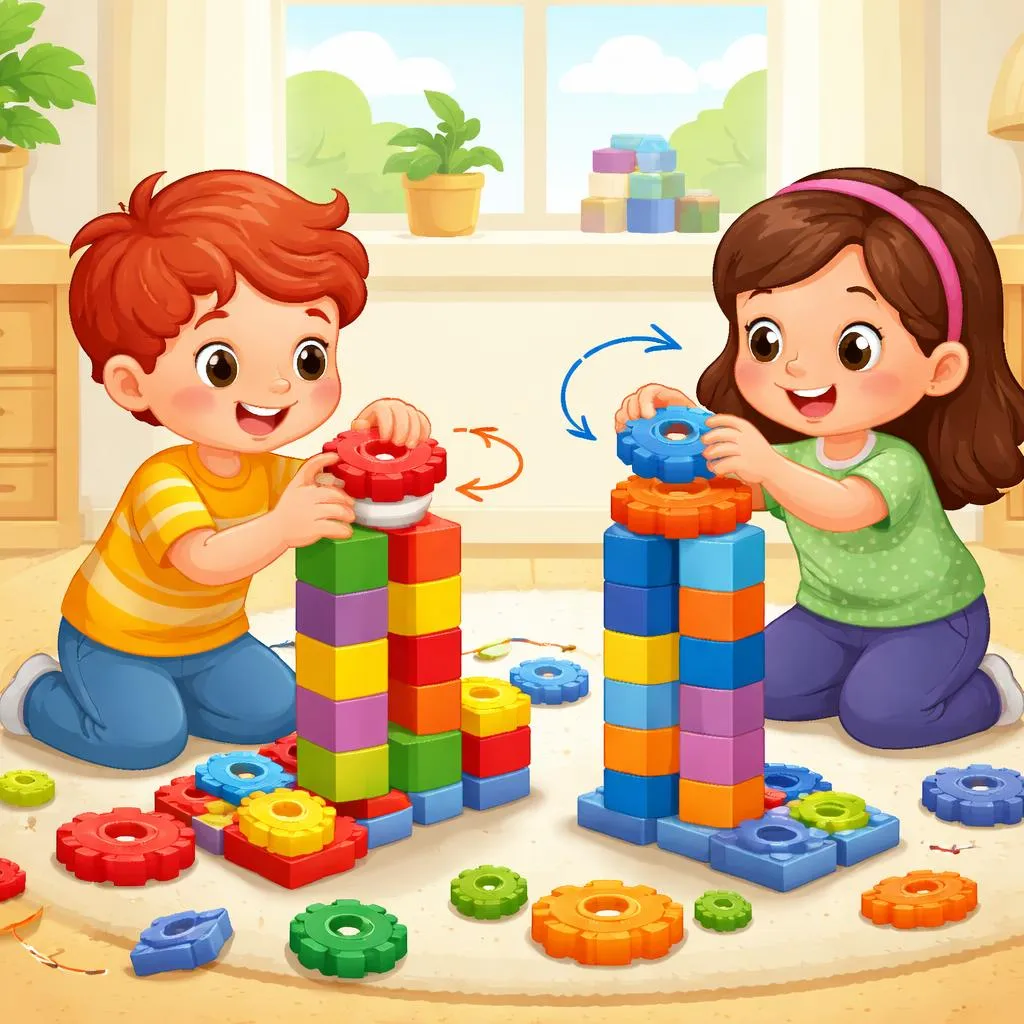

Welcome to our building block club. Today we meet Mia and Leo. They love creating towers. Last Saturday, they sat on the floor. Mia held a blue block. She twisted it sideways. She said, "I am turning to fit this piece." Leo held a red block. He spun it around completely. He said, "I am rotating to show the best side." Mia clicked blocks together. Leo admired his work. Both felt proud. See the difference? One changed direction partly. The other moved in a full circle. Let us explore why.
Understanding Turning To And Rotating To
Turning To Means Changing Direction Partly
Imagine twisting a doorknob to open it. You move it halfway. This is turning to adjust. Motion is partial.
Think of a driver turning a steering wheel. Wheels shift left or right. This is turning to steer. Change is limited.
Picture yourself turning a page in a book. Paper flips to the next side. This is turning to progress. Movement is small.
Rotating To Means Spinning In A Complete Circle
Now imagine a top spinning on a table. It whirls around and around. This is rotating to spin. Motion is full.
Think of a planet orbiting the sun. Path makes a perfect circle. This is rotating to orbit. Cycle repeats.
Consider a dancer doing a pirouette. Body spins once completely. This is rotating to twirl. Turn is whole.
How To Tell Them Apart Fast
Turning to is partial and directional. Rotating to is full and circular. Ask yourself: Did I move partway? If yes, it is turning to. Did I spin all around? If yes, it is rotating to.
Turning to feels like a pivot. Rotating to feels like a revolution. One is a slice. The other is a whole pie.
Remember the shape. Turning to draws an arc. Rotating to draws a circle. Look at the path.
Three Real Life Scenarios
Scene one happens during block building. Mia stacks green blocks. She turns a block sideways. She says, "I am turning to make a bridge." Leo places yellow blocks. He rotates a block to face forward. He says, "I am rotating to show the pattern." Tower grows tall. Design looks neat.
Scene two happens in the kitchen. Mom cooks pancakes. She turns the pan slightly. She says, "I am turning to spread batter." Then she rotates the pan fully. She says, "I am rotating to flip the pancake." Pancake browns evenly. Breakfast tastes yummy.
Scene three happens at dance class. Mia learns a new step. She turns her body to face the mirror. She says, "I am turning to check my form." Leo practices a spin. He rotates his whole body. He says, "I am rotating to feel the music." Moves look graceful. Teacher claps happily.
Notice the shift. Partial adjustments first. Full spins second. Choose your phrase based on completeness.
Common Mistakes And How To Fix Them
Mistake one: Saying "I rotated the key in the lock." Why it is wrong: Keys turn partially. Rotating would spin them uselessly. Correct alternative: "I turned the key in the lock." Memory trick: Turn keys; rotate tops.
Mistake two: Saying "I turned the wheel to do a donut." Why it is wrong: Donuts need full rotation. Turning only changes direction. Correct alternative: "I rotated the wheel to do a donut." Memory trick: Rotate for circles; turn for corners.
Mistake three: Saying "She rotated to look at her friend." Why it is wrong: Looking needs a partial turn. Rotating would spin her away. Correct alternative: "She turned to look at her friend." Memory trick: Turn to face; rotate to spin.
Mistake four: Saying "He turned to do a cartwheel." Why it is wrong: Cartwheels involve full rotation. Turning is too small. Correct alternative: "He rotated to do a cartwheel." Memory trick: Rotate for flips; turn for shifts.
Memory trick: Think of a clock. Turning to is moving the hand to three. Rotating to is spinning the whole clock. Your brain knows the difference.
Fun Activities To Master These Words
Activity one is a motion game. I say a word. You act it out. Turning to? Twist your shoulders partly. Rotating to? Spin your whole body around. We laugh together.
Activity two is a story chain. Start with "I turned the block when..." The next person adds "Then I rotated because..." Use silly verbs. Giggle at the images.
Activity three is a drawing race. Draw someone turning a doorknob. Draw someone rotating a wheel. Show your partner. Guess which is which.
Activity four is a show-and-tell. Bring a photo of you turning a page. Say, "I used turning to for this." Bring a photo of you rotating a hula hoop. Say, "I used rotating to for this." Demonstrate the feeling.
These games train your brain. You will pick the right word naturally. Play them with friends today.
Easy Rhyme To Remember Forever
Partial shift, that is turning.
Full spin, that is rotating.
Door knob twists, turn with care.
Top spins fast, rotate the air.
Small change, turn the way.
Whole circle, rotate and sway.
Arc drawn, turn to bend.
Circle made, rotate and mend.
Clap and chant this rhyme. Soon it lives in your memory. No more mix-ups.
Your Homework Assignment This Week
Choose one task below. Write or draw your answer. Share it tomorrow.
Task one: Block journal. Prepare a small notebook. Draw three pictures. First: Turning a block to fit. Second: Rotating a block to display. Third: Both smiling. Write a sentence under each. Example: "I turned to build. I rotated to design. Both felt creative."
Task two: Role-play version. With parents, play "Toy Workshop." You say, "I will turn the screw." Parents say, "I will rotate the gear." Switch roles. Practice using phrases correctly.
Task three: Sharing version. Tomorrow in class, tell your deskmate: "I turned my head to listen. I rotated to dance. What about you?" Listen to their examples.
Bring your work to class. We will hang the best drawings. Everyone shares their sentences.
Life Practice Weekly Challenge
Complete one challenge. Show proof to your teacher or parent.
Challenge A: Morning routine. Turn to face the window. Rotate to look all around. Say, "I turned to see. I rotated to explore." Feel the difference. Take a photo of you rotating.
Challenge B: Playtime hero. Turn a block to connect. Rotate a block to align. Place them side by side. Label them correctly. Show your friend.
Challenge C: Reading nook. Turn to the next chapter. Rotate to read aloud. Use them during story time. Tell your version to a sibling.
Challenge D: Art fun. Turn to sketch a curved line. Rotate to draw a spiral. Create a picture. Hang it on the fridge.
Do at least one challenge. Smile when you use the right phrase. You are growing smarter every day. Keep exploring words. Great job today.