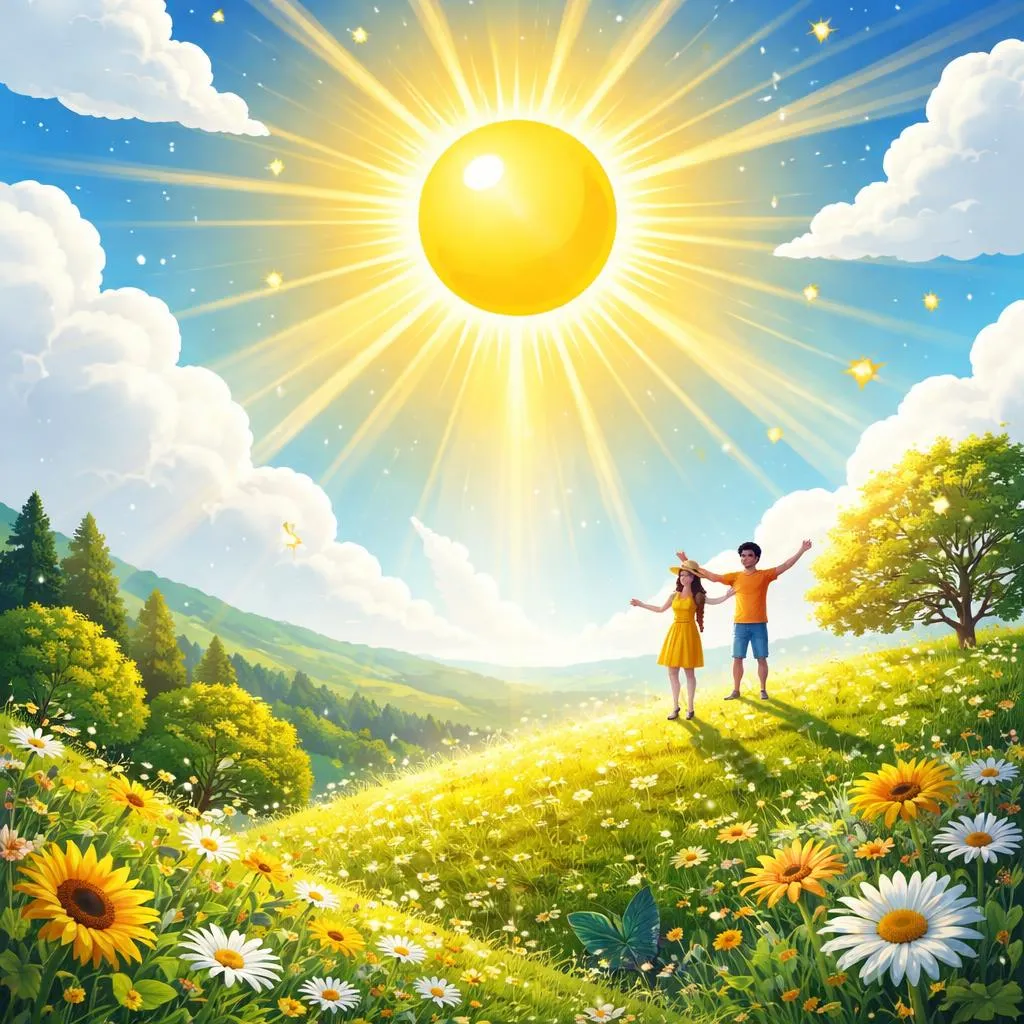

Hello, word explorer! Look at the bright sun in the sky. I feel warm sunshine on my face. Both talk about that bright, warm thing. But are they the same? They are two words about light and heat. One is like the actor on stage. One is like the light shining from the actor. Let's discover their secret! Today, we explore the bright word pair "sun" and "sunshine". Knowing the difference makes you a word expert. Let's begin.
First, let's be Language Listeners. Listen at home. Here are two sentences. "The sun is very big and hot." "The sunshine is coming through the window." Both talk about the bright thing. But do they sound the same? One sounds like the big star itself. One sounds like the light it makes. Can you sense the difference? Great listening! Now, let's look closer.
Adventure! Into the World of Light and Warmth
Welcome to understanding our brightest star. The "sun" and "sunshine" are connected. But their jobs are different. Think of the "sun" as the actor on a big stage. It is the thing itself. It is a giant, hot ball of gas in space. Think of "sunshine" as the light and warmth from that actor. It is what the sun gives us. It is the effect. Both are about brightness. But one is the "actor". One is the actor's "light". Let's learn about each one.
The Actor vs. The Actor's Light Think about the word "sun". The "sun" is the big star itself. It is a noun, a thing. It is the center of our solar system. The sun rises in the east. Now, think about "sunshine". "Sunshine" is the light and warmth from the sun. It is the effect we feel. I love the morning sunshine. The sun is a star. The sunshine is lovely. "Sun" is the actor. "Sunshine" is the light.
The Thing vs. The Feeling Let's compare what they are. The "sun" is a physical object. We can draw a picture of the sun. "Sunshine" is a feeling or a condition. It is the bright, warm effect. Let's play in the sunshine. You look at the sun. You feel the sunshine. One is the source. One is the result.
Their Special Word Partners and Common Uses Words have best friends. "Sun" often partners with actions and descriptions of itself. The sun sets. The sun is bright. Under the sun. "Sunshine" often partners with feelings and descriptions of light. Warm sunshine. A ray of sunshine. Full of sunshine. Note: "Sun" is the main character. "Sunshine" is the gift it gives. "Sun" connects to science and sky. "Sunshine" connects to mood and weather.
Let's visit a school scene. In science, we learn the sun is a star. This talks about the celestial object itself. Let's read our books in the sunshine. The word "sun" fits the science lesson about the star. The word "sunshine" fits the pleasant light for reading. One is an object of study. One is a condition for an activity.
Now, let's go to the playground. The bright sun is high in the sky. This describes the position of the star itself. We played in the warm sunshine all afternoon. The word "sun" fits the location of the star in the sky. The word "sunshine" fits the warm feeling during play. One is a thing you see. One is a feeling you experience.
Our Little Discovery So, what did we find? The "sun" and "sunshine" are a team. But the "sun" is the big, hot star itself. It is the actor. "Sunshine" is the light and warmth that comes from the sun. It is the actor's light. We orbit the sun. The sunshine makes me happy. "Sun" is the actor on stage. "Sunshine" is the light shining from it.
Challenge! Become a Light-Word Champion
Ready for a nature test? Let's try your new skills!
"The Best Choice" Challenge Let's imagine a nature scene. Plants need the sun to grow. This refers to the star itself as the energy source. The cat stretched out in the patch of sunshine. The word "sun" is the champion for the star that provides energy for growth. The word "sunshine" is the best choice for the specific patch of light the cat enjoys. One is the source. One is the result.
"My Sentence Show" Your turn to create! Here is your scene: A bright morning at home. Can you make two sentences? Use "sun" in one. Use "sunshine" in one. Try it! Here is an example: "I can see the sun from my window." This is about seeing the star itself. "The kitchen is filled with golden sunshine." This is about the light filling the room. Your sentences will show the actor versus its light!
"Eagle Eyes" Search Look at this sentence. Can you find the word that could be better? Let's check a home context. "Let's close the curtains, the sunshine is too bright in my eyes." Hmm. The light in your eyes is from the sun. But the thing that is "too bright" is the light itself, not the star. The word for the bright light is "sunshine", not "sun". A better sentence is: "Let's close the curtains, the sun is too bright." This means the star itself is the problem. Or: "The sunshine is too bright in my eyes." This means the light is the problem. Both can work, but they mean slightly different things. "Sun" focuses on the source. "Sunshine" focuses on the light. Did you spot the difference? Super thinking!
Harvest and Action! Turn Knowledge Into Your Superpower
Great exploring! We started thinking "sun" and "sunshine" were the same. Now we know they are a perfect team. The "sun" is the star itself, the actor. "Sunshine" is the light and warmth it gives, the actor's light. You can now talk about our bright friend with perfect clarity.
What you can learn from this article: You can now see that the "sun" is the big, hot star in our sky. It is the object, the source of light and heat. You can now understand that "sunshine" is the light and the warmth that comes from the sun. It is what we feel on a bright day. You know that Earth goes around the sun. I feel happy in the sunshine. You learned to match the word to the idea: "sun" for the star itself; "sunshine" for the light and feeling it creates.
Life practice application: Try your new skill today! Be a light detective. Look for the word sun—this is for the bright ball in the sky itself, in science, stories, or when pointing at it. Look for the word sunshine—this is for the bright, warm light that makes things glow, that you feel on your skin, or that fills a room. Remember, the sun is the actor, sunshine is its light. Use "sun" when you talk about the star. Use "sunshine" when you talk about the light and warmth. You will describe your bright world even better