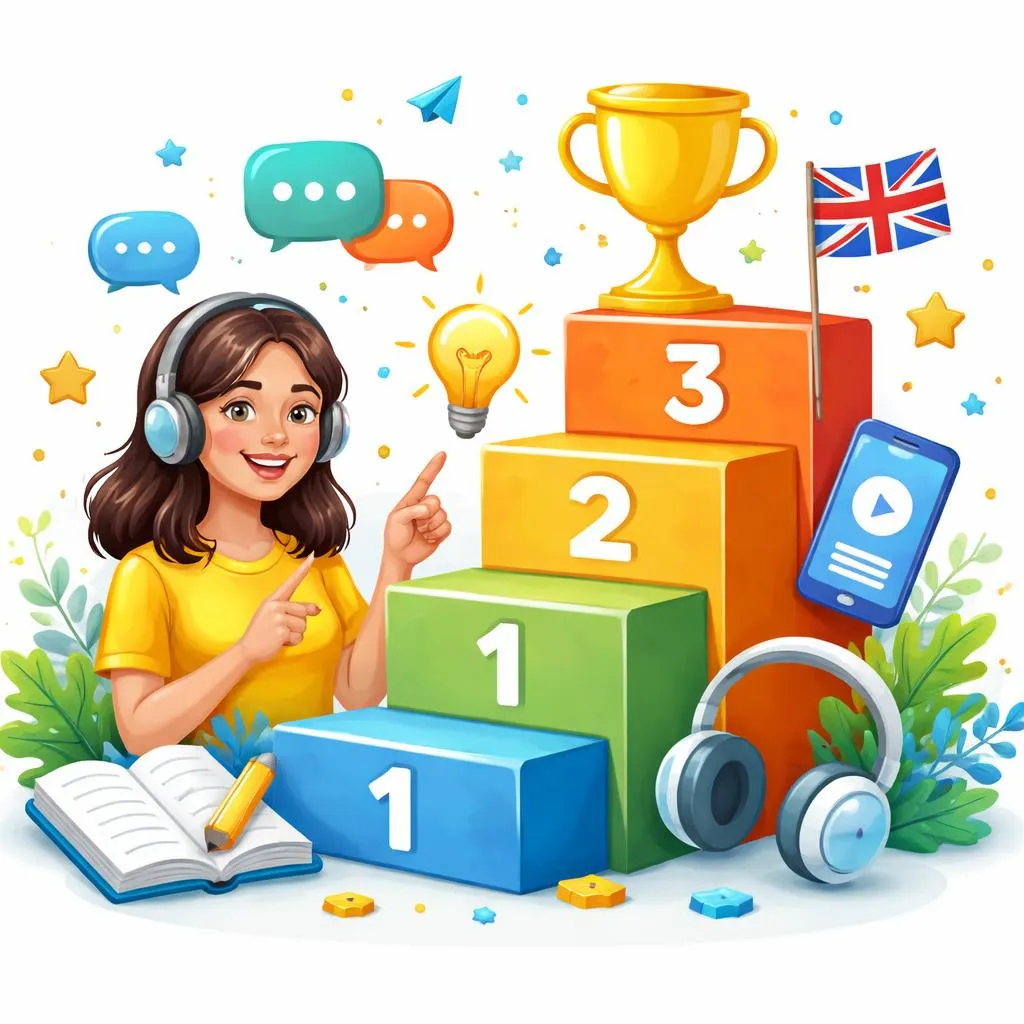

For decades, learning English has been surrounded by complex methodologies, expensive courses, and vague promises of fluency. It’s time for a revolution. Based on a fundamental, no-nonsense approach proven by self-learners, mastering English is not a decade-long mystery but a clear, three-step process. This is not theory; it is a battle-tested blueprint. Forget apps that teach you to say "apple" for the thousandth time. If you commit to the following sequence with discipline, you will conquer the English language.
The Foundational Truth: Order of Operations is Everything
The single biggest mistake learners make is attacking all aspects of the language at once in a disordered manner. The key is a strict, sequential focus, just as you cannot build a roof before laying a foundation. Our three-phase operation is non-negotiable.
Phase 1: Master the Sound System (Month 1-2)
You cannot reproduce what you cannot hear. The very first and most critical step is dedicating one intensive month solely to the sounds of English. This is not about accent reduction for beauty; it is about functional intelligibility and training your ear.
- The Tool: Use a dedicated phonetics course like Wang Shiren's English Phonetics Course or similar resources that drill the International Phonetic Alphabet (IPA) for English. Your goal is to understand every vowel and consonant sound, how they are physically formed in the mouth, and how they differ from your native language sounds.
- The Method: Spend 1-2 hours daily. Listen to a sound, mimic it exactly, and record yourself. Compare. Identify troublesome pairs (e.g., ship/sheep, vet/wet). Learn the rules of linking, stress, and intonation patterns. By the end of this month, you should be able to accurately pronounce and transcribe any new word you see. This phase tunes your instrument—your mouth and ears.
Phase 2: Internalize the Architectural Blueprint (Months 2-4)
With sounds under your command, you now need the rules for assembling them into meaning. This is grammar—not to be dreaded, but embraced as the liberating scaffold for your thoughts.
- The Tool: Use a comprehensive, reference-style grammar book like Cambridge English Grammar. Do not use a textbook for learners; use the definitive guide meant for deep understanding.
- The Method: You are not just reading; you are engineering. Go from cover to cover. Understand how sentences are built from the ground up: phrases, clauses, tense-aspect-modality, the logic of conditionals. After each chapter, write 50 of your own example sentences. The goal is not to memorize rules for a test, but to develop an intuitive feel for what "sounds right" in English sentence construction. This gives you the power to generate your own infinite correct sentences, not just repeat memorized ones.
Phase 3: The Grand Immersion & Acquisition Engine (Months 5-24+)
Now you have the tools (sounds) and the blueprint (grammar). It is time to build the cathedral. This is done through massive, deliberate immersion with one core activity: intensive reading of authentic literature.
- The Tool: Choose a classic novel. Start with an accessible yet rich 19th-century novel like Jane Eyre, Pride and Prejudice, or David Copperfield. Their prose is grammatical, vocabulary-rich, and narratives are compelling.
- The Method: This is the heart of the method. You will read from page one to the last page. You will have a notebook. For every single page:
- Read a paragraph aloud, applying your Phase 1 phonetics. This connects sight to sound.
- Analyze the sentence structures you see, recognizing the grammar from Phase 2. See the rules in action.
- For every single word you do not know, you look it up and write it down in your notebook. You will memorize it. This is not optional. This is how you mine the vocabulary of a native speaker directly from its source.
- The Result: Finishing one 400-page novel in this fashion will teach you more practical, nuanced vocabulary and syntax than five years of standard classes. You then move to the next novel (Wuthering Heights, Great Expectations). As you progress, the number of unknown words per page plummets. Your brain, now wired for English sounds and structure, begins to think in the language. You graduate to more complex works (Ulysses, etc.). This is the accelerator.
The Power of Listening and Dictation: The Parallel Path
While the three-step sequence is primary, a parallel activity from Day 1 supercharges the process: Dictation.
- From the beginning of Phase 1, start listening to clear, spoken English (audiobooks of your novels are perfect, or courses like New Concept English).
- Play one sentence. Pause. Write down exactly what you heard. Check it against the transcript. This single exercise forces intense listening, reveals your sound blind spots, and reinforces spelling and grammar simultaneously. One year of daily dictation will transform your listening comprehension and accuracy more than any other single exercise.
A Living Testimony: From Zero to Mastery
This is not a fantasy. It is a documented path. Consider the student who started English in junior high with zero background. For three years, their core activity was the dictation and memorization of New Concept English Books 1-3. This built an impeccable foundation. In high school, they memorized Book 4 and then began the novel-reading method, intensively studying seven classics from the Bront?s to Joyce. The result? Not just exam success, but deep, intellectual ownership of the language.
The Mindset for Success
This method requires grit, not genius. It rejects shortcuts and embraces the satisfying struggle of direct engagement with the language's greatest artifacts. You are not a passive consumer of "English lessons." You are an active miner, extracting the language's riches directly from the source.
- Consistency Over Cramming: One hour daily is worth ten on Sunday.
- Embrace the Dictionary: The dictionary is your best friend, not a sign of failure.
- Output from Input: Your writing and speaking will naturally and powerfully emerge from this mountain of high-quality input. You will speak with the vocabulary of Dickens and the syntax of Austen because you have lived inside their minds.
The global English-learning industry thrives on your confusion. They want you to believe it's complicated. It is not. The roadmap is clear: Master the sounds. Decode the grammar. Devour literature, word by word. This is how you do not just learn English—you conquer it. Now, close this article, get your phonetics book, and begin. Your journey to mastery starts today.