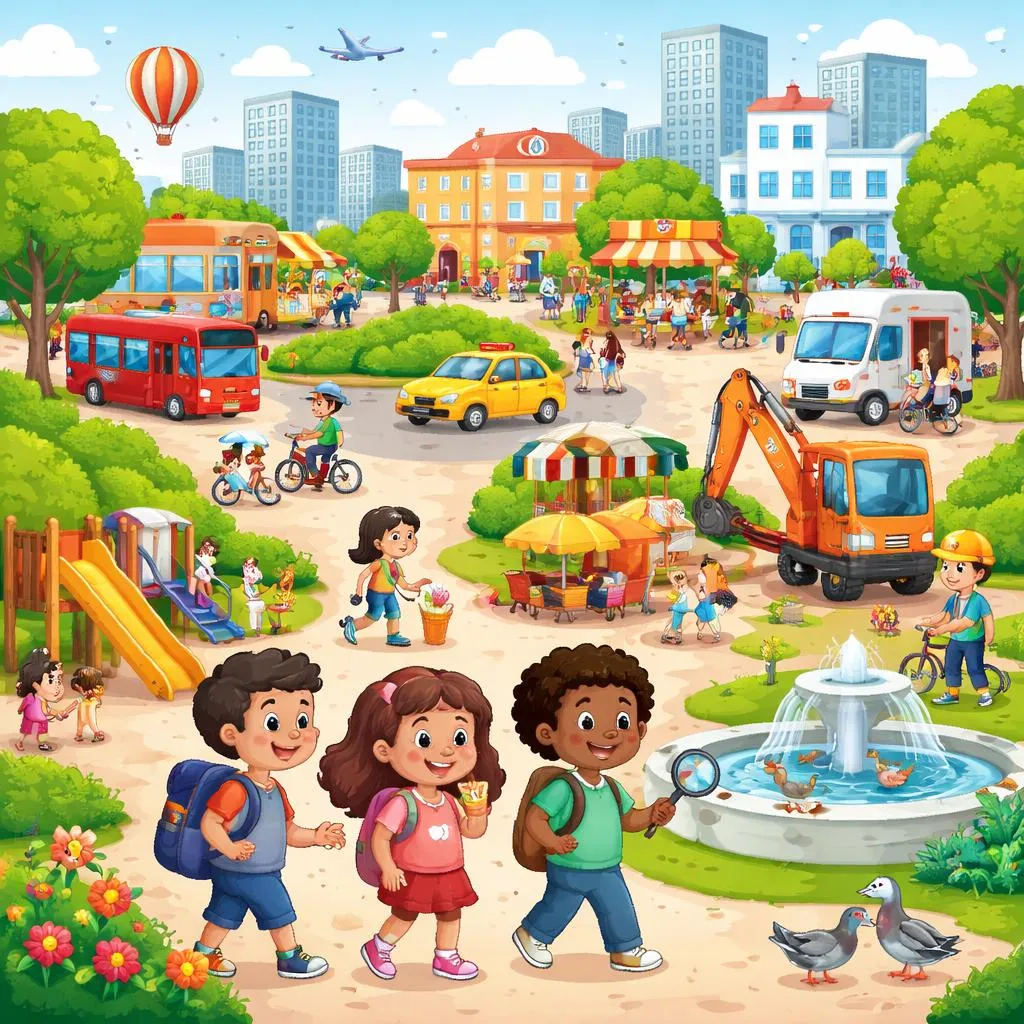

What is things in a city?
Things in a city refers to places, buildings, people, and objects found in urban areas. This topic helps learners connect English words to real environments. It also supports social studies and geography learning.
In teaching practice, city vocabulary provides concrete nouns and functional language. It helps learners describe where they go and what they see. This topic supports early speaking and reading skills.
Teachers often use maps, photos, and real-life examples to build understanding.
Meaning and explanation
A city is a large town with many people, buildings, and services. Cities have homes, schools, shops, and hospitals. They also have roads, parks, and transportation systems.
In English learning, city vocabulary includes places, vehicles, and community roles. This language connects daily experiences with structured grammar.
For example: This is a school. I see a bus. The police station is near the park.
These sentences support basic sentence patterns.
Categories or lists
Things in a city can be grouped into several categories. This grouping helps learners organize vocabulary and concepts.
Public places include schools, libraries, and parks. Service places include hospitals, police stations, and post offices. Shopping places include supermarkets and malls. Transportation includes buses, trains, taxis, and bicycles. Buildings include houses, apartments, and offices.
Teachers often introduce one category at a time. This scaffolded approach prevents overload.
Daily life examples
Daily routines provide meaningful contexts for city vocabulary. Morning routines include going to school or taking a bus. Afternoon routines include visiting a park or shopping with family. Evening routines include going home and resting in an apartment.
Teachers can model sentences connected to daily life. I go to school in the city. I see tall buildings. I ride a bus to the park.
Role play activities deepen understanding. One learner becomes a shopkeeper. Another learner becomes a customer.
This contextual practice strengthens functional language use.
Printable flashcards
Printable flashcards are effective for teaching things in a city. Cards can show a school, hospital, park, bank, and restaurant.
Image cards support visual recognition. Word cards support literacy development. Sentence cards support speaking practice.
Teachers can use flashcards for matching games and memory tasks. This repeated exposure increases retention.
Flashcards can also include community helpers. Police officer, doctor, teacher, and firefighter are common examples.
Learning activities or games
City map activities build spatial awareness. Learners place building cards on a simple map. They say sentences like, “The park is next to the school.”
Treasure hunt games encourage movement and language. Learners find pictures of city places around the classroom. They name each place in English.
Transportation role play builds speaking skills. One learner pretends to drive a bus. Others pretend to be passengers.
Story-based activities integrate literacy. Teachers tell a story about a city trip. Learners act out visiting a library, cafe, and park.
Board games reinforce vocabulary. Players move on a city-themed board and say sentences. “I am at the supermarket.” “I am at the hospital.”
Digital games with city scenes support listening and reading. Learners click on objects and hear the word.
Art projects integrate creativity and vocabulary. Learners draw a city and label buildings. They describe their city using simple sentences.
Project-based learning deepens understanding. Learners design a model city using paper and boxes. They present their city in English.
Things in a city provides a rich thematic unit for early English education. This topic integrates vocabulary, geography, and social understanding. Through structured teaching, visual materials, and interactive activities, learners gain confidence in describing urban environments and everyday experiences.