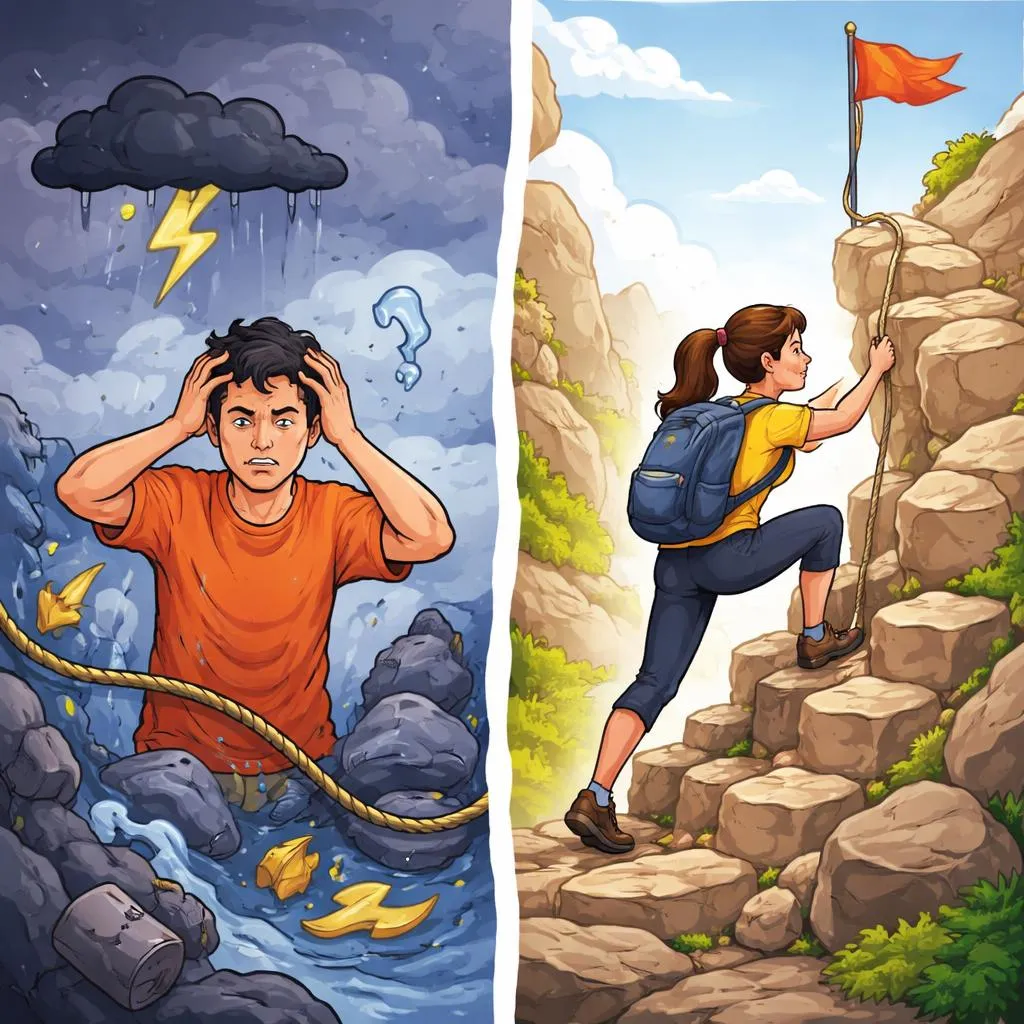

Hello, word adventurer! Getting into trouble feels bad. Facing a difficulty feels hard. Both words talk about tough times. But are they the same kind of tough? They are two ways to talk about challenges. One is like a messy, tangled ball of string. One is like a tall, steep mountain to climb. Let's untangle their meanings! Today, we explore the challenge word pair "trouble" and "difficulty". Knowing the difference makes you a word expert. Let's begin.
First, let's be Language Listeners. Listen at home. Here are two sentences. "I am in trouble for spilling juice." "I have difficulty tying my shoes." Both talk about a tough spot. Spilling juice. Tying shoes. Do they sound the same? One sounds like a bad situation with someone. One sounds like a hard thing to do. Can you sense the difference? Great listening! Now, let's look closer.
Adventure! Into the World of Challenges
Welcome to understanding tough spots. "Trouble" and "difficulty" are both about hardship. But their feel and cause are different. Think of "trouble" as a tangled ball of string. It is a bad or problematic situation. It often involves a rule or a person. It feels messy. Think of "difficulty" as a steep mountain. It is the state of being hard to do. It is about the challenge of a task. It feels like a climb. Both are not easy. But one is the "tangled string" of a bad spot. One is the "steep mountain" of a hard task. Let's learn about each one.
A Tangled Ball of String vs. A Steep Mountain Think about the word "trouble". "Trouble" is a bad situation. It often means you did something wrong. It can bring problems with others. I got in trouble for being late. Now, think about "difficulty". "Difficulty" is the state of being hard. It is about how hard something is to do. I had great difficulty reading that sign. Breaking a vase causes trouble. Reading tiny print causes difficulty. "Trouble" is the tangled mess. "Difficulty" is the steep climb.
A Bad Situation vs. A Hard Task Let's compare their core meaning. "Trouble" is often about a problematic situation. It can involve other people. The noisy dog caused trouble with the neighbors. "Difficulty" is about how hard a task or activity is. It focuses on the challenge itself. She finished the puzzle with difficulty. You can be in trouble. You can have difficulty doing something. One is a situation you're in. One is a challenge you face.
Their Special Word Partners and Common Uses Words have best friends. "Trouble" often partners with getting into or causing problems. Get in trouble. Cause trouble. Be in trouble. "Difficulty" often partners with having or facing a challenge. Have difficulty. With great difficulty. A level of difficulty. Note: You can make trouble. You can experience difficulty. "Trouble" connects to problems. "Difficulty" connects to hardship.
Let's visit a school scene. The loud group got in trouble. They broke a rule. The new science topic posed a difficulty for many. The word "trouble" fits the bad situation with the teacher. The word "difficulty" fits the challenge of understanding the hard topic. One is a rule problem. One is a learning challenge.
Now, let's go to the playground. Those kids are making trouble near the slide. They are causing a problem. The tall climbing wall presents a difficulty. The word "trouble" fits the behavior causing a problem. The word "difficulty" fits the physical challenge of the wall itself. One is about causing problems. One is about facing a challenge.
Our Little Discovery So, what did we find? "Trouble" and "difficulty" both describe hard things. But "trouble" is a bad or problematic situation. It often involves rules or other people. "Difficulty" is the state of being hard to do. It describes how challenging a task is. Arguing with a friend is trouble. Solving a tough riddle is a difficulty. "Trouble" is the tangled ball of string. "Difficulty" is the steep mountain to climb.
Challenge! Become a Challenge-Word Champion
Ready for a nature test? Let's try your new skills!
"The Best Choice" Challenge Let's imagine a nature scene. The raccoon got into trouble rummaging in the trash. The raccoon is in a problematic situation. The steep, rocky hill was a major difficulty for the hikers. The word "trouble" is the champion for the raccoon's problematic, rule-breaking situation. The word "difficulty" is the best choice for describing how hard and challenging the hill was to go over. One is a problematic act. One is a physical challenge.
"My Sentence Show" Your turn to create! Here is your scene: Learning to ride a bike. Can you make two sentences? Use "trouble" in one. Use "difficulty" in one. Try it! Here is an example: "I got in trouble for scraping the garage." This is about the bad situation from damaging something. "I had difficulty keeping my balance." This is about the challenge of the task itself. Your sentences will show a bad situation versus a personal challenge!
"Eagle Eyes" Search Look at this sentence. Can you find the word that could be better? Let's check a home context. "I had a lot of trouble understanding this book." Hmm. Understanding a book is about how hard the task is. The word for the challenge of a task is "difficulty", not "trouble". "Trouble" sounds like you broke a rule. A better sentence is: "I had a lot of difficulty understanding this book." Using "difficulty" correctly describes the challenge of reading. "Trouble" would fit if you read when you shouldn't. Did you spot it? Super thinking!
Harvest and Action! Turn Knowledge Into Your Superpower
Great exploring! We started thinking "trouble" and "difficulty" were the same. Now we know they are different. "Trouble" is a problematic situation, often involving a mistake or a rule. "Difficulty" is how hard something is to do. It is the challenge of a task. You can now talk about tough times with perfect clarity.
What you can learn from this article: You can now see that "trouble" is a bad situation you can be in. It often happens after a mistake or breaking a rule. You can now understand that "difficulty" is how hard it is to do something. It describes the challenge of a task or activity. You know that getting a time-out is trouble. Finding a math problem very hard is a difficulty. You learned to match the word to the experience: "trouble" for problematic situations; "difficulty" for challenging tasks.
Life practice application: Try your new skill today! Be a word detective. Listen for the word trouble—this is for when someone is in a bad spot, like after an argument or a mistake. Listen for the word difficulty—this is for when something is hard to do, like a new skill or a tough question. Remember, trouble is the tangled ball of string, difficulty is the steep mountain. Use "trouble" when talking about a problematic situation. Use "difficulty" when talking about how hard something is. You will explain your day much better